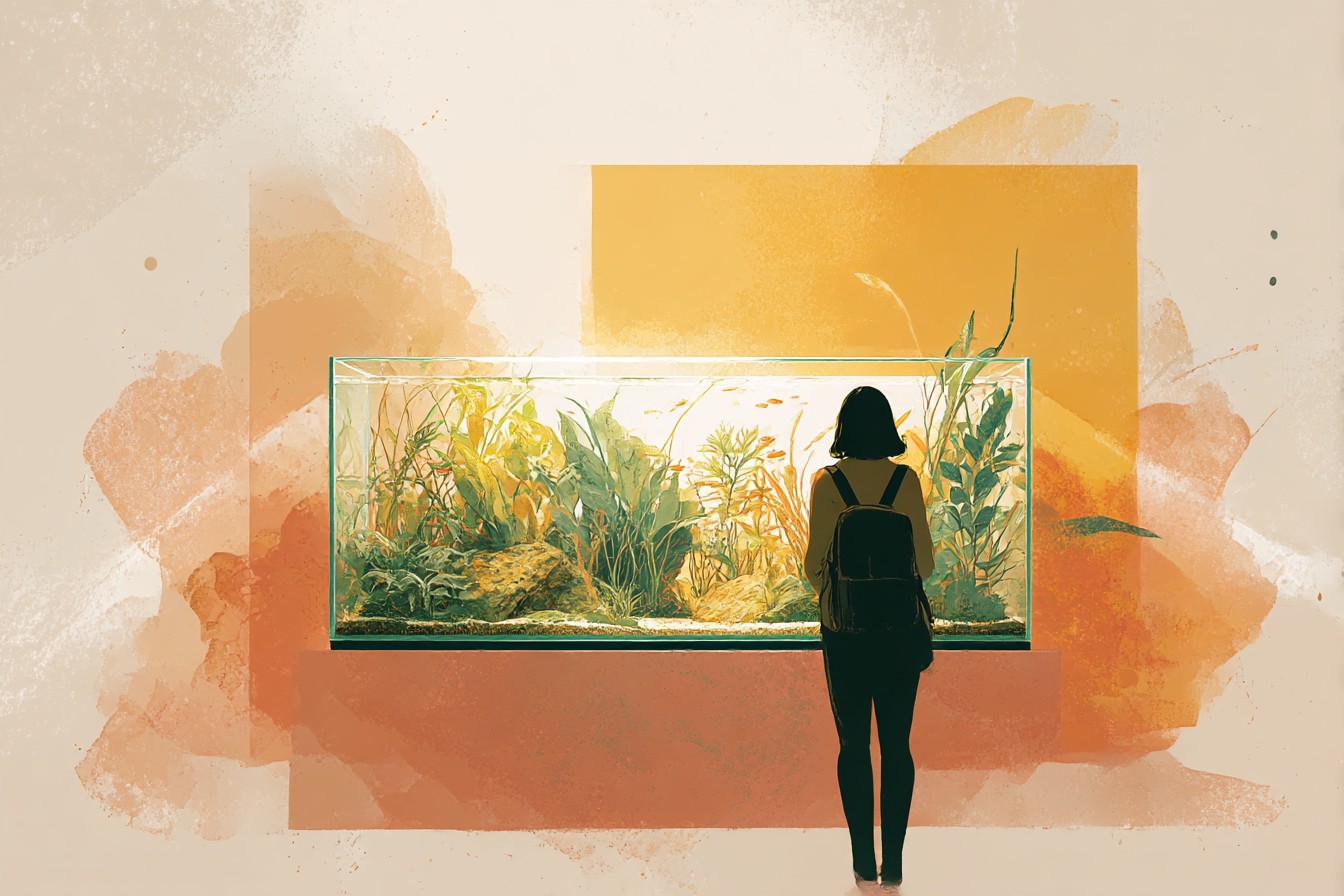
I’m looking at a large 55-gallon tank sitting in my garage that my friend was about to throw away and I said, “What could go wrong?” Yeah, famous last words. The tank I bought for $50 looked like it had been used to raise goldfish for 20 years, but I liked the idea of giving it new life. Either I saw potential to teach my students something new or I just wanted to do something during the summer that didn’t require me to grade papers.
In the end, I ended up with four tanks at my house, a class tank that my students fight over who gets to help maintain, and enough plant trimmings to start a small plant nursery in my garage. My wife still rolls her eyes when I bring home “just a few more” plants, but she has finally quit complaining about the electric bill from all the LED lights. Looking back, I made almost every rookie mistake you can think of.
I purchased the wrong substrate, put plants that wouldn’t normally thrive in the same tank together, almost lost everything twice, and overspent on everything. However, each of these failures taught me something, and now when my seventh graders ask why their science fair goldfish looks miserable in that tiny bowl, I have real experience to share with them.
Aquascaping is very deceiving from the outside.
It appears to be nothing more than placing plants and fish in water and calling it a day. However, there is a lot more to it than that. There is the chemistry of the aquarium, including nitrogen cycles, pH levels, and hardness tests that will give you whiplash.
Then there is the biology of the aquarium, such as which plants will coexist peacefully, which fish will eat the plants you want to keep, and how to keep the entire ecosystem in balance. Finally, there is the artistic side of aquascaping, and that was the area that took me the longest to master. My first aquascape was an education.
I went to the local fish store (Neptune’s Kingdom) and told the young salesperson that I wanted to get some plants and be done with it. He sold me a ton of things that looked great in his display tanks, but he didn’t tell me that many of the things he sold me required CO2, and that my regular aquarium light would be of absolutely no use in helping my plants grow. When I came home I planted all of the plants based on a YouTube video I had watched, replaced my goldfish, and waited for my underwater garden to come alive.
What came to life was a slow-motion disaster. Plants began to melt, the water turned cloudy, and the fish looked stressed. In a matter of two weeks I had created a brown, algae covered mess that looked like a swamp, rather than an underwater garden.
This was the beginning of my first lesson: research, then buy. I spent the remainder of that summer researching about aquatic plants, water chemistry, lighting requirements, etc., things I should have researched prior to purchasing anything. As I began to explore the world of aquatic plants and aquascaping, I found out there was a tremendous amount of information available regarding the subject.
Most people tend to overlook the foundation issues associated with aquatic plants and aquascaping, and this is typically where beginners screw up. People love to talk about the beauty of the plants and the colourful fish, but if the foundation isn’t correct, none of it will matter. It’s like trying to grow a garden in concrete.
The size of the tank can be a concern. The 55-gallon tank I purchased initially seemed enormous, but I now understand that larger tanks are generally easier to manage in terms of water stability and the ability to recover quickly if something goes wrong. The smaller tanks, especially my 10-gallon tank at home, seem to crash and burn at the slightest provocation.
There is also a lot of misinformation concerning substrate. Substrate is more than just decoration; plants obtain nutrients from their roots, and in the case of aquariums, this nutrient source often comes from the substrate. While regular gravel may look nice, it provides little to no nutritional value to your plants.
I found this out the hard way when my Amazon sword plants were struggling to thrive, regardless of my best efforts. I switched to a high-quality, aquatic specific substrate, and my sword plants flourished. LED lighting was another expense I didn’t plan for initially.
I assumed that aquarium lighting couldn’t be that expensive since I already had regular light bulbs in my home. Boy, was I wrong. Aquarium lighting is vastly different from regular lighting.
Aquarium plants require a specific range of light spectrums, intensities, and durations to thrive. I eventually upgraded to high-quality LED lighting, and it was like flipping a switch. All of a sudden, my plants were thriving.
Filtration is another area that seems relatively easy until you begin to get into the details. A filter serves multiple purposes: filtration, circulation, surface agitation for petrol exchange, and habitat for beneficial bacteria that keep your aquarium’s ecosystem in balance. I went through three different filters before finding one that worked well for my particular set up.
The first was inadequate, the second was overpowering (it was comical watching my delicate stems blow wildly in the currents), and the third was just right. Hardscaping refers to all of the rock and wood used to create structure within your aquarium. This is the area where you truly begin to design your aquarium versus simply maintaining it.
I remember spending an entire Saturday at the local landscape supply centre searching for rocks that I felt spoke to me. The gentleman assisting me believed I was crazy when I tested the rocks with vinegar to determine if they would contaminate the aquarium water, held them up to the light to examine their colour and clarity, and arranged the rocks in various configurations directly in the parking lot. I stumbled upon a beautiful piece of Malaysian driftwood at a garage sale for five dollars.
The piece of wood had been soaking and curing for years. I am currently still using the driftwood in my classroom aquarium, and it has become the central focal point for everything else in the aquarium. Placing rocks properly is a bit more difficult than it sounds.
You Might Also Like
There are actual guidelines for placement — rule of thirds, odd number of placements, creating sight lines and flow. It may sound artistic and pretentious, but it works. My initial attempts at placing rocks were random, and I thought I had done it correctly.
I began to study photographs of natural landscapes, specifically streams and lakeshores, to gain a greater understanding of how to create a natural appearance in my aquarium. Planting day is always an exciting event, and even now I enjoy planting new additions to my aquariums. However, I recall my early experiences planting new plants in my aquariums to be embarrassing.
Attempting to plant tiny stems with regular tweezers while the stems float in the water is akin to performing surgery while riding a roller coaster. I eventually purchased specialised tools to assist with planting, and they greatly improved the process. Selecting the right plants for your aquarium took me a long time to figure out.
Initially, I selected plants based on their visual appeal, and I ignored whether they would thrive in my specific aquarium environment. I mixed high tech plants that required CO2 with low tech plants that thrived under different environmental conditions. I had plants that needed intense lighting and others that preferred shaded areas.
It was like attempting to grow both orchids and cactus in the same pot — it just didn’t work. After experiencing many failures, I learned to select plants that matched my equipment and skills, rather than the other way around. Java Fern and Anubias became my favourite plants — nearly impossible to kill, visually appealing in most aquarium environments, and they don’t require optimal environmental conditions.
With these plants, I built my confidence, and I eventually progressed to more challenging species. Choosing the right fish for your aquarium was another learning experience for me. I had to learn patience, primarily due to my own mistakes.
I overstocked my tank early on, didn’t quarantine new fish before adding them to my tank, and selected fish that were incompatible. Unfortunately, I lost a few fish that I grew to care about, largely due to mistakes that I should have avoided. Today, I thoroughly research each fish species before introducing it to my aquarium, quarantine all new fish for at least two weeks, and I stock my tank conservatively.
My classroom aquarium has evolved into a dynamic and living laboratory. We modify our tank as we study different ecosystems throughout the school year. Students vote on the fish species we introduce to the tank, help with planning our hardscape, and even contribute to selecting plant species to add to the tank.
A few of their suggestions have been pure genius — kids pay attention to details that adults often overlook, and ask questions that make you think differently about why you’re approaching a task a certain way. Developing a maintenance routine for my aquarium took longer than I expected. Over-watering or under-watering will shock the aquarium and cause problems.
If you alter your lighting schedule by mere minutes, you may encourage algae growth. Incorrect dosing of fertilizer may result in visible deficiency symptoms in your plants. Maintaining a healthy aquarium requires a delicate balance, and it takes practise to achieve it.
Two years ago, I experienced a major crash in my classroom aquarium. After returning from spring break, I found that my tank was overrun with black beard algae — it appeared as if someone had spray painted a fuzzy black substance on everything. The students were heartbroken, I was mortified, and it took us months to restore the tank to a condition that was aesthetically pleasing.
However, discovering what caused the problem and correcting it provided me with a wealth of knowledge that far exceeded the knowledge gained from years of having successful aquariums. Currently, when I receive inquiries from other teachers regarding establishing a classroom aquarium, I tell them to establish a simple aquarium and anticipate making mistakes. That beautiful aquascape you see on Instagram?
That person likely has killed more plants than you have ever had. Fish stores rarely showcase their failed aquariums, and online forums rarely display images of algae infestations. Trust me, we’ve all been there.
One of the largest revelations I experienced as I continued to develop my skills in aquascaping was the realization that creating the perfect underwater scene is secondary to developing a living system.
The plants will continue to grow, the fish will mature and exhibit changing behaviours, and the entire ecosystem will evolve over time. What was aesthetically pleasing six months ago may be completely unsuitable today.
That is not failure, that is the normal functioning of nature. My home aquariums have become a relaxing escape for me, where I can unwind after long days of interacting with middle schoolers. Watching fish swim through planted landscapes, observing how light passes through the water, and viewing the gentle sway of plants in the current is calming and mesmerizing.
Far superior to any screen saver, more captivating than television, and more satisfying than any hobby I have attempted to date. As a teacher, the hobby of aquascaping has also contributed to my ability to provide a more effective and interactive educational experience for my students. When we are studying photosynthesis, I can demonstrate actual plants producing oxygen bubbles in response to bright light.
During the study of nitrogen cycling, we collect water samples weekly and record the data to track our progress. Studying symbiotic relationships? Simply observe how the fish produce waste that nourishes the plants, which in turn purify the water for the fish.
It is all interconnected, and having it demonstrated in a live aquarium allows my students to visualize the concepts and retain them better than through abstract illustrations alone.

[…] you can actually maintain it without dedicating your weekend to water changes. Forgiving enough for beginners to learn without killing everything, challenging enough to keep you engaged as you develop your […]
[…] Your Water – Get a pH, GH and KH test kit. Learn exactly what you’re working with before you make any decisions.Take it a step further and use […]