
# Barclaya Longifolia: The Red Crypt That Flowers Underwater I bought my first Barclaya longifolia because the aquascaping forums wouldn’t shut up about underwater flowers. My daughter had been pestering me about getting something that would bloom in the tank, and I’d been explaining for weeks why that wasn’t really how aquatic plants work. Then someone posted a photo of their B. longifolia sending up a proper flower spike right there in the water column, and I realised I’d been talking nonsense.
Three weeks later, a small bulb arrived in the post that looked like something I’d dig up from the garden. No leaves, no roots, just this brown lump that cost more than I usually spend on plants. My seven-year-old was distinctly unimpressed.
“That’s not a plant, Dad. That’s a potato.” Two months later, when it sent up its first red-brown leaves and then, impossibly, that first flower spike, she changed her tune entirely.

Now she cheques the tank every morning to see if the Barclaya has done anything new overnight.
This isn’t your typical aquarium plant. Barclaya longifolia is the botanical equivalent of a magic trick that works even when you know how it’s done. It grows from a bulb, goes properly dormant when it feels like it, and produces flowers that bloom completely underwater.
In a hobby where most plants either flower above the surface or don’t flower at all, it’s genuinely special. This article covers what makes it work, why it’s worth the effort, and whether the reality lives up to the reputation. ## Quick Reference | Care Level | Lighting Needs | CO2 Required | Growth Rate | Max Size | Our Rating | |————|—————-|————–|————-|———-|————| | Intermediate | Medium-High | Recommended | Slow-Medium | 50cm | 8.5/10 | ## The Bulb Plant That Rewrote the Rules Barclaya longifolia comes from a distribution that includes Burma, the Andaman Islands, southern Thailand, India, Sumatra, and New Guinea (Diszhal.info). It’s a proper tropical species that grows in shallow waters where seasonal flooding and drought cycles are part of life.
That seasonal rhythm is built into its biology, which explains why it behaves so differently from most aquarium plants. What sets this apart is that it’s a member of the water lily family that’s adapted completely to underwater life. Most Nymphaeaceae want to send leaves to the surface and flower above water.
Barclaya longifolia does the opposite. It keeps its leaves submerged and flowers right there in the water column. The first time botanists saw this happening, it challenged what they thought they knew about how aquatic flowering plants worked.
The plant was first described in scientific literature in the 19th century, but it took until the late 20th century for it to become available in the aquarium trade. Even now, it’s not exactly common. Most aquatic plant suppliers stock it occasionally rather than keeping it as a regular line, partly because it’s seasonal in the wild and partly because growing it commercially requires understanding its dormancy cycle.
What made it famous in aquascaping circles wasn’t just the underwater flowers, though that’s certainly the headline feature. It was the combination of dramatic foliage, genuine botanical interest, and the fact that when it’s happy, it creates a focal point unlike anything else you can put in a tank. The long, reddish-brown leaves (Aquarium Plants Factory) move differently from typical aquarium plants, more like underwater fabric than standard plant material. ## What Makes It Special The first thing that strikes you about B. longifolia is the leaves.
They can grow 30–50 cm long (Aqua-Fish.net), but length isn’t the remarkable bit. It’s how they move. Unlike the stiff, structural leaves of most aquarium plants, these flow with the current like ribbons.
They’re thin enough to be translucent, with a reddish-brown colour that shifts depending on your lighting and the angle you’re viewing from. The colour develops properly under good light. In my tank, new leaves start almost green, then develop bronze tones, and finally settle into that distinctive red-brown that photographs so well.
The colour isn’t uniform either – there are variations across each leaf, with veining that shows up particularly well when backlit. It’s the sort of visual effect that changes throughout the day as the light shifts. But the real magic happens when it decides to flower.
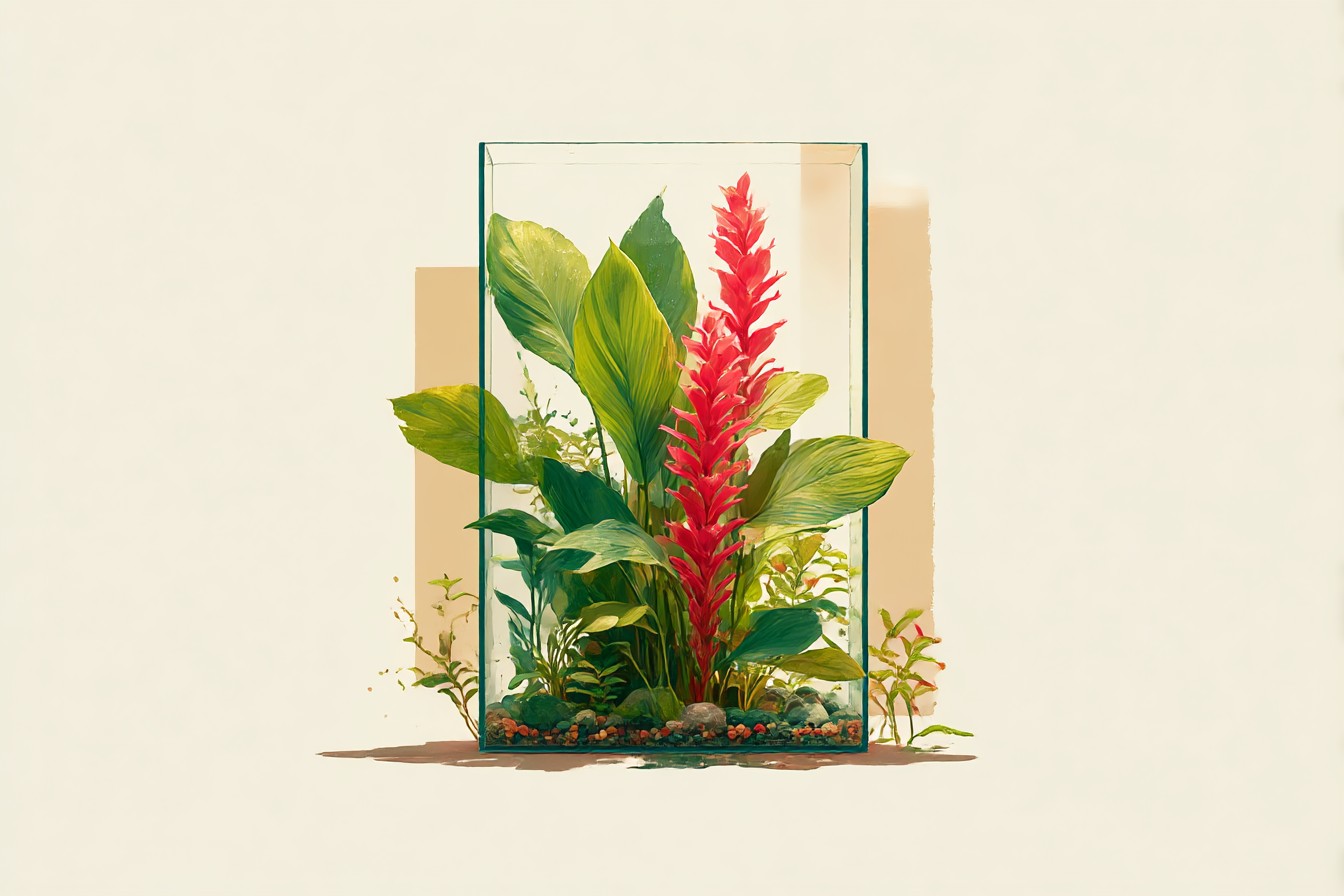
The flower spike emerges from the centre of the plant and grows straight up through the water column. Unlike most aquatic plants that are trying to reach the surface, B. longifolia flowers are designed to open underwater. The blooms are small and not particularly showy by garden standards, but in an aquarium, they’re extraordinary.
Watching a flower open completely submerged still feels like watching something that shouldn’t be possible. The plant grows from a bulb, which gives it characteristics that most aquarium plants don’t have. It stores energy, which means it can survive periods of poor conditions by going dormant.
It also means the growth pattern is different. Instead of steady, continuous growth, B. longifolia tends to grow in spurts. It’ll sit apparently doing nothing for weeks, then suddenly push out several new leaves in quick succession.
This bulb-based growth also affects how you plant it. Unlike stem plants or rosettes that you can just stick in the substrate, the bulb needs to be positioned carefully. Too deep and it may rot.
Too shallow and it may float free. Getting it right requires some trial and error, but once it’s established, it anchors itself properly. The plant’s relationship with CO2 is interesting too.
It will grow without additional CO2, but slowly and with less impressive colouration. With CO2 levels of 10–40 mg/L (AquariumLesson), growth speeds up noticeably and the red-brown pigmentation becomes much more pronounced. I’ve run it both ways in different tanks, and the difference is significant enough that I wouldn’t attempt it again without CO2 injection.
Water chemistry matters more than with many aquarium plants. It prefers slightly acidic to neutral water, with a pH range of 5.5–7.5 (AquariumLesson) and temperature between 22–28°C (Aqua-Fish.net). In my experience, it’s more sensitive to pH swings than many plants, particularly when it’s establishing from a new bulb.
You Might Also Like
The seasonal dormancy behaviour is perhaps the most distinctive characteristic. B. longifolia may enter seasonal dormancy (Aqua-Fish.net) even in the stable conditions of an aquarium. The plant will gradually slow its growth, the existing leaves will deteriorate, and eventually you’re left with just the bulb.
The first time this happened in my tank, I thought I’d killed it. Three months later, new shoots appeared and the cycle began again. This dormancy isn’t necessarily tied to seasons in the way you might expect.
It seems to be more about the plant’s internal clock and energy reserves. Some growers report dormancy periods every 8-12 months, while others see more irregular patterns. Understanding this behaviour is crucial because during dormancy, the plant looks dead but actually isn’t. ## The Honest Assessment B. longifolia isn’t a beginner plant, despite what some sellers might imply.
The bulb stage is particularly tricky. New bulbs can take weeks to show any signs of life, and during that time they’re vulnerable to rot if conditions aren’t right. I’ve had bulbs that sprouted within days and others that sat doing nothing for two months before suddenly producing leaves.
The uncertainty is frustrating when you’ve paid premium prices. The plant’s size can be problematic too. At maximum height of 50 cm (Diszhal.info), it needs a tall tank to show properly.
In anything under 60cm height, you’re constantly trimming to prevent it from reaching the surface. And unlike many plants where trimming encourages bushier growth, cutting B. longifolia leaves just gives you shorter, damaged-looking leaves. Water quality sensitivity is higher than many aquarium plants.
While the acceptable pH range is reasonably wide at 5.5–7.5, sudden changes can trigger premature dormancy or leaf melt. I learned this the hard way during a substrate change that shifted my pH from 6.8 to 7.4 over a few days. The plant responded by dropping all its leaves and going dormant for four months.
The dormancy cycle, while fascinating, can be inconvenient. There’s no way to prevent it, and no reliable way to predict when it will happen. Having your showpiece plant disappear for months at a time doesn’t work well if you’re trying to maintain a consistent aquascape.
I’ve had guests ask what happened to “the pretty red plant” months after it had gone dormant. Availability and cost are ongoing issues. Good-quality bulbs aren’t cheap, and they’re not always available when you want them.
I’ve seen prices range from reasonable to eye-watering depending on supplier and season. The plant’s unwillingness to propagate easily in aquarium conditions means most stock still comes from wild collection or specialist growing facilities. The flowering, while spectacular, is unpredictable.
Some plants flower regularly, others rarely or never. There doesn’t seem to be a reliable way to encourage flowering beyond providing good conditions and waiting. After two years, my original plant has flowered three times, but I couldn’t tell you what triggered it on those occasions versus the times it didn’t flower. ## Legacy and Influence B. longifolia changed how aquascapers think about focal plants and natural behaviour in tanks.
Before it became available, most aquarium plants were chosen for predictable growth and easy management. This plant introduced the idea that some unpredictability and seasonal behaviour might actually add interest to a tank rather than being problems to solve. The success of B. longifolia in the hobby opened the door for other bulb-based aquatic plants that had previously been considered too difficult or unpredictable for general aquarium use.
It proved that hobbyists were willing to work with plants that had more complex requirements if the visual payoff was worth it. It also influenced how the hobby thinks about plant dormancy. Rather than seeing a dormant plant as a failure, B. longifolia taught aquascapers that dormancy could be a natural part of a plant’s lifecycle, something to work with rather than fight against.
This has changed approaches to other seasonal plants and broadened what’s considered acceptable behaviour in planted tanks. The underwater flowering capability has inspired more research into other aquatic plants that might flower submersed under the right conditions. While B. longifolia remains unique in how reliably it flowers underwater, other species have been found to have similar capabilities that were previously overlooked. ## The Verdict Barclaya longifolia isn’t for everyone, but for the right tank and the right keeper, it’s genuinely special.
If you want predictable, easy-care plants that look the same year-round, this isn’t it.
If you want something that behaves like a proper wild plant with seasonal rhythms and spectacular moments, and you’re willing to work with its requirements, it’s extraordinary. The water parameters aren’t particularly demanding – temperature of 24–28°C and pH of 5.5–7.5 (AquariumLesson) covers most well-maintained planted tanks.
You do need decent lighting and CO2 injection for best results, and you need a tall enough tank to let it develop properly. Most importantly, you need to accept that it will go dormant sometimes, and that’s normal behaviour, not something you’ve done wrong. This works best as a specimen plant rather than part of a mass planting.
One healthy B. longifolia can anchor an entire aquascape when it’s in active growth. The movement of the leaves and the possibility of underwater flowers make it genuinely captivating in a way that few aquarium plants manage. My daughter still cheques our B. longifolia every morning.
Two years in, it’s produced three flower spikes, gone dormant twice, and consistently been the plant that visitors remember from our tank. That combination of botanical interest and visual drama is what makes this plant worth the effort, even when it’s testing your patience by disappearing for months at a time. See where this placed in our full ranking of must-have aquarium plants.


