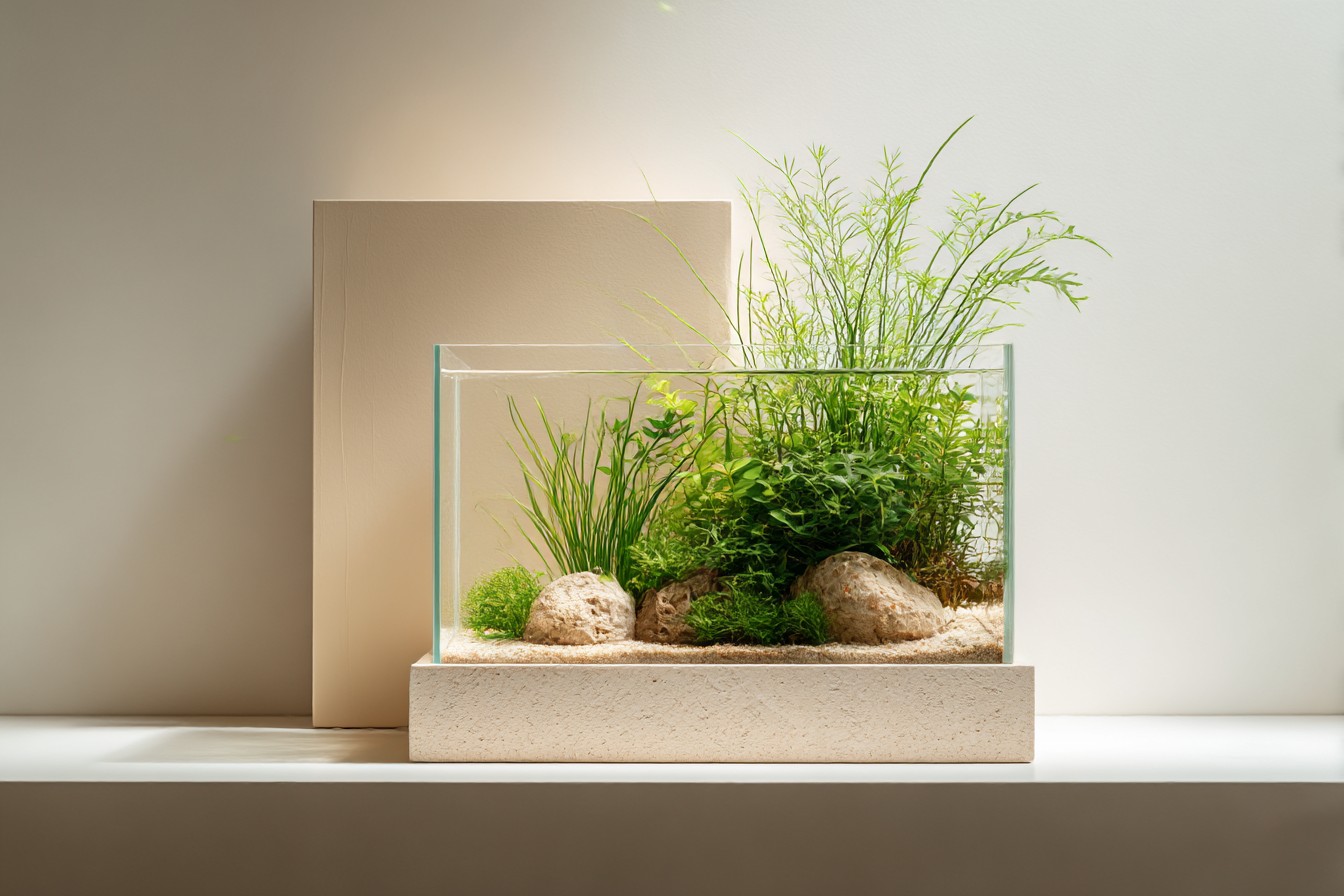
# Small Planted Aquarium Ideas for Desktops and Shelves I’ve got five tanks running in my student flat right now. The biggest one is twelve litres. The smallest sits on my desk next to my monitor and holds about nine litres when filled.
None of them need CO2 injection, none of them cost more than fifty quid to set up, and all of them work better than the first “proper” tank I tried to build when I started this hobby three years ago. The thing about small planted tanks is that they force you to get the fundamentals right. You can’t rely on sheer water volume to buffer your mistakes.
You can’t chuck in a massive filter and hope it sorts everything out. You need to understand what actually makes a planted system stable, then build that stability into a space that’s smaller than most people’s bedside drawer.

I started with small tanks because that’s what fit my budget and my living situation.
What I discovered is that they’re not just a compromise version of “real” aquascaping. They’re a completely different discipline. The constraints make you think harder about every decision.
Every plant has to earn its place. Every piece of hardscape matters. There’s no room for anything that doesn’t contribute to the overall system. ## Quick Reference | Tank Size | Dimensions | Weight (Filled) | Suitable Plants | Setup Cost | Maintenance | |———–|————|—————–|—————-|————|————-| | 2.5 gallon | 12″ x 6″ x 8″ | 26.9 lb | 4-6 species max | £30-50 | Weekly | | 5 gallon | Variable | 58.7-62 lb | 6-8 species max | £40-70 | Bi-weekly | | Desktop nano | 8-12″ cube | 15-35 lb | 3-5 species max | £25-45 | Weekly | ## The Reality of Desktop Aquascaping Small planted tanks occupy a weird space in the hobby.
Everyone acknowledges they exist, but most guides assume you’re working with at least 60 litres and decent lighting. The advice doesn’t scale down. You can’t just take a standard planted tank approach and miniaturise it.
I learned this the hard way with my first attempt. Bought a 2.5 gallon kit because it was cheap and looked straightforward (Fish Tank Focus). The dimensions seemed reasonable enough: 12 inches by 6 inches by 8 inches (Fish Tank Focus).
Empty weight of just 3 pounds meant I could stick it anywhere (Fish Tank Focus). Once filled, it weighed 26.9 pounds (Fish Tank Focus), which was still manageable for a desk setup. But manageable weight doesn’t mean manageable chemistry.
I planted it like I’d read about in forums dedicated to much larger tanks. Too many species, too much biomass, not enough thought about how the plants would actually interact in that confined space. The whole thing crashed within six weeks.
Algae everywhere, plants melting, water that smelled like a pond. The problem wasn’t the tank size. It was my assumption that aquascaping principles work the same way regardless of scale.
They don’t. ## What Actually Works in Small Spaces After rebuilding that first tank three times, I’ve worked out what actually functions in desktop aquascaping. The key is thinking about it as a complete system from the start, not as a scaled-down version of something bigger. **Plant selection becomes critical.** In a larger tank, you can get away with plants that grow too fast or spread too aggressively because there’s space to manage them. In a 2.5 gallon setup, one plant taking over can destabilise the entire scape within a fortnight.
I stick to slow-growing species that I can predict. Anubias nana petite. Java moss tied to small pieces of wood.
Maybe one stem plant that I can trim regularly without it throwing off the balance. **Hardscape has to work harder.** Every piece of wood or stone needs to create visual depth while also providing surfaces for beneficial bacteria and attachment points for plants. I spend more time arranging hardscape in a small tank than I do in larger ones because there’s no room for elements that are just decorative. Everything has to serve multiple purposes. **Lighting becomes both easier and harder.** Easier because you need less of it and a simple LED strip can cover the whole tank.
Harder because you need to get the intensity exactly right. Too much light in a small volume with limited CO2 creates algae problems fast. Too little and your plants won’t grow properly.
I run most of my small tanks on a six-hour photoperiod with medium-intensity LED strips. It took me months of tweaking to find the sweet spot. **Water changes matter more.** In a larger tank, you’ve got water volume working as a buffer. Small tanks are less forgiving.
I do 30% water changes weekly on anything under 20 litres. It sounds like a lot of maintenance, but we’re talking about maybe two litres of water. Takes five minutes.
The filtration approach changes completely. Those tiny filters that come with desktop kits do basically nothing useful (The Spruce Pets). The cartridges need replacing every four weeks (The Spruce Pets), which gets expensive and doesn’t provide stable biological filtration.
I remove the standard filter media and stuff the space with ceramic rings or filter floss that I can rinse and reuse. The plants do most of the actual filtration work. ## Working With Kit Limitations Most people start with kits like the Aqueon MiniBow series, which come in 2.5 gallon and 5 gallon options (The Spruce Pets). The 5 gallon version weighs 5.25 pounds empty (The Spruce Pets) but around 58.7 to 62 pounds when filled (Fish Tank Focus, Private Scuba).
That converts to roughly 19 litres (UnitConverters), which gives you significantly more flexibility than the 2.5 gallon versions. These kits aren’t designed for serious planted setups, but they’re what most people have access to and they can work if you understand their limitations. The lighting is usually adequate for low-light plants.
You Might Also Like
The filtration is borderline useless but can be modified. The real issue is that they’re designed around the idea that small tanks are temporary or for children, so the components reflect that assumption. I’ve modded every kit I’ve worked with.
Replace the filter media with something that actually provides biological filtration. Add a small heater if you’re keeping anything that needs stable temperatures – most heaters suitable for small tanks need to be under 6.5 inches in length for 3 to 10 gallon setups (AquAnswers). Upgrade the lighting if you want anything beyond the most basic low-light plants.
The modifications aren’t expensive, but they’re necessary if you want the setup to actually work long-term rather than just look acceptable for a few weeks. ## Plant Combinations That Actually Work I’ve tried dozens of plant combinations in small tanks. Most fail for predictable reasons: growth rates don’t match, nutrient requirements conflict, or one species simply outcompetes everything else too quickly. What works is building around one primary plant that you know will stay manageable, then adding support species that complement rather than compete with it.
In my current desktop tank, I’ve got Anubias barteri nana as the focal point. It grows slowly, doesn’t need much light, and provides a stable visual anchor. Around it, I’ve added Java moss on the hardscape and a small patch of Eleocharis parvula in the foreground.
The moss grows at roughly the same rate as the Anubias. The Eleocharis spreads slowly and creates carpet texture without taking over. This combination has been stable for eight months now.
The plants balance each other nutritionally. The visual composition works. Most importantly, I can predict how it will look in three months’ time.
That predictability is crucial in small tanks where there’s no room for surprises. Other combinations I’ve had success with: Cryptocoryne wendtii with Java moss and small pieces of Bucephalandra. Microsorum pteropus petit with Fissidens fontanus moss and a single stem of Rotala rotundifolia that I trim aggressively.
The key is always choosing plants that grow at compatible rates and won’t suddenly explode across the tank. ## The Honest Challenges Small planted tanks look straightforward in photos, but they’re actually more technically demanding than larger setups in several ways that nobody talks about honestly. **Temperature stability is harder to maintain.** Small water volumes heat up and cool down faster. If your room temperature fluctuates, your tank temperature fluctuates with it. I’ve learned to position tanks away from heat sources and drafts, but you can’t eliminate the problem entirely. **Algae problems happen faster and are harder to correct.** In a larger tank, an algae outbreak might develop over several weeks and you can address it gradually.
In a small tank, you can go from clear water to green soup in days. Once established, algae is proportionally harder to remove because any treatment affects a higher percentage of the total water volume. **Plant trimming requires more precision.** Cut too much off a plant in a 60-litre tank and it’s barely noticeable. Make the same mistake in a 10-litre tank and you’ve completely changed the visual balance.
I’ve learned to trim little and often rather than doing major maintenance sessions. **Stock options are genuinely limited.** Despite what some guides suggest, most fish are not suitable for tanks under 20 litres. Shrimp work, but they have their own requirements. If you want livestock, you need to accept that your options are restricted and plan accordingly.
The hobby has a tendency to oversell small tanks as “beginner friendly” when they’re actually more demanding than larger setups in several important ways. ## Why They’re Worth the Effort Despite the challenges, small planted tanks have taught me more about aquascaping principles than larger builds ever did. The constraints force you to really understand what you’re doing rather than just following recipes. You learn to read plants properly because you have to.
In a small tank, you notice when something’s not quite right before it becomes a major problem. You develop a better eye for composition because every element has to justify its presence. You understand the nitrogen cycle more thoroughly because you can see the effects of changes more quickly.
There’s also something satisfying about creating a complete ecosystem in such a confined space. My desk tank runs without any external inputs other than occasional water changes and very light feeding for the cherry shrimp. It’s essentially a closed loop that maintains itself.
That’s harder to achieve in larger tanks where there are more variables to control. The skills transfer upwards too. Everything I learned struggling with desktop tanks made managing larger setups easier.
You develop a sense for system balance that comes from working within tight constraints. ## Making It Work Long-Term The difference between small planted tanks that work and ones that don’t comes down to accepting what they actually are rather than trying to make them into something they’re not. They’re not miniature versions of large planted tanks.

They’re their own thing with their own requirements and limitations.
Success means choosing plants that will still look proportional in six months’ time. It means understanding that maintenance will be more frequent even if each session is quicker. It means accepting that your stocking options are limited and planning around that reality rather than fighting it.
Most importantly, it means approaching the whole project systematically. Document what you’re doing. Test one variable at a time.
When something goes wrong – and something will go wrong – you’ll have the information you need to debug the problem properly rather than just starting over. Small planted tanks aren’t a stepping stone to “real” aquascaping. They’re a legitimate form of the hobby that happens to fit on your desk and cost less than a decent meal out.
Done properly, they’re every bit as rewarding as the elaborate builds that fill up social media. They just require you to think harder about every decision you make.


