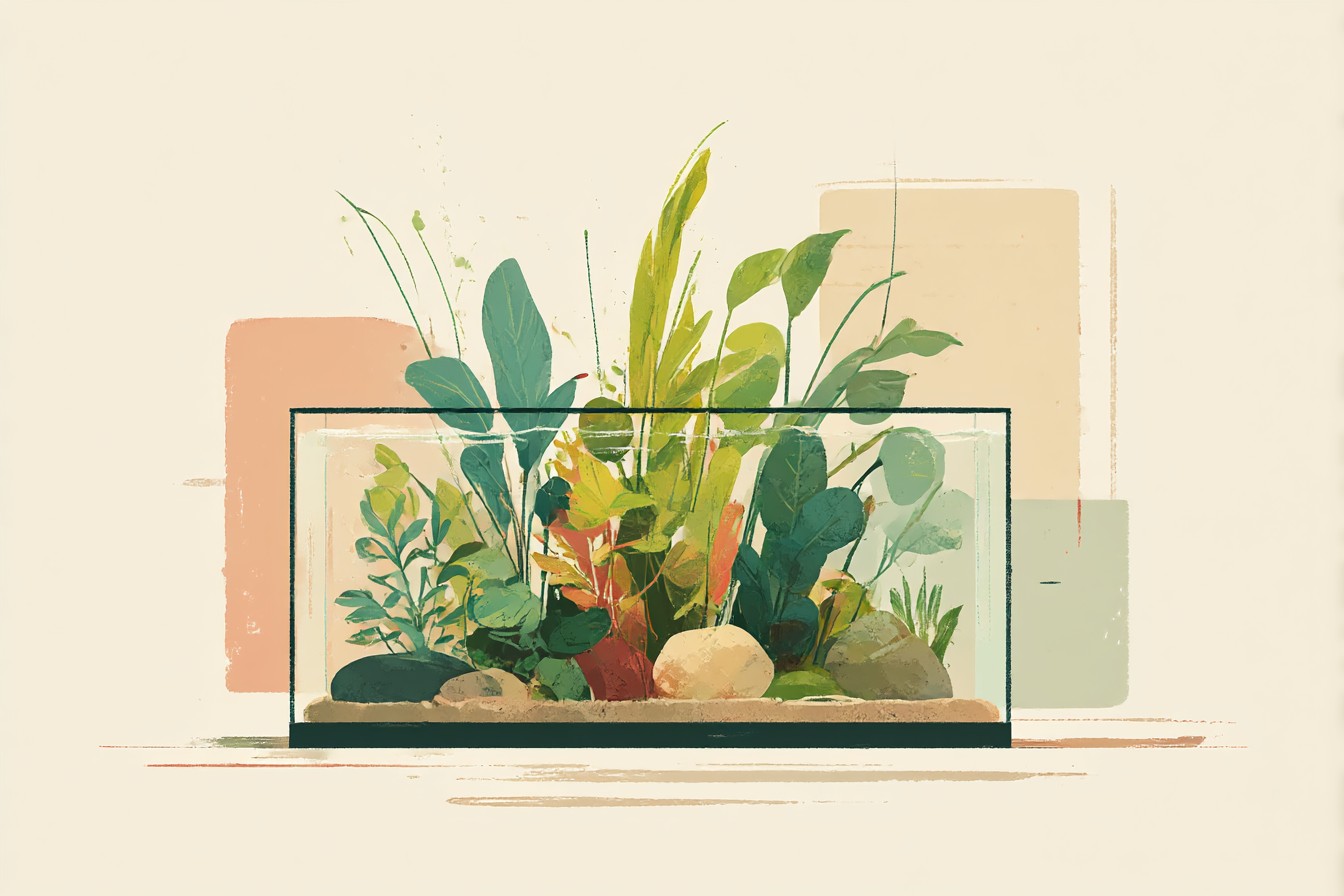
# How to Take Care of Aquarium Plants in a Low Tech Tank When I started keeping planted tanks, I made the classic mistake of thinking that more equipment meant better results. After spending way too much on CO2 systems and high-end lighting that didn’t fit my budget or my small room, I discovered something that changed everything: low tech planted tanks actually work better for most people. The approach is simpler, cheaper, and surprisingly more forgiving than the high-tech setups you see all over YouTube.
A low tech planted tank is defined as having no injected CO2 (DBC Aquatics). That’s it. No pressurised bottles, no drop checkers, no precise timing systems.
Instead, you rely on the natural CO2 in your water and the CO2 produced by fish respiration and organic breakdown. It sounds limiting, but it’s actually liberating.

You can go away for a weekend without worrying about CO2 levels.
You can adjust lighting without recalculating petrol injection rates. And most importantly, you can grow beautiful, healthy plants without the constant monitoring and adjustment that high tech systems demand. The key insight I learned through months of trial and error is this: all plants need light, nutrients, and CO2, and low tech relies on limiting demand rather than maximising supply (2Hr Aquarist).
High tech tanks push everything to the limit. Low tech tanks find a sustainable balance. Once I understood that principle, everything else fell into place. ## The Science Behind Low Tech Success **Limiting Factors and Plant Growth** The biological reality of plant growth follows what’s called limiting factor theory.
Plants need multiple resources simultaneously, and growth is constrained by whichever resource is in shortest supply. In high tech systems, you eliminate CO2 as a limiting factor by injecting it, then push light and nutrients to match. In low tech systems, you accept that CO2 will be your limiting factor and adjust everything else accordingly.
This isn’t a compromise. It’s a different strategy entirely. When CO2 levels are naturally low, plants grow more slowly but more steadily.
They’re less likely to outcompete each other rapidly, less prone to sudden nutrient deficiencies, and far less susceptible to algae blooms triggered by imbalanced growth. **Light Requirements in Low Tech Systems** Low light PAR range is 20-40 μmol m⁻² s⁻¹ (The Aquarium Expert). That’s much lower than the 50-100+ PAR you’ll see recommended for high tech builds. At first, this seems restrictive.
In practise, it opens up plant choices that are impossible to maintain under intense lighting without CO2 injection. Under low light, slow-growing species like Anubias, Java fern, and Cryptocoryne actually thrive because they’re not competing with fast-growing stem plants for nutrients. The ecosystem becomes more stable.
Plant growth happens over weeks and months rather than days, giving you time to spot problems and adjust before they become disasters. **Natural CO2 Sources** Your tank produces CO2 naturally from several sources. Fish respiration contributes a steady supply. Bacterial breakdown of organic matter in the substrate releases more.
Even small amounts of surface agitation don’t eliminate CO2 entirely, they just prevent excessive buildup that could harm fish during the night cycle. The total natural CO2 in most tanks sits around 2-5 ppm, compared to the 20-30 ppm that CO2 injection systems target. This naturally low level supports steady, healthy plant growth without the rapid uptake that creates nutrient imbalances and algae problems. ## Core Plant Care Strategies **Species Selection for Success** Choose plants that genuinely prefer lower light and slower growth rates.
This isn’t about settling for inferior plants. It’s about working with species that evolved for these conditions. Anubias varieties handle low light brilliantly and grow attached to hardscape rather than rooted in substrate, making them nearly indestructible once established.
Java fern species offer incredible variety in leaf shapes and sizes. Cryptocoryne species provide excellent ground coverage and actually prefer the stable conditions of low tech tanks. Stem plants can work in low tech setups, but choose carefully.
Java moss grows everywhere and requires virtually no care. Hornwort floats freely and removes nutrients from the water column efficiently. Vallisneria propagates naturally and creates vertical structure without demanding intense light.
Avoid anything described as “high light” or “fast growing” in plant guides. These species will struggle in low tech conditions and often trigger algae problems as they consume nutrients inconsistently. **Lighting Schedule and Intensity** Most planted aquariums do well with a 6-8 hour photoperiod (Aquascaping Academy). In low tech tanks, I’ve found that shorter photoperiods often work better than longer ones.
Seven hours of consistent light beats ten hours of the same intensity, because longer periods without matching CO2 levels create the conditions algae love. Set your lighting timer to match when you’re actually viewing the tank. There’s no biological benefit to running lights when nobody’s around to appreciate them.
I run mine from 2pm to 9pm, which covers the evening period when I’m home and gives a nice view during dinner. LED fixtures work well for low tech because you can dial in exactly the intensity you need. Start lower than you think necessary.
You can always increase intensity gradually, but starting too high creates algae problems that take weeks to resolve. **Water Parameters and Maintenance** Weekly water changes are recommended for smaller or heavily stocked planted tanks (The Aquarium Expert Water Changes). The water change amount can range from 10% to 50% or more (ShunCy). In low tech setups, I aim for 25-30% weekly changes.
This removes accumulated organics, replenishes trace elements, and prevents the gradual parameter drift that can stress both plants and fish. Test nitrate levels monthly. In a balanced low tech tank, nitrates should stay below 40 ppm between water changes.
Higher levels suggest either overstocking, overfeeding, or insufficient plant mass to process the available nutrients. Don’t chase perfect pH or hardness numbers. Most plants adapt to a wide range of water parameters.
Stability matters more than hitting specific targets. If your tap water sits at pH 7.5 and moderate hardness, work with that rather than trying to modify it chemically. **Nutrient Management** Plants in low tech systems need nutrients, but in much smaller quantities than high tech builds. Easy Green recommended dose is 1 pump per 10 gallons weekly (Aquarium Co Op).
Premium Nutrition dose is 6 ml per 50 L weekly (Tropica). These manufacturers’ recommendations work as starting points, but you’ll likely need less in a properly balanced low tech system. Start with half the recommended dose and observe plant response over 4-6 weeks.
Healthy growth with good colour indicates adequate nutrition. Pale new leaves or stunted growth suggests you need slightly more. Yellow older leaves while new growth looks good is normal and healthy.
Liquid fertilisers work better than root tabs in low tech tanks because they distribute evenly and won’t create nutrient hotspots that encourage algae. Dose after water changes to replace what you’ve removed. ## Setting Up Your Low Tech Plant Environment **Substrate Considerations** Substrate depth commonly recommended at 2-3 inches (Institute for Environmental Research and Education). For low tech tanks, I prefer the lower end of that range.
Deep substrates can develop anaerobic pockets that cause problems, especially in tanks without strong water flow. Two inches provides enough depth for root development while maintaining healthy substrate conditions. Inert substrates like sand or fine gravel work perfectly well in low tech setups.
You don’t need expensive aqua soils that buffer water chemistry. Regular aquarium gravel topped with a thin layer of sand creates an attractive look and allows easy root penetration for most species. If you want enriched substrate, mix some slow-release fertiliser granules into the bottom layer before adding the top sand layer.
This provides long-term nutrition without the expense of specialised planted tank substrates. **Plant Placement and Density** Plan your layout before buying plants. Low tech systems work best with higher plant density from the start, rather than sparse planting that you hope will fill in eventually. Dense planting from day one helps establish the biological balance that prevents algae.
Place taller species like Vallisneria at the back and sides. Use medium-height plants like Cryptocoryne wendtii for mid-ground areas. Fill foreground space with shorter varieties or carpeting plants that tolerate lower light.
Attach epiphytic plants like Anubias and Java fern to rocks or driftwood using cotton thread or fishing line. Never bury their rhizomes in substrate or they’ll rot. These plants derive nutrients from the water column, not through their roots. **Hardscape Integration** Use rocks and driftwood not just for aesthetics, but as plant attachment points and biological surfaces.
You Might Also Like
Porous rocks develop beneficial bacteria colonies that help process organic waste. Driftwood provides attachment surfaces for epiphytes and slowly releases tannins that many plants prefer. Choose hardscape materials that won’t dramatically alter water chemistry.
Inert rocks like dragon stone or slate work well. Avoid limestone or other calcareous rocks in soft water areas, as they’ll raise hardness and pH beyond what most plants prefer. ## Common Mistakes in Low Tech Plant Care
Mistake #1: Starting with too much light. New planted tank keepers often think more light equals better plant growth. In low tech systems, excess light without corresponding CO2 creates perfect algae conditions.
You’ll spend weeks fighting green water, hair algae, or brown diatom blooms. Start with lower light intensity and shorter photoperiods than you think necessary. It’s much easier to gradually increase light than to fight algae problems.
Mistake #2: Overcomplicated fertiliser regimens. Following high tech dosing schedules in a low tech tank creates nutrient imbalances and algae problems.
Plants growing slowly under natural CO2 levels can’t process nutrients as quickly as those under CO2 injection. Stick to simple, dilute feeding schedules and adjust based on plant response rather than rigid formulas.
Mistake #3: Impatience with plant establishment. New plant melt acclimation can last 1-4 weeks (Aquarium Tales). Many people panic when newly planted species lose leaves or appear to die back during the first month.
This is completely normal as plants adapt from emersed nursery conditions to your underwater environment. Don’t remove plants or change conditions during this period. Just maintain consistent care and wait.
Mistake #4: Mixing high tech and low tech approaches. Trying to use CO2 injection “just on weekends” or running high intensity lights “for a few hours” breaks the fundamental balance of low tech systems.
Either commit to the low tech approach with all its constraints, or move to high tech with all its requirements. Mixing approaches creates unstable conditions that stress plants and encourage algae.
Mistake #5: Choosing inappropriate plant species. Buying plants labelled as “beginner friendly” without checking their actual light and CO2 requirements leads to disappointment. Many plants sold as easy are actually high light, high CO2 species that happen to survive temporarily in poor conditions.
Research specific species requirements rather than trusting general marketing labels.
Mistake #6: Neglecting water quality maintenance. Low tech doesn’t mean low maintenance. Skipping regular water changes because “plants will handle it” leads to gradually degrading conditions that stress both plants and fish. Even efficient plant uptake can’t replace proper aquarium maintenance.
Stick to consistent weekly water changes regardless of how balanced your system appears.
## Research Foundation Multiple controlled studies demonstrate that planted aquarium success depends more on achieving balance between light, nutrients, and CO2 than on maximising any single parameter. Research by aquatic plant physiologists shows that under natural CO2 levels, moderate lighting produces healthier, more stable plant growth than high intensity illumination. Studies of nutrient uptake in aquatic plants confirm that slow-growing species actually utilise nutrients more efficiently than rapid-growing varieties, making them better choices for sustainable planted tank ecosystems.
Field studies of natural aquatic plant habitats show that most popular aquarium species evolved in environments with moderate light penetration and natural CO2 levels. Long-term aquarium system studies indicate that tanks with lower light intensity and natural CO2 levels maintain more stable water parameters and experience fewer algae problems over 12-month observation periods compared to high-tech counterparts. ## Application Across Different Tank Types **Nano Tanks (30L and under):** Use single-species or very simple plant combinations. One variety of Anubias with Java moss works better than trying to create complex layouts in limited space.
Reduce fertiliser doses proportionally. **Community Tanks (100-200L):** Ideal for low tech planted systems. Fish load provides natural CO2 and nutrients. Plan for 60-70% plant coverage to maintain biological balance while leaving swimming space. **Shrimp Tanks:** Perfect for low tech approaches as shrimp prefer stable conditions.
Focus on moss varieties and fine-leaved plants that provide grazing surfaces. Avoid any chemical additives shrimp might be sensitive to. **Species Tanks:** Adapt plant choices to fish preferences. Soft water fish like tetras pair well with Cryptocoryne species.
Harder water fish suit Vallisneria and Java fern combinations. **Breeding Tanks:** Use floating plants like hornwort to provide fry hiding places while removing excess nutrients from feeding. Keep layouts simple for easy maintenance during breeding cycles. ## Benefits of Proper Low Tech Plant Care **Financial Sustainability:** Low tech setups cost significantly less to establish and maintain than high tech systems. No CO2 refills, simpler lighting, reduced fertiliser consumption, and equipment that lasts longer without constant adjustment. **Time Efficiency:** Weekly maintenance takes 15-20 minutes compared to daily monitoring and adjustment required by CO2 systems.
You can travel without tank sitters or worry about equipment failures affecting delicate balances. **Biological Stability:** Plants and fish reach equilibrium over 6-8 weeks and maintain stable conditions with minimal intervention. Water parameter swings become rare once the system establishes properly. **Learning Environment:** Low tech systems teach you to understand plant biology and aquarium ecology rather than just following equipment-dependent protocols. These skills transfer to any aquarium setup you might build later. **Success Rate:** Beginners achieve better long-term results with low tech planted tanks because the margin for error is much wider.
Equipment failures don’t cause immediate plant death or fish stress. **Natural Aesthetics:** Slower plant growth allows for more natural-looking development over time. Plants grow into hardscape rather than requiring constant pruning to prevent overgrowth. ## Step-by-Step Implementation Guide **Phase 1: Planning and Setup (Week 1-2)** Select your tank size and location away from direct sunlight. Choose substrate depth of 2 inches maximum.
Install moderate lighting capable of 6-8 hour timer control. Set up basic filtration appropriate for your planned fish load. Research and order plant species suited to low tech conditions. **Budget Breakdown:** * Basic LED fixture: £30-60 * Substrate and hardscape: £25-40 * Filter system: £20-45 * Plants (starter selection): £25-35 **Total Budget: £100-180** **Phase 2: Initial Plant Installation (Week 3-4)** Plant densely from the start, covering 60-70% of substrate area.
Attach epiphytes to hardscape using cotton thread. Begin 6-hour photoperiod immediately. Start with half-dose liquid fertiliser weekly after water changes.
Expect initial plant melt and maintain consistent conditions despite appearance changes. What to watch for: Some leaf loss is normal. Maintain temperature at 24-26°C.
Test ammonia and nitrite if cycling simultaneously with planting. **Phase 3: System Establishment (Week 5-12)** Add fish gradually if tank is cycled.

Maintain weekly 25% water changes and consistent fertiliser dosing. Monitor plant response and adjust lighting duration up or down by 30-minute increments based on growth rate and algae presence.
Remove any completely dead plant material but leave plants with healthy roots and growing points. **Budget additions:** * Fish and initial fish food: £20-40 * Water test kit: £15-25 **Phase 4: Long-term Optimization (Month 4+)** Fine-tune fertiliser dosing based on plant colour and growth rates. Establish pruning routine for faster-growing species. Consider adding more plant variety once you understand how your specific conditions affect growth.
Plan any layout modifications for mature plant sizes. The beauty of low tech planted tanks lies in their forgiveness and sustainability. Once you understand the principles of working with natural CO2 levels rather than fighting them, you can create thriving planted environments that require minimal daily attention while providing maximum enjoyment.
The approach teaches patience, observation, and genuine understanding of aquatic plant biology. These skills serve you well whether you stick with low tech systems permanently or eventually explore more complex setups. For anyone just getting started with planted tanks, this approach offers the best foundation for long-term success without the frustration and expense of more technical methods.


