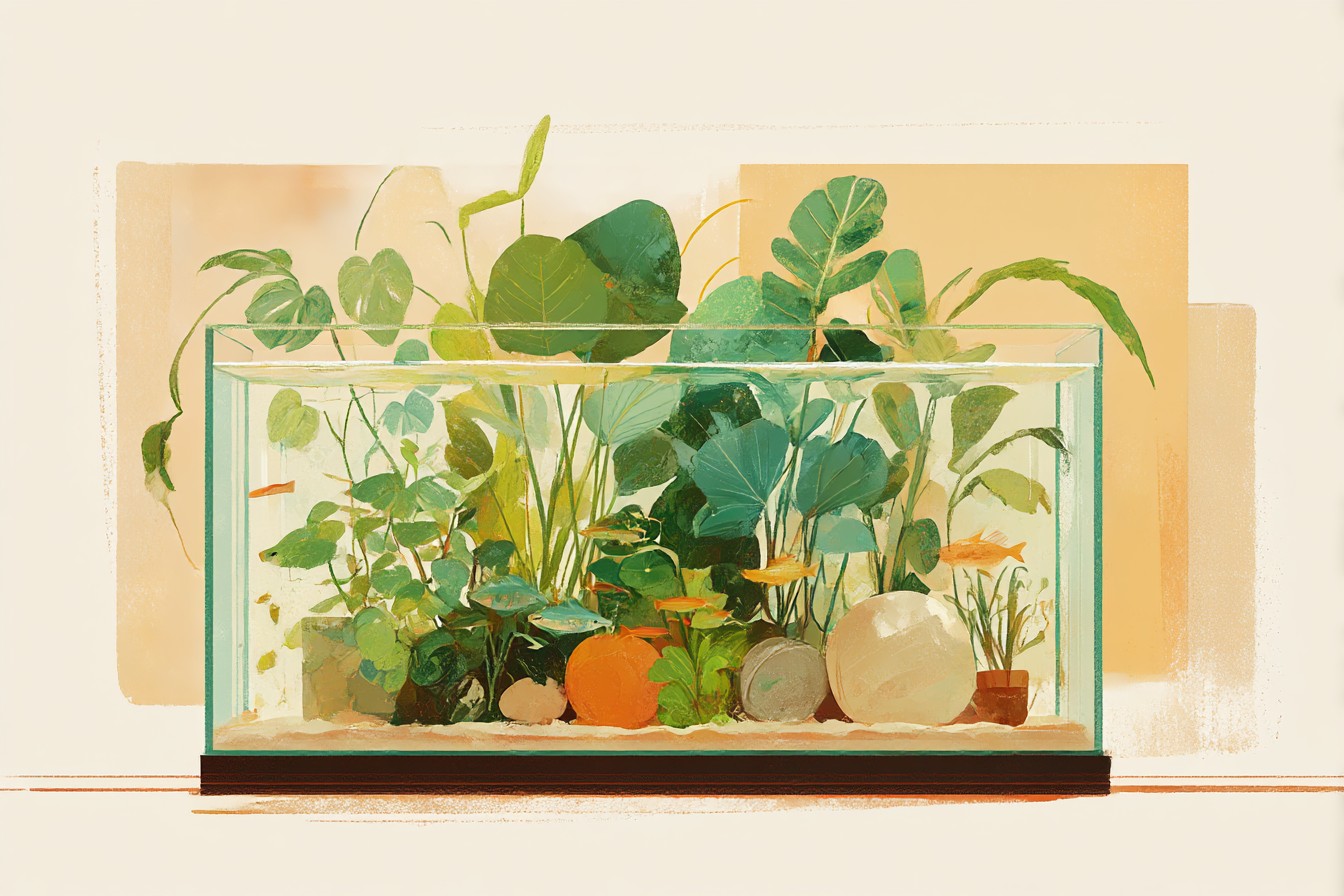
# House Plants in an Aquarium: What Terrestrial Species Can Handle the Water Your standard aquarium setup doesn’t have to end at the waterline. Some of the most effective natural filtration comes from terrestrial plants that can adapt to growing in water, and many common houseplants will thrive with their roots submerged while their leaves grow above your tank. This isn’t just about aesthetics, though the look of trailing pothos or peace lily emerging from your aquarium certainly beats most artificial decorations.
The real benefit is biological. These plants consume nitrates more aggressively than most aquatic species, help stabilise pH swings, and provide additional surface area for beneficial bacteria. They’re also considerably cheaper than buying enough aquatic plants to fill a large tank, and you can propagate most of them from cuttings you already have at home.
Getting this right requires understanding which plants actually work long term versus which ones will slowly rot in your tank, how to position them for both plant health and fish safety, and what the maintenance requirements really look like. There’s quite a bit of misinformation floating around online about which houseplants are genuinely aquarium compatible, so let’s work through what actually functions. ## The Science Behind Terrestrial Plants in Aquatic Systems **Root Adaptation Mechanisms** When terrestrial plants grow in water, they develop different root structures than they would in soil.

The roots become more efficient at oxygen uptake and develop larger air spaces called aerenchyma tissue.
This adaptation allows them to survive in the low-oxygen environment that water provides compared to well-aerated soil. **Nutrient Processing Differences** Emergent plants like pothos and peace lily demonstrate about 75% of the nitrate removal potential compared to surface water plants (Aquarium Science). This is still significant biological filtration, particularly when you consider that annual emergent plants like vegetables only achieve roughly 50% nitrate removal potential versus surface water plants (Aquarium Science). **Water Chemistry Considerations** Most houseplants adapted for water culture prefer pH levels between 6.0 and 7.0, which aligns well with typical freshwater aquarium parameters. The key factor is chlorine content.
Chlorine is used as a drinking water disinfectant (US EPA), which means using dechlorinated aquarium water provides better conditions for root development than straight tap water. The nitrogen compounds that fish waste produces are actually beneficial nutrients for these plants, unlike true aquatic plants that can sometimes struggle with excessive organics. Terrestrial plants growing in water will readily consume ammonia, nitrites, and nitrates, making them excellent biological filters for heavily stocked tanks. ## Primary Species and Implementation Methods **Pothos (Epipremnum aureum)** Pothos remains the most reliable choice for aquarium integration.
Common house plants used in aquariums include pothos, philodendron and lucky bamboo (Windy City Aquariums), with pothos leading the list for good reason. When starting pothos in water, cutting length should be 3-4 inches (Gardening Know How). Position the cutting so that at least two nodes are below the waterline.
These nodes will develop into the primary root system. In an aquarium environment, you’ll typically see root development within 7-10 days. The roots will continue expanding and can grow several feet long if left undisturbed.
For maintenance in pure water culture, pothos water should be fully replaced every 2-3 weeks (Gardening Know How). In an established aquarium, this isn’t necessary since your regular water changes handle this requirement. **Spider Plants (Chlorophytum comosum)** Spider plants work particularly well because they’re naturally adapted to periodic flooding in their native environment. The plant is listed as non-toxic to cats and dogs (ASPCA), making it safer if you have pets that might nibble on trailing leaves.
In pure water culture, spider plants need water changes every 3-5 days (Real Simple). In aquarium conditions, your normal maintenance schedule handles this. The plantlets that spider plants naturally produce can be rooted directly in the aquarium water, giving you an endless supply of additional biological filtration. **Dracaena Species** Several dracaena varieties adapt well to aquarium conditions, particularly Dracaena sanderiana (lucky bamboo) and Dracaena marginata.
Dracaena in water culture can develop a complete root system within 2 months (Real Simple), though you’ll see initial root development much sooner. The key with dracaena is ensuring only the roots and lower stem contact the water. If the leaves become submerged, they’ll rot quickly and can cause water quality issues.
Position these plants in tall, narrow containers or use aquarium clips to maintain proper height. **Peace Lily (Spathiphyllum)** Peace lilies provide excellent nitrate removal and will flower reliably when grown as emergent plants. The root system becomes quite extensive, making them suitable for larger aquarium systems. However, all parts of peace lilies are toxic if ingested, so consider this if you have pets or small children who might access the tank area. **Philodendron Species** Heartleaf philodendron and similar trailing varieties work similarly to pothos but tend to be slightly less tolerant of poor water conditions.
They’re excellent choices for well-maintained tanks but may struggle in systems with inconsistent parameters. **Budget and Setup Considerations** Most of these plants cost between £3-8 as cuttings or small plants from garden centres. You can often get cuttings free from friends who already have established plants. The total setup cost for adding terrestrial plants to an existing tank runs £15-30, including any clips, small containers, or positioning hardware you might need.
Compare this to filling the same space with aquatic plants, which would typically cost £40-80 depending on the species chosen, and the economics become quite attractive. ## Common Implementation Mistakes
Mistake #1: Submerging the wrong plant parts. Many people assume that if roots can go underwater, leaves can too. This kills most terrestrial plants within days. Only the roots and, in some cases, the lower stem should contact water.
Submerged leaves will rot and can crash your tank’s water quality as they decompose.
Mistake #2: Using plants that look similar to aquarium-safe species. Not all trailing houseplants work in aquariums. Tradescantia, for example, looks similar to pothos but will rot in aquarium conditions. Stick to the species with documented success rather than experimenting with untested plants in an established tank.
Mistake #3: Expecting immediate nitrate reduction. These plants need 4-6 weeks to develop sufficient root mass to provide meaningful biological filtration.
You Might Also Like
Don’t reduce your normal maintenance routine until the plants are well established and showing vigorous growth.
Mistake #4: Positioning plants where they block equipment access. Terrestrial plants can grow quite large over time. Position them where their eventual size won’t interfere with filter maintenance, feeding, or tank cleaning. Pothos vines can easily reach 6 feet or more, and spider plants produce numerous plantlets that need periodic removal.
Mistake #5: Using plants toxic to your livestock. Some houseplants that thrive in water are toxic to fish if leaves autumn into the tank or if plant compounds leach into the water.
Research toxicity for both your fish species and any household pets before adding new plants.
Mistake #6: Inadequate light provision. These plants still need appropriate lighting for the leaf portions growing above water. Standard aquarium lighting often doesn’t provide enough coverage for tall emergent plants. You may need additional lighting or positioning adjustments to maintain healthy growth.
## Research Support Multiple sources document the effectiveness of terrestrial plants in aquatic systems.
Houseplants that grow in water include 25 plant species (Real Simple), though only a subset of these are suitable for long-term aquarium integration. The documented nitrate removal capabilities and the successful water culture requirements for common houseplants provide a solid foundation for aquarium applications. The adaptation mechanisms these plants use for water-based root systems are well understood, and the maintenance requirements are thoroughly documented for water culture applications.
This translates directly to aquarium environments with some modifications for the presence of fish and existing biological systems. ## Applications Across Different Tank Types **Community Planted Tanks:** Use pothos or philodendron for gentle nitrate removal without disrupting established plant systems. Position them to create natural backgrounds or corner features. **Heavily Stocked Cichlid Tanks:** Peace lilies and spider plants handle the higher nutrient loads well and provide additional biological filtration capacity. Their robust root systems cope with the stronger water movement these tanks often require. **Nano Shrimp Setups:** Small dracaena cuttings or single pothos nodes work well without overwhelming the limited space.
The slight tannin release from some terrestrial plant roots can benefit shrimp health. **Goldfish Systems:** All mentioned species work well with goldfish, though position them where the fish cannot uproot or damage the plants. Goldfish produce substantial waste that these plants will readily process. **Quarantine Tanks:** Pothos cuttings establish quickly and help maintain stable water quality during the quarantine period. They’re easy to remove and sterilise between uses. ## Key Benefits Summary **Enhanced Biological Filtration** The additional root surface area provides space for beneficial bacteria while the plants directly consume nitrogen compounds.
This dual action helps maintain more stable water parameters, particularly in heavily stocked systems. **Cost-Effective Tank Enhancement** At a fraction of the cost of equivalent aquatic plants, terrestrial species provide similar biological benefits while adding visual interest above the waterline. Many can be propagated indefinitely once established. **Reduced Maintenance Requirements** Stable nitrate levels mean fewer water changes and less parameter monitoring over time. Most users see noticeable improvements in water stability within 6-8 weeks of establishment. **Natural pH Buffering** The organic acids released by healthy root systems help buffer pH fluctuations, particularly valuable in tanks with unstable carbonate hardness or heavy bioloads. **Improved Air Quality** The leaf portions growing above water provide standard houseplant benefits for room air quality while contributing to tank ecosystem health. **Educational Value** Watching root development and plant growth provides insight into biological processes that pure aquatic setups don’t offer as clearly. ## Step-by-Step Implementation Guide **Phase 1: Planning and Preparation (Week 1)** Choose your species based on tank size, lighting, and livestock compatibility.
Purchase cuttings or small plants, or take cuttings from existing houseplants. Prepare any positioning hardware like clips or small containers. Budget Breakdown: * Plant materials: £5-15 * Positioning supplies: £3-8 * Total Budget: £8-23 **Phase 2: Initial Setup (Week 1-2)** Install plants with only roots and lower stems contacting water.
Position them for adequate light exposure and easy maintenance access.

Begin monitoring for initial root development and any adverse reactions from fish. What to watch: Root emergence within 5-10 days, no signs of leaf yellowing or rotting, normal fish behaviour around new additions. **Phase 3: Establishment Period (Weeks 2-6)** Allow root systems to develop while maintaining normal tank maintenance.
Trim any dead or yellowing leaves promptly. Begin reducing feeding slightly if plants show vigorous growth and nitrate levels start dropping. What to watch: Expanding root systems, new leaf growth on plant portions, gradual reduction in nitrate readings during regular testing. **Phase 4: Mature System Management (Week 6 onwards)** Adjust feeding and water change schedules based on improved water quality.
Begin propagating successful plants for additional tanks or to replace aging specimens. Trim root systems if they become excessive. Budget for Phase 4: * Replacement nutrients for reduced feeding: £2-5 monthly * Optional propagation supplies: £5-10 * Ongoing maintenance: minimal **Phase 5: Advanced Integration (3+ months)** Consider adding complementary terrestrial species or expanding the system.
Document which species work best in your specific conditions for future reference. Total ongoing costs: £3-8 monthly, primarily for replacement plants or expansion materials. The biological benefits become fully apparent around the 8-12 week mark, when established root systems are processing nutrients efficiently and contributing meaningfully to tank stability.
At this point, you can genuinely reduce your maintenance workload while improving conditions for your fish.


