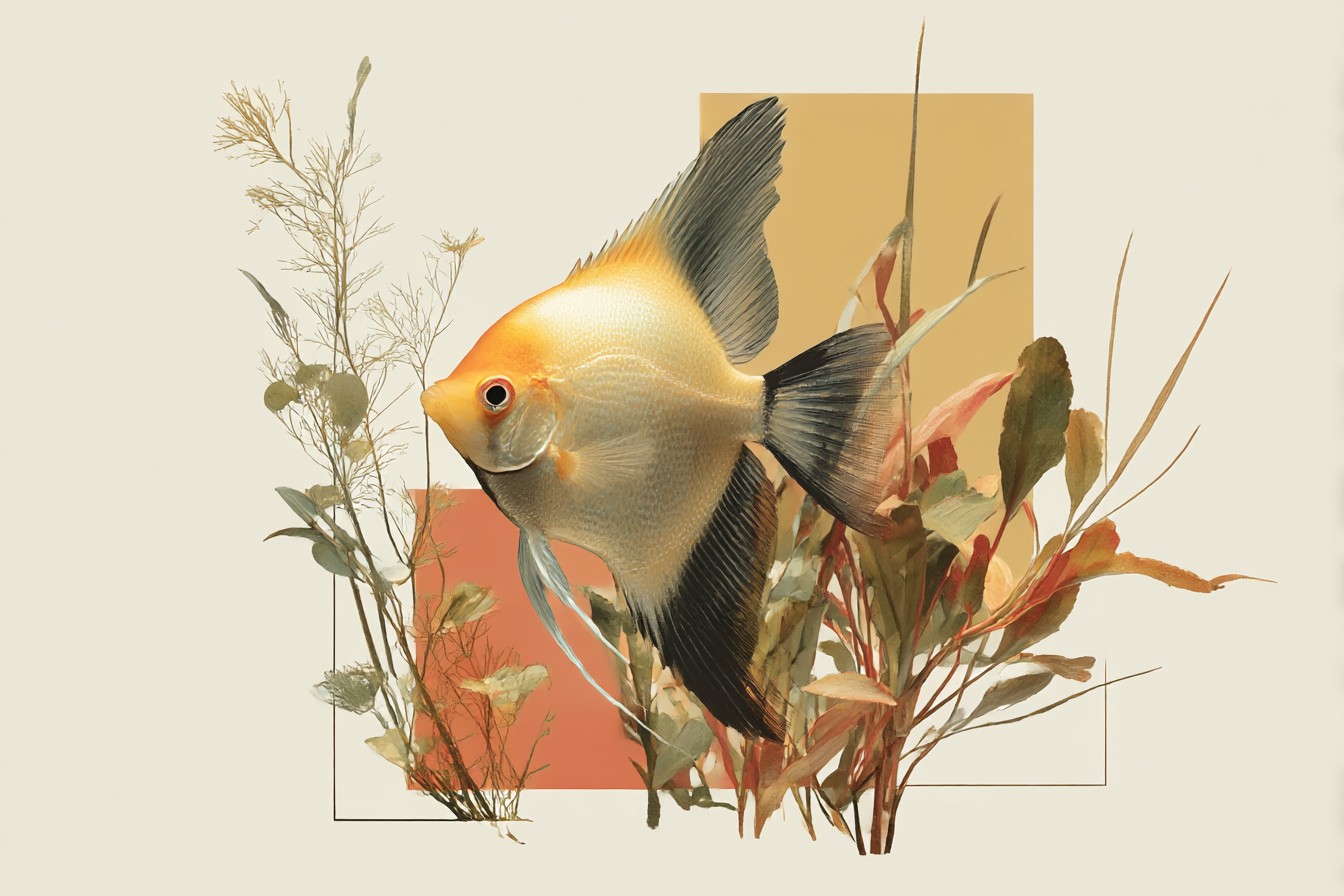
# Angelfish in a Planted Aquarium and Which Plants They Won’t Destroy Keeping angelfish with live plants isn’t just about creating a prettier tank. It’s about understanding why these tall, elegant cichlids behave the way they do around vegetation and how to work with their natural tendencies rather than against them. After eighteen months of trial and considerable error with my own planted angelfish setup, I can tell you that the common wisdom about angels demolishing every plant in sight is only half true.
They’re selective destroyers, and once you understand their preferences, you can build a thriving planted tank that both you and your angels will enjoy for years. The key lies in recognising that angelfish aren’t just randomly destructive. They’re following specific behavioural patterns that evolved in their natural Amazon habitat, where they navigate through dense vegetation, claim territories, and forage for food.
When they uproot your expensive Cryptocoryne or shred your carefully positioned stem plants, they’re not being spiteful. They’re being angelfish.

The solution isn’t to give up on plants entirely but to choose the right ones and position them thoughtfully. ## Understanding Angelfish Behaviour in Planted Systems **Territorial Marking and Plant Interaction** Angelfish establish territories through physical interaction with their environment, which includes plants (Seriously Fish).
Adult angels can reach 6 inches in body length and up to 8 inches in height, making them substantial fish that naturally impact their surroundings (Seriously Fish). This size means they’re capable of moving or damaging plants that smaller fish would simply swim around. In their native waters, angels navigate through submerged tree branches and dense aquatic vegetation.
They’ve evolved to push through obstacles rather than always swim around them. In our tanks, this translates to angels testing the stability of plants, particularly those positioned in what they consider prime territory. **Foraging Patterns and Root Disturbance** Angels are natural foragers who sift through substrate and probe among plant roots looking for food. This behaviour becomes more pronounced when they’re underfed or bored, but even well-fed angels will investigate plant bases as part of their normal routine.
Plants with shallow root systems or those that aren’t fully established become casualties of this natural behaviour. **Breeding Behaviour Impact** When angelfish pair and prepare to spawn, their interaction with plants intensifies dramatically. They’ll clean potential spawning sites, which often means removing or relocating plants they consider unsuitable. A breeding pair will redesign significant portions of their territory, and delicate or poorly anchored plants rarely survive this process.
The pH range angels prefer, 6.5 to 7.5, actually suits most aquarium plants well (The Aquarium Expert). Their temperature preference of 76°F to 82°F also aligns with tropical plant requirements (The Aquarium Expert). The hardness range of 3 to 15 dGH gives you flexibility with both soft-water and moderate-hardness plant species (The Aquarium Expert).
The water parameters aren’t the problem; the fish behaviour is. ## Selecting Angel-Resistant Plants **Anubias Species: The Reliable Foundation** Anubias varieties are the backbone of any angelfish planted tank. Their thick, leathery leaves resist casual nibbling, and their robust rhizome system makes them nearly impossible for angels to uproot accidentally. I’ve watched my angels investigate Anubias barteri thoroughly, nudging the leaves and exploring around the roots, but they’ve never damaged them.
The key with Anubias is proper attachment. Tie them to driftwood or rocks using fishing line or cotton thread. Never bury the rhizome in substrate, as this will cause rot regardless of fish interference.
Anubias grows slowly, which some aquascapers see as a limitation, but this actually works in your favour with angels since rapid growth can trigger their plant-moving instincts. **Java Fern Varieties: Vertical Interest Without Risk** Java fern and its cultivars (narrow leaf, Windelov, trident) provide excellent vertical structure that complements angelfish body shape. Like Anubias, Java ferns attach to hardscape rather than rooting in substrate, making them immune to angel excavation activities. The slightly bitter taste of Java fern leaves deters most fish from nibbling, and the tough leaf structure withstands casual contact from swimming angels.
Position Java ferns on the back and sides of your tank to create depth without cluttering the swimming space angels need. **Cryptocoryne: The Gamble That Often Pays Off** Here’s where experience matters more than theory. Cryptocoryne species get a mixed reputation with angels, and I understand why. Young or recently planted Crypts are vulnerable because their root systems haven’t established properly.
Angels investigating the substrate can easily dislodge them. However, well-established Cryptocoryne with mature root systems are remarkably resilient. Crypt wendtii, in particular, develops such extensive roots after six months that even determined angel excavation rarely dislodges it.
The trick is patience. Plant your Crypts and accept that some may get moved initially. Those that survive the first few months typically remain stable long-term. **Amazon Sword: Size Matching** Echinodorus species, particularly larger Amazon swords, work well with angels because they match the fish’s scale.
A mature Amazon sword can grow large enough that even adult angels treat it as a permanent fixture rather than something to investigate or move. The challenge with Amazon swords is their nutrient requirements. They’re heavy feeders that need root tabs and good substrate fertility.
If you’re not prepared to maintain them properly, they’ll decline regardless of fish interference, and struggling plants are more likely to be investigated by curious angels. ## Tank Setup Strategies for Success **Spatial Planning and Territory Management** The minimum tank size for a single angelfish is 29 gallons (Aquifarm), but this doesn’t account for territorial behaviour in planted setups. Angels need visual barriers and defined spaces, particularly if you’re keeping multiple individuals. A typical 29-gallon tall tank measures 30 inches long by 18 inches high (Aquifarm), which provides adequate height for adult angels but limited horizontal swimming space.
For planted setups, I’d recommend going larger if possible. The suggested minimum aquarium size of 100 x 40 x 50 cm provides much better space for both fish comfort and plant placement (Seriously Fish). Plan your plant placement around angelfish territorial needs.
Create distinct zones using taller plants as dividers. Angels are less likely to disturb plants that clearly define territorial boundaries than those placed randomly throughout the tank. **Substrate Considerations** Angels will investigate and sift through substrate, so your plant choices need to account for this. Fine sand works well because it doesn’t create clouds when disturbed, but it provides limited nutrition for root-feeding plants.
If you choose sand, you’ll need to rely heavily on root tabs for plant nutrition. Planted tank substrates like aquasoil provide better plant nutrition but can become messy when angels dig. A compromise approach uses a layer of nutritious substrate capped with sand.
You Might Also Like
This gives plants access to nutrients while minimising mess from angel foraging behaviour. **Hardscape Integration** Use driftwood and rocks extensively in angelfish planted tanks. Hardscape serves multiple functions: attachment points for epiphytic plants, territorial markers for fish, and physical barriers that protect substrate-rooted plants from excessive disturbance. Position larger pieces of driftwood to create caves and overhangs where angels can establish territories without constant visual contact with tank mates.
This reduces stress and the resulting destructive behaviour that stressed angels often exhibit. ## Common Mistakes That Lead to Plant Destruction
Mistake #1: Choosing delicate, fast-growing stem plants. Rotala, Ludwigia, and similar species are beautiful but completely wrong for angelfish tanks. Angels will uproot them during normal swimming and foraging activities. Even if the plants survive initially, they rarely establish properly under constant disturbance.
Stick to robust species with strong attachment systems.
Mistake #2: Insufficient plant establishment time. Newly planted tanks are disasters waiting to happen with angels. Plants need at least 4-6 weeks to develop proper root systems before they can withstand angel investigation. Many aquascapers add fish too quickly and then blame the angels when plants get uprooted during the first week.
Mistake #3: Poor hardscape planning. Tanks without adequate driftwood or rock work force angels to interact with plants as territorial markers.
When plants become the primary environmental features, angels will rearrange them according to their territorial needs. Always provide non-living hardscape as the main structural elements.
Mistake #4: Overcrowding and stress responses. Small groups are rarely recommended under 55 gallons for good reason (Purple Aquatics). Stressed or overcrowded angels become more destructive, not just toward plants but toward each other.
Proper stocking densities reduce plant damage significantly.
Mistake #5: Ignoring breeding behaviour. Angels preparing to spawn become incredibly active in rearranging their environment. If you see a pair forming, expect significant plant disruption. Many aquascapers don’t plan for this and lose months of careful plant growth when their angels decide to breed.
## Research Support Multiple studies confirm that angelfish environmental interactions increase with territory establishment and breeding preparation.
Their foraging behaviour, documented in both wild and captive populations, shows consistent patterns of substrate investigation and plant interaction (Seriously Fish). Temperature preferences align closely with tropical plant requirements, with native water temperatures ranging from 26°C to 30°C (75°F to 86°F) (Wikipedia), supporting the viability of planted tank systems. Maximum documented length of 15 cm demonstrates the substantial size these fish achieve (FishBase), explaining their capacity for environmental modification through physical interaction with tank contents. ## Broader Application **Cichlid Planted Tanks:** Similar principles apply to other medium-sized Central and South American cichlids.
Robust plant selection and hardscape integration work for most species that exhibit territorial behaviour without excessive aggression. **Community Planted Systems:** Angels in community setups often show less plant disturbance due to the presence of other fish that modify territorial behaviour. However, plant selection principles remain the same. **Breeding Setups:** Dedicated breeding tanks require minimal planting focused on spawning site provision rather than aesthetic goals. Java fern and Anubias on driftwood provide surfaces without competing for space. **Small Tank Applications:** In minimum-sized tanks (29 gallons), focus on 2-3 robust plant species rather than attempting diverse plantings.
Limited space intensifies territorial behaviour and plant interaction. ## Benefits Summary **Improved Water Quality:** Established plants in angelfish tanks provide natural nitrate reduction and pH buffering, reducing maintenance frequency and improving fish health over the 8-12 week establishment period. **Natural Behaviour Expression:** Well-designed planted environments allow angels to exhibit natural territorial and foraging behaviours without destructive outcomes, reducing stress indicators within 4-6 weeks of proper setup. **Aesthetic Appeal:** Successfully planted angelfish tanks create stunning visual displays that highlight the fish’s natural grace while providing environmental enrichment that improves coloration and activity levels. **Breeding Success:** Established plants provide security and spawning sites that increase breeding success rates while reducing aggression between pairs and toward other tank inhabitants. **Long-term Stability:** Properly selected plants create stable environmental conditions that mature over 6-12 months, requiring less intervention than bare tanks while providing natural biological filtration. **Educational Value:** Observing angelfish interaction with different plant species provides insights into fish behaviour and natural habitat requirements, improving overall aquarium management skills. ## Step-by-Step Implementation Guide **Phase 1: Foundation Setup (Weeks 1-2)** Start with hardscape placement using substantial pieces of driftwood and rocks to create territorial boundaries. This forms the backbone of your angelfish environment before any plants or fish are added. Establish substrate system appropriate for your chosen plants.
For mixed planting, use aquasoil capped with fine sand, or sand with root tab planning for heavy feeders like Amazon swords. **Budget Breakdown:** * Quality driftwood pieces (2-3 large): £25-40 * Rock work (dragon stone or similar): £15-25 * Substrate (aquasoil + sand): £30-45 **Total Budget: £70-110** **Phase 2: Plant Establishment (Weeks 3-6)** Add robust plant species starting with Anubias and Java fern attached to hardscape.

These provide immediate structure and begin biological filtration establishment without substrate disturbance risks. Plant any substrate-rooted species (Crypts, Amazon swords) with proper root protection and fertilization.
Allow minimum 4 weeks for root establishment before adding fish. **Budget Breakdown:** * Anubias varieties (4-5 plants): £30-50 * Java fern species (3-4 plants): £20-35 * Root-feeding plants: £25-40 * Root tabs and fertilizers: £15-25 **Total Budget: £90-150** **Phase 3: Fish Introduction and Monitoring (Weeks 7-10)** Introduce angels gradually, starting with single specimens to assess plant interaction before adding additional fish. Monitor plant disturbance patterns and relocate vulnerable species if necessary. Adjust feeding schedule and territory management based on observed behaviour.
Well-fed angels with defined territories show minimal plant disturbance. **Budget Breakdown:** * Quality angelfish (1-2 specimens): £15-30 * Appropriate foods: £10-15 **Total Budget: £25-45** **Phase 4: System Maturation (Weeks 11-16)** Fine-tune plant placement based on established territorial patterns. Add additional specimens if space and behaviour permit, maintaining awareness of territorial dynamics. Implement long-term maintenance routine focusing on plant health and growth management rather than frequent rearrangement that disrupts established patterns. **Budget Breakdown:** * Additional plants or replacements: £20-35 * Maintenance supplies: £15-25 **Total Budget: £35-60** The reality of keeping angelfish with plants isn’t about finding some magical combination that prevents all plant interaction.
It’s about understanding what drives their behaviour and working with it rather than against it. Choose plants that can handle some disturbance, give them time to establish properly, and create an environment where angels can express natural behaviours without destroying everything you’ve carefully planted. The result is a tank that’s both beautiful and genuinely functional for the fish living in it.


