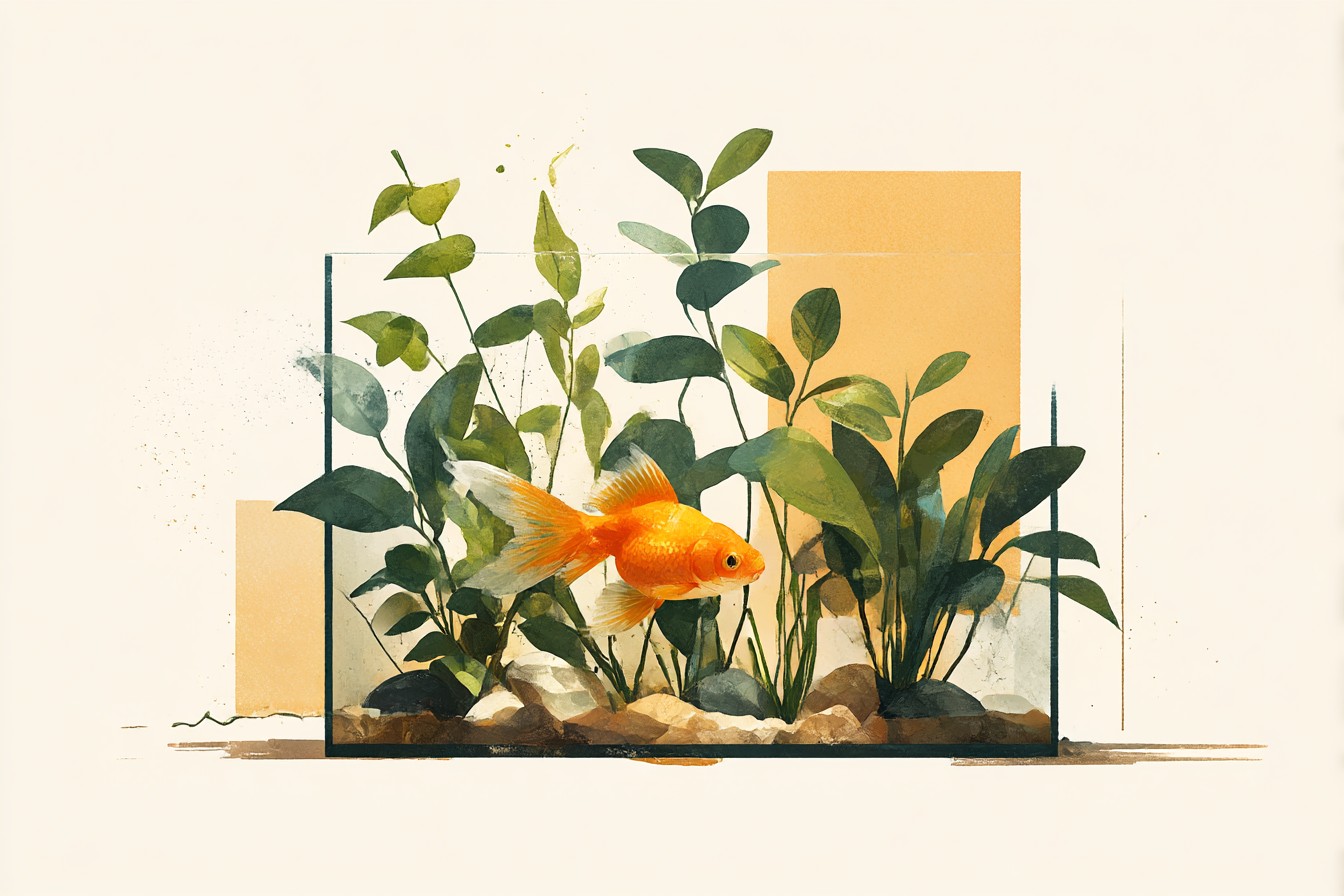
# Goldfish Planted Aquarium and the Plants That Survive Being Constantly Eaten The conventional wisdom says goldfish and live plants don’t mix. Goldfish are notorious plant destroyers, apparently incapable of leaving anything green alone long enough for it to establish. Walk into most aquatic shops and mention goldfish with planted tanks, and you’ll get that look.
The one that says you clearly don’t understand what goldfish do to plants. I used to believe this completely. My first goldfish tank was a sterile glass box with plastic decorations and artificial plants that looked exactly like what they were.
But after four years of keeping planted tanks, I started wondering if the problem wasn’t goldfish being impossible, but people choosing the wrong plants and giving up too quickly. Turns out there are plants that not only survive goldfish attention but actually thrive in their company.

The trick is understanding which ones work and why, then setting everything up properly from the start.
The difference between success and watching expensive plants disappear overnight comes down to choosing species that either grow faster than goldfish can eat them, taste awful enough that goldfish ignore them, or are physically too tough to destroy. Get this right, and you end up with a planted goldfish tank that stays green and healthy. Get it wrong, and you’ll be replanting every few weeks until you give up entirely. ## The Science Behind Plant Survival in Goldfish Tanks Understanding why some plants survive goldfish requires looking at both plant defence mechanisms and goldfish behaviour patterns.
Successful goldfish plants autumn into three categories based on how they avoid destruction. **Physical Protection**: Plants like Java fern and Anubias have evolved tough, leathery leaves that are difficult for goldfish to tear apart. These species developed in environments with high herbivore pressure, so their cell walls are reinforced with lignin and other structural compounds that make them unpalatable and mechanically difficult to consume. The texture alone deters most goldfish from persistent nibbling (Times of India). **Growth Rate Advantage**: Fast-growing plants like hornwort can outpace goldfish consumption.
These species put energy into rapid cell division and biomass production rather than defensive compounds. Even if goldfish nibble constantly, the plant grows faster than it’s being eaten. Hornwort specifically has adapted to fluctuating herbivore pressure by maintaining growth rates that can double its biomass weekly under good conditions (Times of India). **Chemical Defence**: Some aquatic plants produce compounds that taste bitter or cause mild digestive upset in fish.
While not toxic, these secondary metabolites make the plants less appealing than available fish food or softer plant alternatives. This is why goldfish will often ignore established Java moss while demolishing fresh lettuce leaves added to the same tank. **Temperature Considerations**: Most aquarium plants flourish at 72°F to 82°F (The Aquarium Expert), which overlaps perfectly with goldfish preferences. This temperature range supports active plant metabolism while keeping goldfish comfortable, creating conditions where robust plant growth can compete with herbivore pressure.
The key insight is that goldfish aren’t indiscriminate plant destroyers. They’re opportunistic omnivores that eat what’s easiest and most nutritious. If you provide plants that are tough, fast-growing, or taste unpleasant, while ensuring they’re well-established before introducing goldfish, success becomes much more likely. ## Champion Plants That Actually Work The plants that consistently succeed in goldfish tanks share specific characteristics that make them either unpalatable, indestructible, or fast enough to outgrow constant nibbling. **Java Fern (Microsorum pteropus)**: This is probably the most reliable plant for goldfish tanks.
Java fern thrives without soil and requires minimal maintenance (Times of India). The leaves are thick and leathery with a bitter taste that most goldfish find unappealing. Even persistent nibblers usually give up after a few attempts.
Java fern attaches to rocks or driftwood rather than rooting in substrate, which protects it from goldfish that dig constantly. In my experience, established Java fern in a goldfish tank will show occasional bite marks on older leaves but continues growing steadily. Budget around £8-12 for a decent sized specimen that will spread into multiple plants over 6-8 months. **Anubias Species**: Multiple sources identify Anubias as hardy and beginner-friendly (Times of India), and it’s specifically recommended for goldfish tanks (Voyo Pets).
Anubias leaves are even tougher than Java fern, with a waxy coating that goldfish dislike. The plant grows slowly but steadily, and established specimens are virtually indestructible. Anubias nana is the best variety for smaller goldfish tanks, while Anubias barteri works well in larger setups.
Like Java fern, it attaches to hardscape rather than rooting in substrate. Expect to pay £6-10 per plant, with growth slow enough that it takes 4-6 months to double in size. **Hornwort (Ceratophyllum demersum)**: This floating plant receives consistently high ratings, including 8.5 out of 10 for goldfish compatibility (Modest Fish). Hornwort’s survival strategy is pure growth speed – it can grow several inches per week under good lighting.
Even goldfish that nibble constantly can’t keep up with healthy hornwort growth. It also provides excellent filtration, absorbing ammonia and nitrates that goldfish produce in quantity. The downside is that hornwort sheds needles constantly, requiring regular cleanup.
Budget £4-6 for starter portions that will fill a tank within 2-3 months if left unchecked. **Java Moss (Vesicularia dubyana)**: Listed among core freshwater aquarium plants (Aquatics World), Java moss works in goldfish tanks because of its growth pattern. Individual strands are tiny and replaceable, so even heavy grazing doesn’t kill the colony. The moss grows in dense mats that are difficult for goldfish to uproot entirely.
It’s particularly useful tied to driftwood or rocks where it can establish securely. Once established, Java moss spreads rapidly and provides cover for beneficial bacteria. Expect to pay £5-8 for enough moss to cover a decent area, with full establishment taking 8-12 weeks. **Amazon Sword (Echinodorus species)**: Recommended alongside other hardy species (Voyo Pets), Amazon swords succeed through size and root strength.
Mature swords are simply too large for goldfish to damage significantly. The leaves are tough enough to resist casual nibbling, and the extensive root system anchors them against goldfish digging. Young Amazon swords are vulnerable, so buy established plants or protect juveniles until they reach maturity.
Budget £8-15 for a plant large enough to withstand goldfish attention immediately. These plants work because they’ve been tested by countless aquarists dealing with plant-eating goldfish. They’re not theoretical choices based on plant characteristics alone – they’re proven survivors. ## Common Mistakes That Guarantee Plant Destruction
Mistake #1: Adding delicate plants expecting them to toughen up. Plants like Cabomba, Vallisneria, and most stem plants are fundamentally incompatible with goldfish regardless of establishment time or tank conditions.
Their soft leaves and stems are exactly what goldfish prefer to eat. No amount of patience will make these species viable in goldfish tanks – you’re just feeding expensive salad to your fish.
Mistake #2: Introducing plants to an existing goldfish tank without protection. Even tough plants need establishment time before they can withstand constant attention. Adding new plants directly to a tank with hungry goldfish means they’ll be investigated, nibbled, and often destroyed before they can develop proper root systems or defensive growth patterns.
Always quarantine and establish plants separately first, or use plant weights and guards during the vulnerable establishment period.
You Might Also Like
Mistake #3: Underestimating goldfish digging behaviour. Goldfish are natural bottom-feeders that dig constantly, searching for food in substrate. Plants rooted in gravel or sand get uprooted repeatedly, regardless of species hardiness. This is why epiphytic plants that attach to hardscape work so much better than rooted varieties.
If you want rooted plants, they need deep substrate and heavy root weights, plus time to establish extensive root systems before goldfish are introduced.
Mistake #4: Choosing plants based on appearance rather than goldfish compatibility. The plants that look best in aquascaping magazines are usually the ones that goldfish will destroy fastest. Bright green, soft, fast-growing stem plants are goldfish candy. Success requires prioritising survival characteristics over aesthetic preferences, at least initially.
You can add more decorative species once you understand what works in your specific setup.
Mistake #5: Inadequate lighting for plant growth speed. Plants that survive goldfish grazing do so by outgrowing the damage or being too tough to damage significantly. Poor lighting slows growth rates and weakens plant tissues, making even hardy species vulnerable. Goldfish tanks need stronger lighting than fish-only setups to support plant growth rates that can compete with herbivore pressure.
Mistake #6: Expecting immediate results without proper preparation. Planted goldfish tanks require 3-4 months minimum to reach stable equilibrium where plants are established enough to withstand constant goldfish attention.
Rushing this process by adding fish too early or expecting rapid visual results leads to frustration and plant losses that could have been avoided with more realistic timeline expectations.
## Research Evidence for Plant-Goldfish Compatibility Multiple independent sources consistently identify the same core species as goldfish-compatible, providing convergent evidence for their reliability. Java fern, Anubias, and hornwort appear across all expert recommendations (Modest Fish), (Aquarium Genius), (Voyo Pets). This consistency across different sources and aquarist experiences suggests these plants genuinely work rather than being theoretical recommendations.
The temperature compatibility data supports plant success rates. With most aquarium plants flourishing at 72°F to 82°F (The Aquarium Expert), and goldfish comfortable in the same range, environmental conditions aren’t limiting plant growth or fish behaviour in ways that would explain compatibility issues. Expert sources specifically highlight Java fern and Anubias as beginner-friendly species (Aquifarm), which aligns with their success in goldfish tanks.
Plants that tolerate beginner mistakes in water chemistry and lighting are more likely to establish successfully despite goldfish pressure. ## Adapting Plant Choices to Different Goldfish Setups **Small Fancy Goldfish Tanks (40-80 litres)**: Focus on Anubias nana, Java moss, and small Java fern specimens. Fancy goldfish are less aggressive diggers and have smaller mouths, making them less destructive to established plants. Hornwort works well as a floating plant that doesn’t compete for bottom space. **Large Goldfish Tanks (200+ litres)**: Amazon swords become viable due to space for extensive root development.
Multiple Java fern specimens can create forest effects. Hornwort can be allowed to grow more extensively without overwhelming the tank. Consider Anubias barteri for dramatic size contrast. **Outdoor Goldfish Ponds**: Temperature fluctuations limit tropical plant options to summer months.
Focus on temperate species like hornwort that can handle seasonal temperature swings. Established marginal plants around pond edges provide similar benefits to aquarium plants. **Goldfish Breeding Setups**: Hornwort is particularly valuable as breeding material and fry protection (Times of India). Java moss provides spawning surfaces and fry shelter.
Avoid slow-growing plants that might harbour disease in breeding tanks requiring frequent cleaning. **Common Goldfish Tanks**: Common goldfish are more aggressive diggers and larger, requiring tougher plant choices. Stick to large Java ferns and established Anubias specimens. Amazon swords work better with common goldfish than fancy varieties due to size compatibility. ## Key Benefits of Successfully Planted Goldfish Tanks **Improved Water Quality**: Live plants absorb ammonia and nitrates that goldfish produce heavily, reducing water change frequency and maintaining more stable water chemistry.
Established hornwort and Java moss particularly excel at nutrient uptake, often eliminating measurable nitrate readings within 4-6 weeks of establishment. **Natural Behaviour Encouragement**: Goldfish in planted tanks exhibit more natural foraging and exploration behaviours. They spend time investigating plant surfaces for food particles and microorganisms, reducing stress-related behaviours like glass surfing or aggressive territory disputes. **Biological Filtration Enhancement**: Plant roots and surfaces provide massive surface area for beneficial bacteria colonisation, improving biological filtration beyond what mechanical filters alone can achieve. This is particularly valuable in goldfish tanks where high bioload challenges standard filtration. **Oxygen Production During Photosynthesis**: Healthy plants produce oxygen during light periods, supporting goldfish that have high oxygen demands due to their active metabolism and preference for cooler water with lower dissolved oxygen capacity. **Algae Competition**: Established plants outcompete algae for nutrients, particularly nitrates and phosphates that fuel algae blooms common in goldfish tanks.
This reduces cleaning maintenance and keeps viewing panels clearer for longer periods. **Cost Savings Over Time**: While initial plant investment requires £30-50 for a basic setup, successful plants propagate naturally, eliminating ongoing decoration costs. Improved water quality also reduces medication needs and fish losses from water chemistry problems. ## Step-by-Step Implementation for Goldfish Plant Success **Step 1: Tank Setup Without Fish (Weeks 1-2)** Establish proper lighting, substrate, and hardscape before adding any plants or fish. Install LED lighting capable of 30-40 PAR at substrate level for good plant growth.
If using rooted plants, add 5-7cm depth of plant-specific substrate topped with goldfish-safe gravel to prevent digging access to nutrient-rich layers. **Budget Breakdown:** * LED lighting system: £40-80 * Plant substrate: £15-25 * Hardscape (rocks/wood): £20-35 **Total Budget: £75-140** **Step 2: Plant Establishment (Weeks 3-6)** Add hardy plants and allow full establishment before introducing goldfish. Attach Java fern and Anubias to hardscape using cotton thread or plant glue. Add hornwort as floating plants, and establish Java moss on prepared surfaces.
Monitor growth rates and adjust lighting/fertilisation as needed. **Budget Breakdown:** * Java fern specimens (2-3): £16-24 * Anubias plants (2-3): £12-18 * Hornwort starter bundles: £8-12 * Java moss portions: £10-15 **Total Budget: £46-69** **Step 3: Initial Goldfish Introduction (Weeks 7-8)** Introduce goldfish gradually to established planted tank.

Start with smaller specimens or less aggressive varieties if possible. Monitor plant damage closely and remove any plants showing severe damage before they die and affect water quality.
Feed goldfish adequately to reduce plant browsing pressure. Well-fed goldfish are less likely to view plants as primary food sources. **Budget Breakdown:** * Goldfish specimens: £15-30 * High-quality goldfish food: £10-15 **Total Budget: £25-45** **Step 4: System Optimisation (Weeks 9-16)** Fine-tune lighting, feeding, and plant management based on observed goldfish behaviour and plant growth rates. Add additional plant specimens as space allows and budget permits.
Establish regular maintenance routines that support both plant growth and goldfish health. **Budget Breakdown:** * Additional plants (optional): £20-40 * Plant fertilisers: £10-20 **Total Budget: £30-60** **Step 5: Long-term Maintenance (Months 4+)** Maintain established balance through regular pruning, appropriate feeding, and water parameter monitoring. Propagate successful plants to expand coverage or replace any specimens that don’t adapt well to your specific goldfish behaviour patterns. **Budget Breakdown:** * Ongoing fertiliser/supplies: £5-10/month * Replacement plants (occasional): £10-20/year **Total Budget: £70-140/year** The complete setup requires £176-314 initial investment, with ongoing costs of £70-140 annually. This compares favourably to artificial decoration replacement costs while providing genuine biological benefits that plastic plants cannot match.
Success with goldfish and live plants isn’t about finding magic species that goldfish won’t touch. It’s about understanding which plants can handle goldfish behaviour and setting up conditions where those plants can thrive despite constant attention. Get the right plants established properly, and you’ll have a planted goldfish tank that stays green and healthy long-term.
Rush the process or choose incompatible species, and you’ll be back to plastic plants within a month wondering why everyone said it was impossible.


