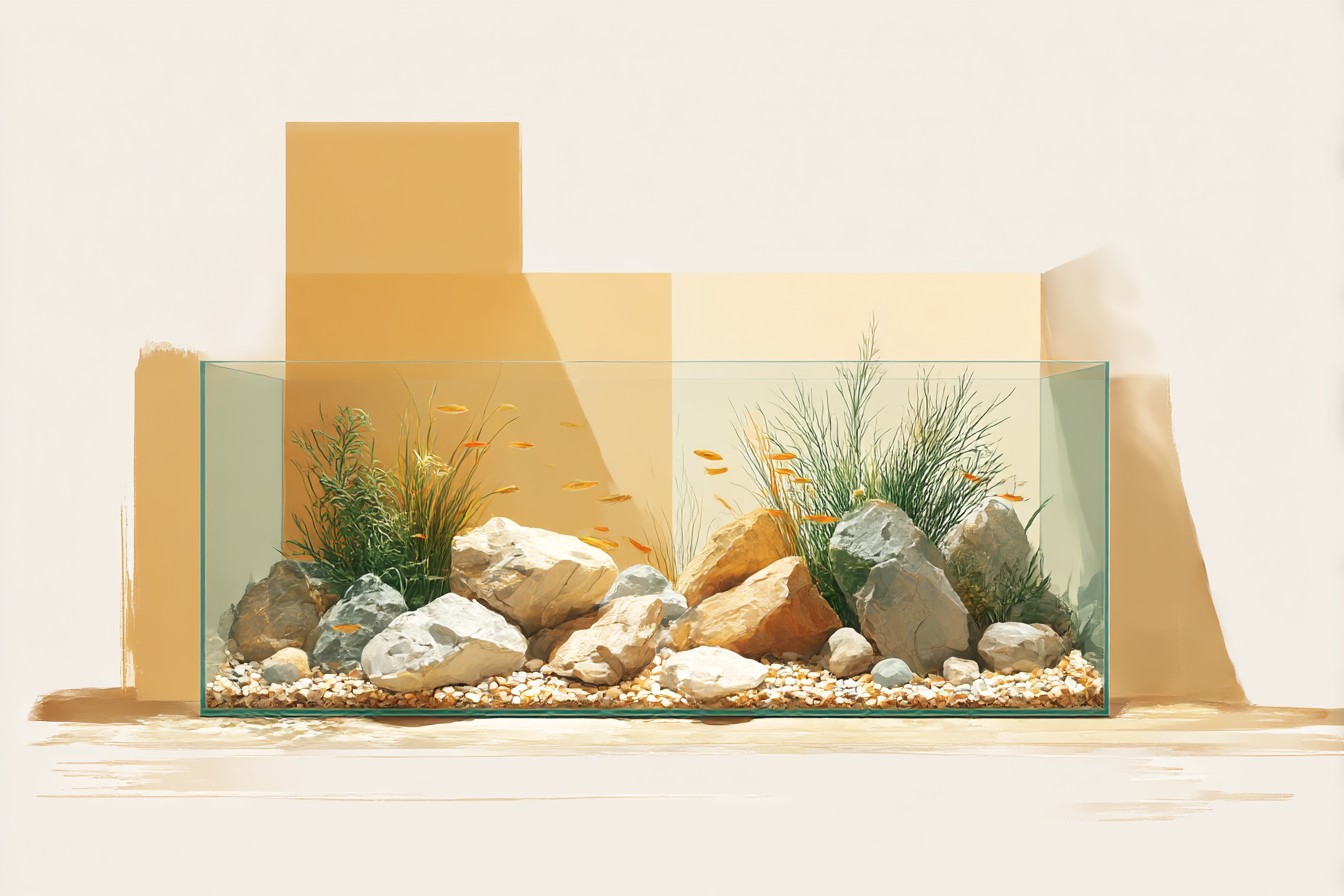
# Hardscape Only Tank and the Fishkeeping Trend That Skips Plants Entirely There’s a quiet revolution happening in aquascaping, and it involves removing what many consider the heart of a planted tank entirely. Hardscape only setups are gaining ground among aquarists who want the visual impact of a thoughtfully designed aquarium without the complexity, cost, or maintenance demands that live plants bring. These tanks strip aquascaping back to its structural bones, relying purely on rock, wood, and substrate to create environments that can be every bit as striking as their planted counterparts.
The appeal makes sense when you dig into what planted tanks actually demand. CO2 injection systems, high intensity lighting, liquid fertilisers, regular pruning schedules, and the constant balancing act between nutrients and light that keeps algae at bay. Strip all that away and you’re left with something fundamentally different, a tank focused entirely on fish behaviour and geological beauty rather than botanical complexity.
The artificial decor market accounts for 35 percent of aquarium accessories sales (IBISWorld), suggesting that plenty of aquarists are choosing structure over vegetation. For newcomers intimidated by the learning curve of planted tanks, or experienced keepers who’ve grown tired of the maintenance routine, hardscape only setups offer a different path entirely.
They’re not a compromise or a stepping stone to planted tanks.
They’re a legitimate approach with their own aesthetic principles and practical advantages. ## The Science Behind Plant Free Systems Understanding why hardscape only tanks work requires looking at what plants actually do in an aquarium ecosystem and how their absence changes the biological dynamics. In planted systems, vegetation serves multiple functions beyond aesthetics. Plants consume nitrates, produce oxygen during photosynthesis, provide surface area for beneficial bacteria, and help stabilise pH through their interaction with CO2 levels. **Nitrogen Cycle Dynamics**: Without plants to consume nitrates as fertiliser, hardscape only tanks rely entirely on water changes and biological filtration to manage waste products.
This actually simplifies the nitrogen cycle significantly, removing the complex interactions between plant nutrition and fish waste processing that can destabilise planted systems. Rock based aquariums require stable biological filtration (Practical Fishkeeping), meaning the filter media becomes even more critical for maintaining water quality. **Oxygen Production**: Plants contribute oxygen during their photosynthetic period but consume it during dark hours. Hardscape only tanks eliminate this day night fluctuation entirely, relying on mechanical aeration and surface agitation for consistent petrol exchange.
This creates more predictable dissolved oxygen levels, particularly beneficial for fish species with higher oxygen demands. **pH Stability**: The relationship between CO2, KH, and pH becomes much simpler without plants consuming and releasing carbon dioxide throughout the photoperiod. pH swings that can stress fish in poorly balanced planted tanks are largely eliminated, though this also means losing the natural pH buffering that established plant growth provides. **Biological Surface Area**: While plants provide substantial surface area for beneficial bacteria colonisation, well designed hardscape can achieve similar results through porous rock structures and complex surface textures. The key difference is that hardscape provides this surface area consistently, without the periodic disruption that comes from plant trimming or removal. ## Primary Implementation Approaches The foundation of any successful hardscape only tank lies in understanding how to create visual interest and biological function using only inorganic materials. This requires a completely different design philosophy from planted aquascaping, one that emphasises form, texture, and negative space rather than growth patterns and colour variation. **Rock Selection and Arrangement**: The choice of primary hardscape material fundamentally shapes both the visual impact and the biological function of the tank.
Dragon stone provides excellent texture and natural caves for fish territories, while remaining chemically inert in most water conditions. Seiryu stone offers dramatic vertical possibilities but will raise pH and hardness over time, making it ideal for African cichlid setups that benefit from higher mineral content. Yorkshire stone and slate provide neutral options that won’t alter water chemistry, crucial for soft water fish or when you need precise control over parameters.
The key principle is selecting rock that matches your intended fish community’s requirements rather than just aesthetic preferences. African cichlid tanks often feature plant free rock layouts (LiveAquaria) specifically because these fish appreciate the mineral content and territorial structure that extensive rockwork provides. **Structural Stability and Flow**: Creating dramatic rock structures requires understanding both engineering principles and water flow dynamics. Stacked stone should be secured to prevent collapse (Green Aqua), using aquarium safe silicone or mechanical interlocking rather than hoping gravity alone will maintain complex arrangements.
Rock structures must allow adequate water circulation (Marine Depot), avoiding dead zones where waste can accumulate and anaerobic conditions develop. This means designing with flow patterns in mind, creating channels and gaps that encourage water movement rather than solid barriers that block circulation. **Substrate Considerations**: The substrate choice in hardscape only tanks serves different functions than in planted systems. Rather than providing root nutrition and anchoring for plants, substrate becomes purely about aesthetics, biological filtration, and fish behaviour.
Bare bottom tanks simplify waste removal (The Spruce Pets), making them popular for high bioload setups or quarantine systems where maintenance efficiency matters more than natural appearance. Sand substrates work well for bottom dwelling species and create clean visual lines, while larger gravels provide more biological surface area but require more thorough cleaning. The key is matching substrate choice to both fish behaviour and maintenance preferences rather than plant root requirements. **Lighting Strategy**: Hardscape only setups reduce lighting demands significantly (Aquarium Co Op), eliminating the need for high PAR values and specific spectrum requirements that plants demand.
This opens up possibilities for dramatic accent lighting, LED strips that highlight rock textures, or simple functional lighting that prioritises fish visibility over photosynthetic support. Without the risk of triggering algae blooms through excess light and nutrients, you can use lighting purely as a design tool, creating shadows and highlighting the three dimensional structure of your hardscape. ## Common Implementation Mistakes
Mistake #1: Underestimating biological filtration needs. Without plants to process nitrates, hardscape only tanks need robust biological filtration to handle the full nitrogen cycle load. Many aquarists assume they can get away with smaller filters since there are no plant roots to work around, but the opposite is true.
You need more biological media capacity, not less, and the filter becomes your primary tool for maintaining water quality rather than a supplement to plant based processing.
Mistake #2: Creating dead zones with solid rock walls. Impressive looking cliff faces and solid stone barriers look dramatic but create areas where water doesn’t circulate properly. Waste accumulates, anaerobic bacteria develop, and you end up with hydrogen sulfide production and localised water quality problems. Every rock structure needs to allow water flow, even if that means sacrificing some visual impact for biological function.
Mistake #3: Choosing rocks that alter water chemistry without planning. Limestone, coral rock, and many marine substrates will raise pH and hardness continuously.
This is perfect if you’re keeping fish that appreciate these conditions, but disaster if you’re trying to maintain soft, acidic water for species like discus or cardinal tetras. Test any rock with vinegar before adding it to your tank. If it fizzes, it will affect your water parameters.
You Might Also Like
Mistake #4: Inadequate structural planning leading to collapses. Rock avalanches in established tanks are traumatic for fish and potentially deadly if they damage equipment or trap livestock.
Plan your structure on paper first, use adequate support points, and secure heavy pieces rather than relying on friction alone. It’s much easier to rebuild a structure during initial setup than to repair it after a collapse with fish in residence.
Mistake #5: Overlooking the lack of natural pH buffering. Established plants help buffer pH swings through their CO2 consumption patterns. Without this natural buffering, hardscape only tanks can experience more significant pH shifts from biological processes, water changes, or equipment failures.
Monitor pH more closely than you might in planted systems and consider additional buffering if you’re keeping sensitive species.
Mistake #6: Assuming lower maintenance requirements. While hardscape only tanks eliminate plant trimming, fertilising, and CO2 management, they often require more frequent water changes to manage nitrates and more thorough substrate cleaning since there’s no plant root system to break down organic waste. The maintenance is different, not necessarily easier.
## Research Support Studies examining plant free aquarium systems consistently show that successful hardscape only tanks require more robust mechanical and biological filtration to compensate for the absence of plant based nutrient processing. The biological load capacity of these systems depends entirely on filter efficiency and water change frequency, making equipment selection more critical than in planted systems where vegetation provides additional processing capacity.
Research into minimalist aquascaping principles demonstrates that visual impact in hardscape only systems relies heavily on proportion, negative space, and lighting rather than the colour and texture variation that plants provide. Minimalist aquascapes emphasise structure over vegetation (Aquascaping Love), requiring different design skills but achieving distinct aesthetic results that many aquarists find more architecturally satisfying than botanical layouts. Water chemistry stability in plant free systems shows different patterns from planted tanks, with more predictable parameters but less natural buffering capacity, requiring more active management of pH and mineral content through water selection and filtration media choices. ## Application Across Different Systems **Marine Fish Only Systems**: Decor only aquariums are common in marine fish only systems (Reef2Reef), where live rock provides both biological filtration and visual structure without the complexity of coral propagation.
These systems demonstrate how hardscape only approaches can create complex, thriving ecosystems focused entirely on fish behaviour and geological beauty. **African Cichlid Tanks**: Rock dominant layouts suit the territorial nature of many African cichlid species while providing the mineral content these fish require. The alkaline conditions created by limestone and coral rock actually benefit these fish rather than creating water chemistry problems. **Quarantine and Medical Systems**: Bare bottom or minimal hardscape setups prioritise easy cleaning and medication compatibility over aesthetics, proving that functional hardscape only systems serve important practical purposes beyond visual design. **Nano Shrimp Systems**: Simple stone or wood arrangements in small tanks can showcase shrimp behaviour without the maintenance demands of carpeting plants or the risk of plant die offs destabilising water chemistry in limited water volumes. **Species Specific Biotopes**: Many natural fish habitats are plant sparse or plant free, making hardscape only tanks more biotopically accurate for species from rocky streams, cave systems, or seasonal pools where vegetation is minimal. ## Benefits Summary **Predictable Water Chemistry**: Without the daily fluctuations in CO2, oxygen, and nutrients that plants create, hardscape only tanks maintain more stable parameters once established. pH swings are minimised, and the biological processes become more predictable and manageable. **Reduced Equipment Costs**: Hardscape only setups reduce CO2 system costs (Aquarium Gardens) entirely, along with the expense of high intensity lighting, fertiliser dosing systems, and plant specific supplements. Initial setup costs focus on quality filtration and hardscape materials rather than botanical support systems. **Lower Ongoing Maintenance**: No plant trimming schedules, no fertiliser dosing routines, no CO2 monitoring, and no concerns about plant health affecting tank stability.
Water changes and filter maintenance become the primary routine tasks, simplifying the maintenance schedule significantly. **Enhanced Fish Focus**: Without plants competing for visual attention, fish behaviour becomes the primary dynamic element in the tank. Territorial interactions, schooling patterns, and feeding behaviours become more prominent and easier to observe. **Flexibility for Sensitive Species**: Fish that are sensitive to plant fertilisers, CO2 fluctuations, or specific water parameters can thrive in hardscape only systems where their exact requirements can be met without compromise for plant needs. **Design Longevity**: Rock and wood structures don’t grow, die, or require replacement like plants do. Once established, the visual design remains stable indefinitely, requiring only cleaning rather than ongoing plant management to maintain its appearance. ## Phased Implementation Guide **Phase 1: Planning and Material Selection (Weeks 1-2)** Begin by researching your intended fish community’s specific requirements for water chemistry, territorial needs, and swimming space.
Select hardscape materials that complement rather than conflict with these requirements. Purchase rock or wood in quantities 10-15% above your initial estimate, as you’ll need extra pieces for structural support and visual balance. Test all rock materials with white vinegar to cheque for carbonate content.
Plan your structure on paper or using digital tools, considering both visual composition and water flow patterns. Budget for quality biological filtration media, as your filter will handle the entire nitrogen processing load without plant assistance. **Budget Breakdown:** * Primary rock or wood materials: £40-80 * Additional structural pieces: £15-25 * Filter media upgrades: £20-35 * Testing supplies: £10-15 **Total Phase 1 Budget: £85-155** **Phase 2: Structure Building and Cycling (Weeks 3-8)** Build your hardscape with particular attention to stability and flow. Use aquarium safe silicone for securing large pieces, and ensure every structure has adequate water circulation.
Begin the nitrogen cycle process with increased biological media capacity to compensate for the absence of plant based processing.
Monitor ammonia and nitrite levels every two days during weeks three to six, as hardscape only tanks may take slightly longer to establish stable biological filtration without plant assistance. Test pH and hardness weekly to understand how your chosen materials affect water chemistry. **Budget Breakdown:** * Aquarium safe silicone: £8-12 * Additional biological media: £15-25 * Water testing supplies: £15-20 * Initial fish food for cycling: £5-10 **Total Phase 2 Budget: £43-67** **Phase 3: Fish Introduction and Fine Tuning (Weeks 9-12)** Introduce fish gradually, starting with hardy species that match your water parameters.
Monitor waste accumulation more closely than in planted systems, as there’s no plant uptake to process excess nutrients. Adjust feeding quantities based on waste production rather than plant growth demands. Fine tune lighting for fish viewing and aesthetic impact rather than photosynthetic requirements.
This is when you’ll discover whether your biological filtration capacity matches your fish load, requiring adjustments if necessary. **Budget Breakdown:** * Initial fish stock: £30-80 * Lighting adjustments: £20-40 * Additional filtration if needed: £25-50 **Total Phase 3 Budget: £75-170** **Phase 4: Long Term Optimisation (Months 4-6)** Establish maintenance routines focused on water changes and substrate cleaning rather than plant management. Monitor nitrate accumulation to determine optimal water change frequency. Consider adding automated systems like programmable feeders or water change systems if the simplified setup inspires you to maintain multiple hardscape only tanks. **Budget Breakdown:** * Maintenance equipment upgrades: £25-60 * Water change automation: £40-100 * Additional tanks if expanding: £60-150 **Total Phase 4 Budget: £125-310** The beauty of hardscape only tanks lies in their structural honesty.
They don’t try to replicate nature’s botanical complexity, instead focusing on the geological foundations that shape aquatic environments. For those who find peace in clean lines, architectural forms, and the pure behaviour of fish without botanical distraction, these systems offer a completely different but equally valid approach to aquascaping. They’re not a step backward from planted tanks, they’re a step sideways into a different aesthetic philosophy entirely.


