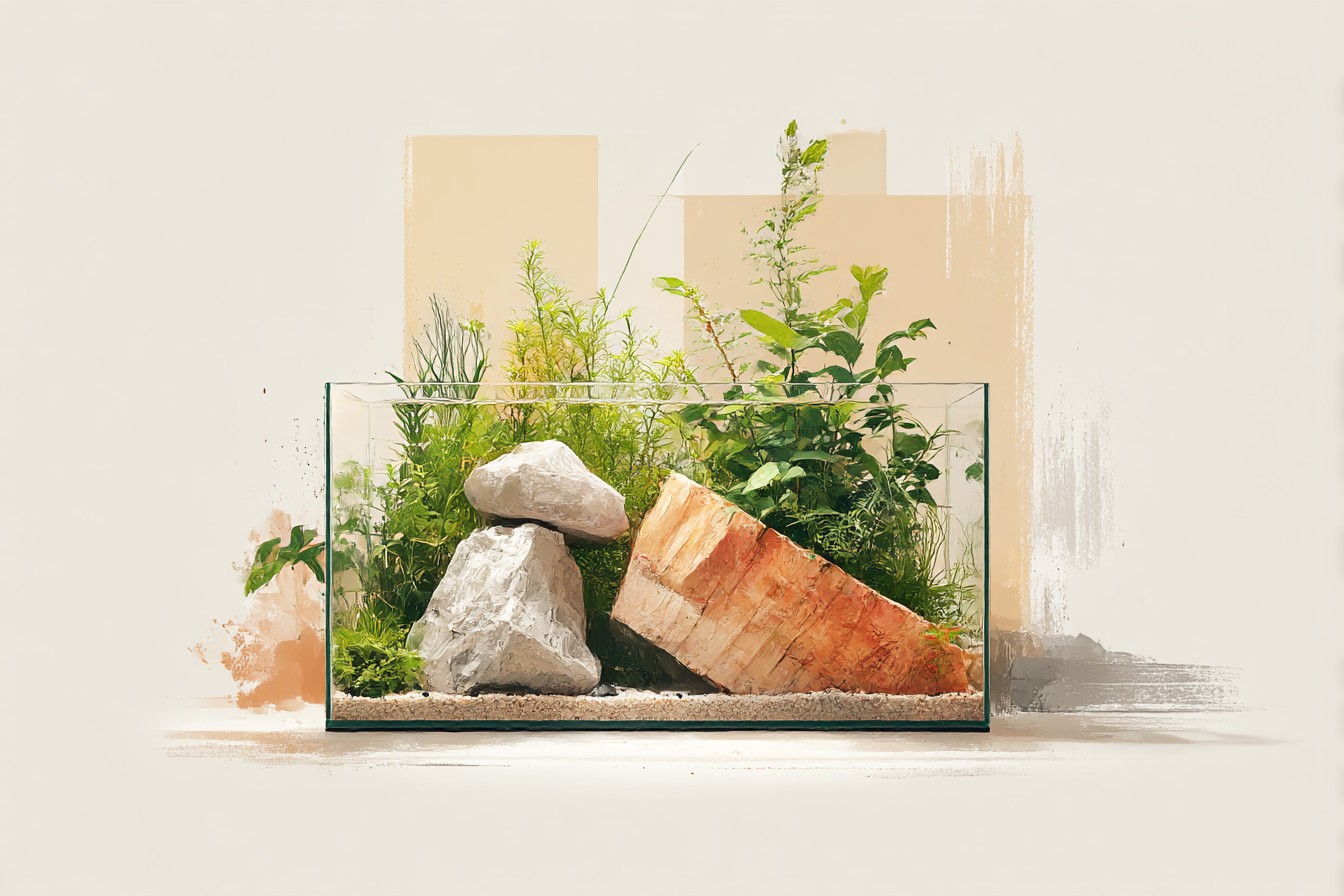
Few things make or break a planted aquarium like your hardscape design. Nothing screams “this isn’t a natural habitat” quite like poor planning and haphazard placement of rocks and driftwood. Fortunately, you can avoid having your aquarium look like the rocks and wood were simply thrown in by learning about how hardscape and plants interact.
Hardscape serves purposes beyond just looking pretty and giving you places to attach plants. Once water and substrate are added, hardscape determines how water flows through your aquarium, whether your fish have territories and hiding areas they need to feel secure, and how your plants can attach and where they have room to grow. Without proper planning your aquarium will experience stagnation problems and stressed fish that can’t find hiding areas, plants won’t attach well or stay put, and algae will be a constant battle.
Likewise, your plants won’t look their best or establish well without sufficient hardscape to work with. Sure, you can have a tank that’s all substrate and plants, but it won’t hold up over the long term.
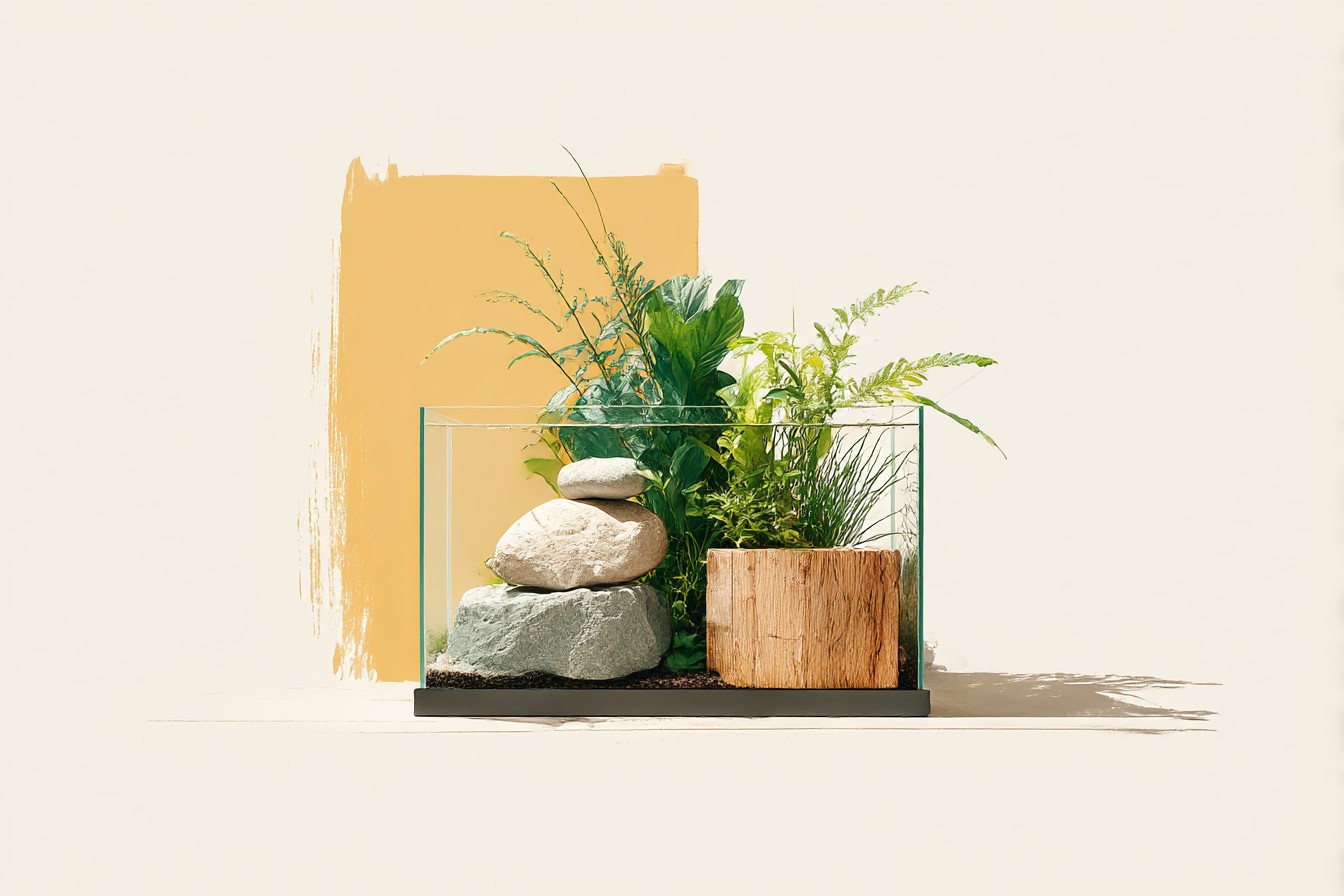
Plants need physical structures to attach to where there’s no substrate, and your fish need places to hide.
You’ve likely seen tanks that people claim to have had for years, but everything looks perfectly manicured and the aquarist bragged about how they didn’t add hardscape because “plants are the stars of my show”. Trust me, we know those tanks don’t look natural. Plants aren’t the stars of your aquarium – a healthy, natural environment is.
It’s more than “add some rocks and driftwood to your aquarium”. Hardscape needs to be properly placed by creating balance and flow, as well as enhancing your plants. The size of the aquarium affects how much hardscape you need as well.
This guide will go through the best practices for hardscape placement based on research into what makes aquascapes aesthetically pleasing. ## Relationship Between Structure and Floristry **Correct balance**: Research has shown that proper layouts have hardscape occupying about 60 percent of the visual mass (Green Aqua). This doesn’t mean literal volume, but rather how much visual presence your rocks and wood have in comparison to your plants. This will change a bit as your plants grow in, but if you have enough plants they should fill out within two to three months.
Starting with too much plant mass means you’ll quickly become overcrowded as everything grows in. **Appropriate flow**: Hardscape placement affects how water flows through your tank. You want your rocks and wood to create gentle flow patterns that bring nutrients to your plants’ roots without stagnating detritus in certain spots. In larger tanks flow can become an issue with fertilizer never reaching the back corners because water flows straight to your filter. **Water parameters**: While most hardscape won’t affect water parameters, it can.
Wood releases tannins which will lower pH over time, and some rocks contain calcium carbonate that will raise pH and KH. Choose your hardscape based on the plants you want, not in spite of it. **Plant attachment points**: Not all of your plants can be planted in substrate – some need to attach to rocks and driftwood. Plan your hardscape placement based not only on how it looks, but also on where your plants will go. **Fish need space too**: While aquascaping contests don’t take into account how your fish behave in the tank (Aquatic Gardeners Association), your fish still require territories and hiding areas that are delineated by your hardscape.
If your fish don’t feel secure because they can’t hide then they become stressed, which leads to immune system suppression and eventually tank-wide disease. ## The Foundation: Three Zone Approach There are three distinct zones in every aquascape: foreground, midground, and background. Your hardscape needs to be placed properly in each zone to support your plants and create natural balance. **Foreground**: Your foreground should draw the viewer into the rest of the aquascape. To do this you only want one or two small pieces of hardscape that act as anchors for the foregound plants while also creating subtle texture so the foreground isn’t completely flat.
A common technique is to utilise the rule of thirds when positioning your foreground elements. Imagine dividing your front glass into thirds both horizontally and vertically. You want to position your elements where those thirds meet rather than the centre of the tank.
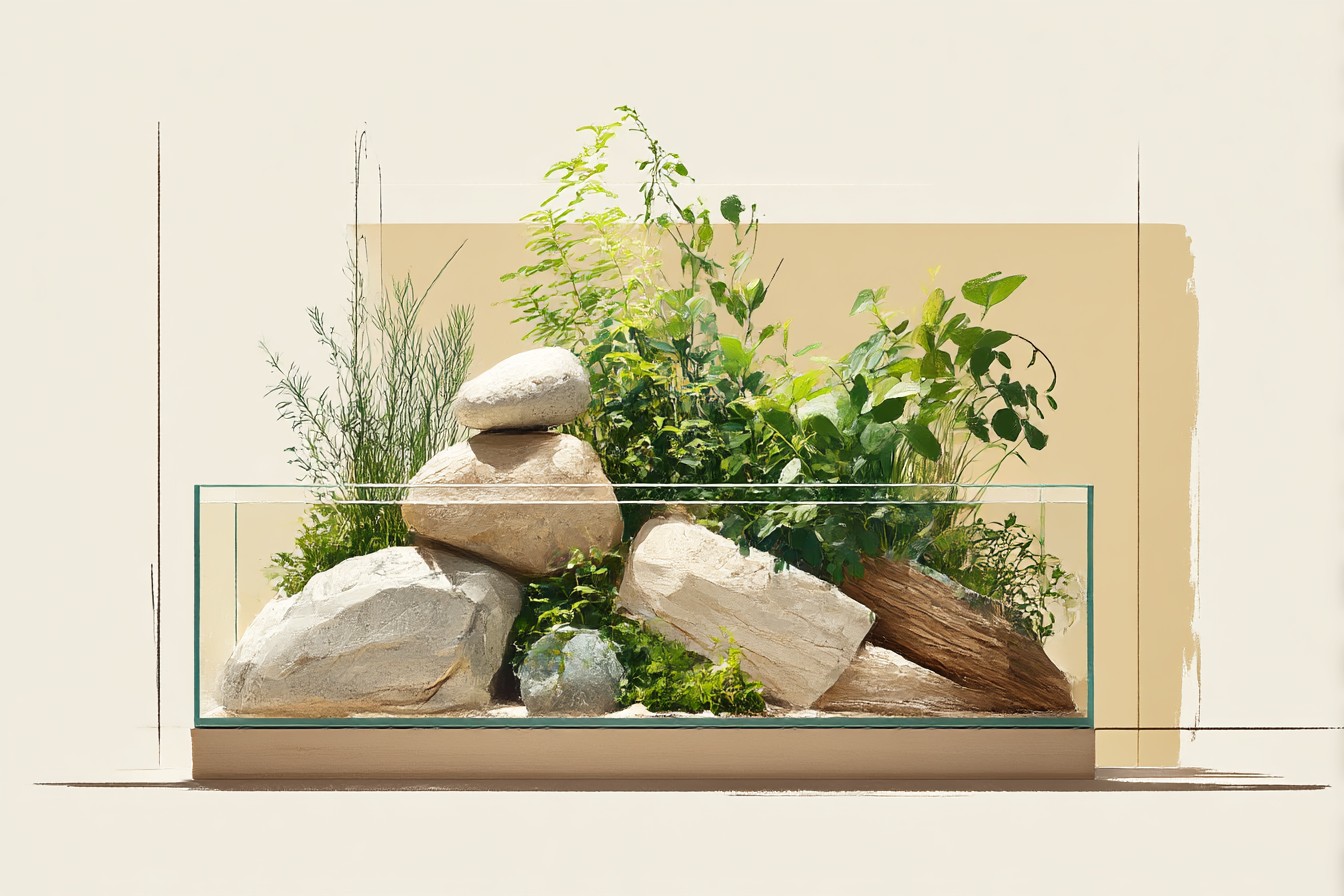
Your foreground hardscape should leave room for carpeting plants, and only take up about a third of the height of your background hardscape. Foreground, midground, and background planting creates depth and interest (Aquascaping Love), and your hardscape placement needs to create that transition rather than block it. **Midground**: The midground is typically where you want your focal point and largest hardscape elements to be. Your largest stones, wood, or other elements should create a focal point while balancing with your background elements.
Leave enough room between your largest elements that water can flow through when positioning midground hardscape. Avoid straight lines running horizontally, vertically, or diagonally through the tank unless that’s your specific intent. Position your hardscape off centre using odd numbers of elements.
People tend to feel more comfortable with odd numbers rather than even. When setting up your midground hardscape leave enough room between elements that water can flow through and plants can grow into the empty space. **Background**: Background hardscape is typically used to hide equipment, but also adds depth and anchors the back wall of the aquarium. For many tanks, the back wall is what draws your eye away from the tank.
Break up the flat expanse of the back wall with some tasteful background hardscape. Background elements are typically the largest since they’ll be mostly hidden by plant growth as your aquarium matures. Use your background placement to hide filter intakes, co2 reactors, or other equipment that you’d prefer not to see.
Just make sure you can get to it when needed without having to rearrange your entire aquascape. Position your background hardscape elements to enhance your aquascape, not detract from it. ## Avoid These Hardscape Pitfalls
Pitfall #1: Symmetry. Nothing in nature is symmetrical. Having both sides of your aquarium be exactly the same is dull and unnatural looking.
Position your aquascaping hardscape off-centre and use odd numbers of pieces for more natural appeal.
Pitfall #2: Improper scale. Hardscape that is too large or too small for your aquarium ruins the natural feel of an aquascape. As a rule of thumb, your largest aquascape element should be no larger than one-third to one-half of the height of your aquarium.
Small pea gravel in a 200 litre aquarium looks stupid, no matter how well you aquascape it. Bulky river rocks in a 10 gallon is no better.
Pitfall #3: Disregarding plant growth habits. Plants will grow. No matter how well you plan your aquascape plant placement, things will get crowded or you’ll notice odd gaps within a few months if you don’t account for how your plants will grow.
Fast growing stem plants like Micranthemum Montgomerie need more space around them than slow growing Anubias Nangi will. Carpeting plants will spread around your hardscape, leave enough space for them to establish.
Pitfall #4: Difficulty maintaining. If your aquascape design doesn’t allow you to easily trim plants, prune hardscape elements, clean substrate, or access equipment you’ll grow to hate maintaining it. Plan your aquascape so you can easily reach any part of the aquarium with aquascaping tools and suck up debris.
If you can’t accomplish this task without completely rearranging your aquascape every time you clean your tank, you’ve done it wrong.
Pitfall #5: Incompatible hardscape. Limestone is used in many aquarium rocks to make them smooth and crack-free. Limestone contains calcium carbonate, which increases pH and KH. If you add limestone rocks to your aquarium you’ll notice your water parameters slowly climb over time.
You Might Also Like
Not all plants do well in higher pH and hardness, so either choose your rocks based on your plants or choose plants that work with your hardscape. To cheque if your rocks contain limestone add them to a mild acid like vinegar. Fizzing indicates they’ll affect your water parameters.
Pitfall #6: Poor wood preparation. Using driftwood that hasn’t been properly cleaned will lead to months of off-gassing tannins into your aquarium, and potential rot and bacterial blooms.
Wood should always be scrubbed, soaked, and preferably boiled before use. Even driftwood sold as “already boiled and ready to use” benefits from a good cleaning and overnight soak.
## Research into Aquascape Design Research into successful aquascaping has shown that Nature style aquascapes combine stone, wood and plants (ADA Global) in certain proportions and arrange them following principles learned from traditional japanese garden aesthetics and landscape photography rules of composition. Symmetrical compositions are found less appealing in research on aquatic display aesthetics. (FUNAOKA, et.al) Analysis of the top finishers from aquascaping contests found that placements of stone, wood and plants affect perceived balance and flow (LANGE, et.al).
These aquascapes were judged most attractive when they drew your eye through the entire tank rather than sections, and created multiple points of interest that changed as plants grew in. Another study on Nature style aquariums found that when compared to aquaria that plants were only added to substrate, root development and overall plant growth was significantly better in tanks when hardscape was used to influence flow creating optimal plant placement.“>(TAKANO et.al) ## All Styles of Aquariums These principles can be applied to any size or style of aquarium. **Nano (Under 40 Litres)**: You really only have room for one focal point piece of hardscape. One dragon stone or large piece of branching wood can provide enough structure and interest without overwhelming your nano aquarium.
You’ll also need to be very careful about plant placement since the wrong plant selection can overrun your small aquarium in weeks rather than months. Nano doesn’t mean no-plants, it means carefully planned plants. **Community Tanks (80-200 Litres)**: This is the sweet spot for aquascaping. You have enough room to create distinct foreground, midground, and background elements while choosing hardscape that complements your plant choices.
Using enough hardscape prevents plants from being easily uprooted by fish (PetMD), which is important if you keep more aggressive species. **Large Tanks (300+ Litres)**: Don’t think you need to limit your aquascaping creativity just because you have a fish tank. Large aquariums can handle much more substantial hardscape elements while still being properly proportioned. You can create entire underwater caves systems if you want, just be sure the design doesn’t overwhelm the fish that live in it.
Large tanks also allow you to use larger plants that would look out of place or overcrowd a small aquarium. **Iwagumi**: Stone only aquascapes that follow strict rules of placement using very few plant species, usually just carpeting plants. Stone selection and placement is critical for these aquascapes since you don’t have wood to fill in gaps or soften the overall look. **Dutch Style**: Minimal hardscape used only to terrace your plant layout and provide subtle structure. All focus is placed on plants. ## Hardscape Benefits **Improved plant growth**: Hardscape allows you to position plants based on how water flows through your aquarium.
Mosses and java ferns attach directly to hardscape, allowing for faster root development and growth compared to being planted in substrate. Having hardscape for plants to attach to also creates defined planting areas that help rooted plants maintain their position when disturbed. **Stable water parameters**: Properly placed hardscape creates natural flow patterns that eliminate dead zones and circulating nutrients to your plants. Proper circulation also prevents detritus from building up in corners or on hardscape elements. **Reduce fish stress**: Fish like established territories and hiding areas that are outlined by your aquarium’s hardscape.
Lower stress levels in fish lead to healthier immune systems which equates to fewer disease issues. Many of the medications we use can harm or kill plants, so an ounce of prevention in the form of properly placed hardscape is your best defence against tortured fish. **Easier maintenance**: When you take the time to position your hardscape properly you know exactly where every plant should go and can easily reach all areas of your aquarium with aquascaping tools. Nothing is more frustrating than plants that can’t be reached to trim or clean because they’re laid out randomly. **A long-lasting aquarium**: Hardscape doesn’t move, which means once you establish your plants they should look great for years to come.
A well thought out aquascape evolves naturally as your plants grow, rather than looking overcrowded or completely change after a few months. **Equipment Integration**: Hardscape can be used to hide equipment such as filter intakes, heaters, or CO2 reactors. By strategically placing your hardscape you can hide necessary equipment without making your aquarium look “dead” or “stuffed” with decorations. ## How to Setup Perfect Hardscape Every Time **Step 1 – Planning and material acquisition (1 week)** Before you go out and buy aquarium rocks and driftwood you should have a plan. Look at your aquarium and lighting setup, then research what kind of aquascape you want.
From there you can determine how large your aquascape elements should be based on the size of your aquarium. Once you have a general idea you can go out and pick up material. Keep in mind certain wood species will discolor the water or affect parameters.
Wood should always be cleaned prior to use. Even driftwood sold as “already boiled and ready to use” should be scrubbed clean and soaked for several days. Dragons stone or similar can be found at most big box pet stores, but you may have to order manzanita or redmoor online.
Spend the extra money and get real wood and stones rather than plastic decorations meant to look like rocks. Budget: * Dragon stone or similar: £15-£40 (Depends on how much you need for your size tank) * Manzanita or Redmoor Driftwood: £20-£50 (Depends on how much wood you’ll need) * Brush to clean wood and stones: £2-3 * White vinegar to test stones: £1-3 Estimated cost £38-£96 **Step 2 – Dry layout and photography (1-2 weeks)** Position your aquarium hardscape in the empty tank before adding water or substrate. Take photos of your layout from multiple angles.
Adjust the position of elements until you are happy with how they look. Liquid when added to the aquarium will rise about a half inch, so make sure you leave that much space between elements and the top of your tank. Don’t be afraid to move things around until you get it right.
This is the hardest part of the process and takes the longest. Once you add water and substrate you don’t want to have to move things around. * Create several different layouts and photograph each. * Cheque that you can easily access all areas for maintenance. * Make sure your equipment can be easily hidden. * Position hardscape to create defined planting areas. **Step 3 – Add substrate and water (2nd week)** Add your substrate around your hardscape creating depth where you’d like it. Slowly add water to your aquarium being careful not to dislodge your layout.
It’s normal for your hardscape to shift a little when you add water. If you substrate washes out from behind your rocks or driftwood tips repeatedly move your layout and start over. Things to look for: * Sand washing out from behind hardscape * Driftwood shifting and changing position. * Excessive tannin release from wood. **Step 4 – Planting and establishment period (3rd – 8th week)** Add your plants how you intended to when you did your dry layout.
You may find as you plant that you need to move things around slightly, but don’t stress over it. Start with slow growing java ferns and anubias that you tie to your hardscape. Next add your rooted plants to create midground structure.
Last add stem plants that can be adjusted later. Plant growth will be minimal during this period as your taking gets established. Adding CO2 will dramatically improve plant growth rates during this phase (Aquarium Co Op).
Budget: * Moss, java fern, anubias, and liverwort: £25-£50 * Carpeting plants: £20-£40 * Stem plants: £15-£30 * Initial fertilizers: £15-£25 Estimated cost £75-£145 **Step 5 – Growth maintenance (8th week onward)** About a month after planting you can expect to see some growth.
Trim your stem plants now to keep them in cheque. Stem plants require regular trimming to stay neat(Buce Plant), usually every other week once they’ve started growing.
You may find as plants grow that you need to move things around, but don’t be afraid to do so. Learn from your mistakes! Most people run their lights 6-8 hours a day (LiveAquaria).
Depending on how your plants respond you can adjust up or down. Observe how your aquarium looks after a few weeks and change if necessary. You should have an established aquarium within 12-16 weeks if parameters are where they should be.
Your aquascaped aquarium is a living thing that grows and changes over time. By understanding the relationship between your hardscape and plant selections you set your aquarium up for success rather than guessing and hoping things grow the way you want them to. It takes more effort upfront to aquarium than buying a five gallon bucket, but the rewards are worth the effort.