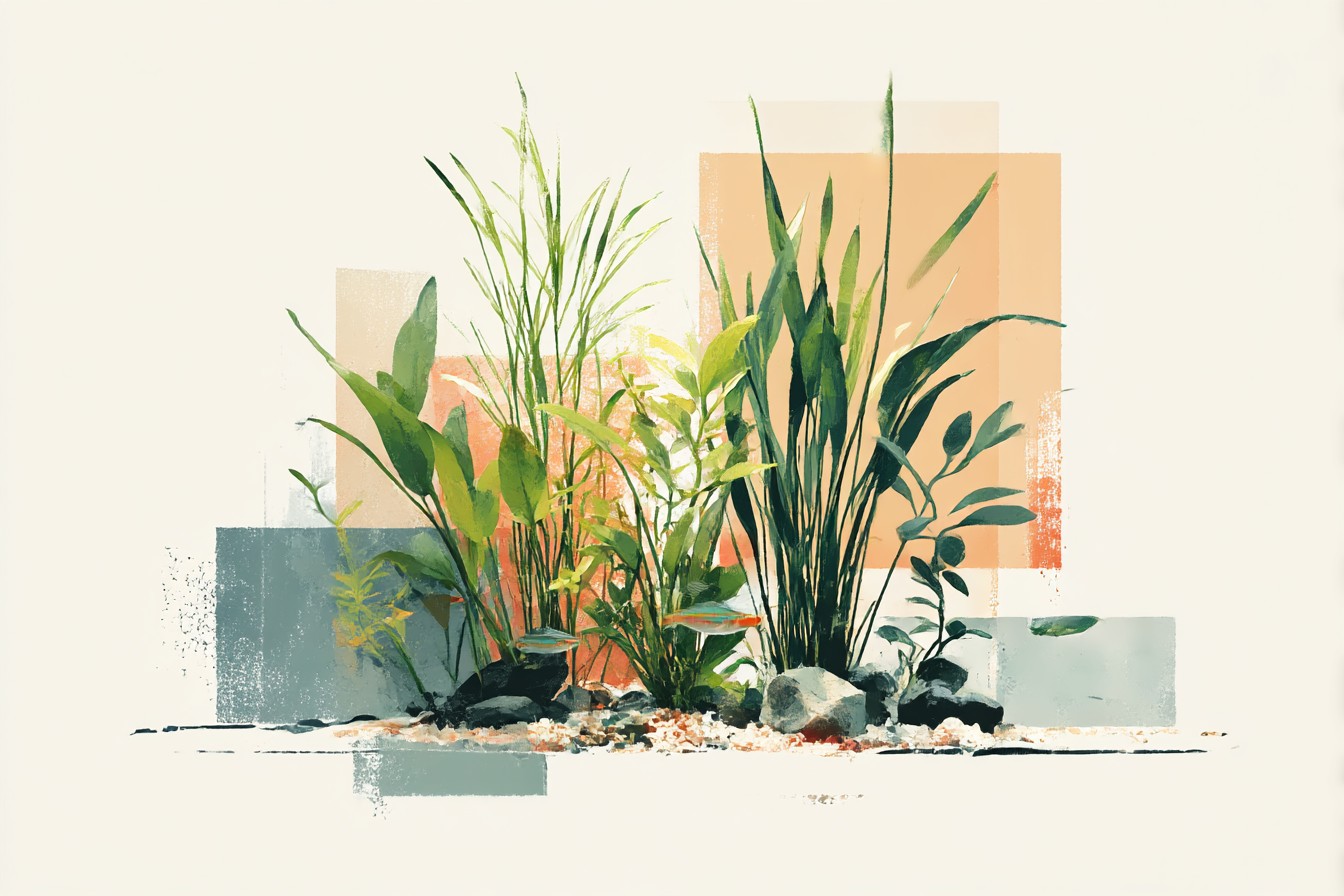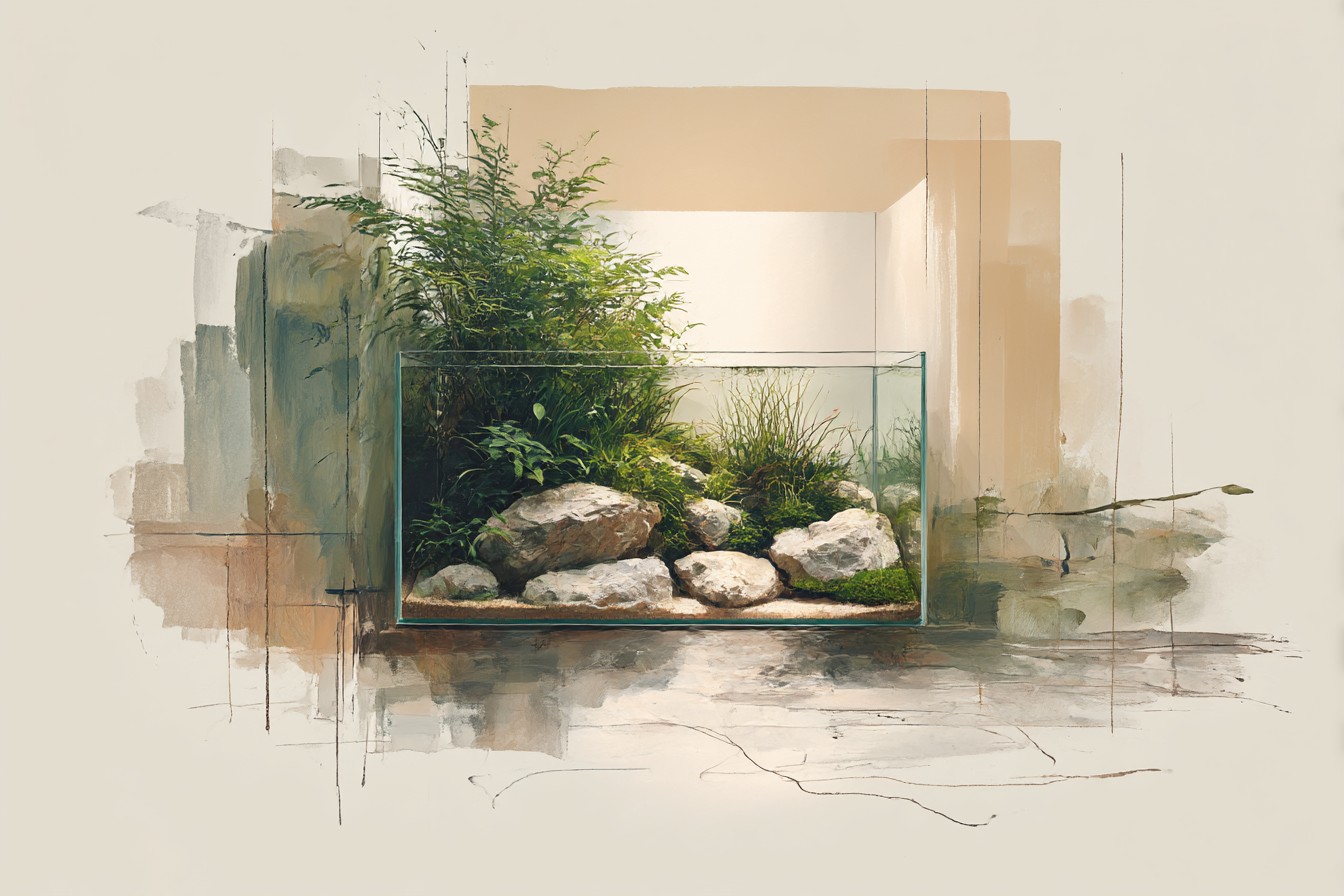
Walk into any halfway decent aquatics shop and you’ll find tanks labelled as “Nature Style” or “Amano Style” that have no business wearing that name. To complete ignoramuses, they will often appear to have achieved the Nature look by throwing in some stone carpet plants, and sticking driftwood and rocks around without much of a plan. The “Nature Style” they’ve achieved is little more than what you’d see in the lobby of some heartless corporate office building.
The style of aquarium that Takashi Amano developed and called Nature Aquarium, however, is much more than something that you can duplicate by following steps in a book or magazine. Nature Aquarium is an entire philosophy surrounding how to bring natural beauty into an aquarium, and when you learn what Nature Aquarium *actually* is, it completely changes the way you build aquascapes. I learned this the expensive way.
For about a year and a half, I thought I was creating Nature Aquariums. The stones were perfect golden ratio placements of aquascaping perfection, the carpets were pristine and flowed like water, and not a single strand of algae dared show itself in these ponds of sterile perfection.
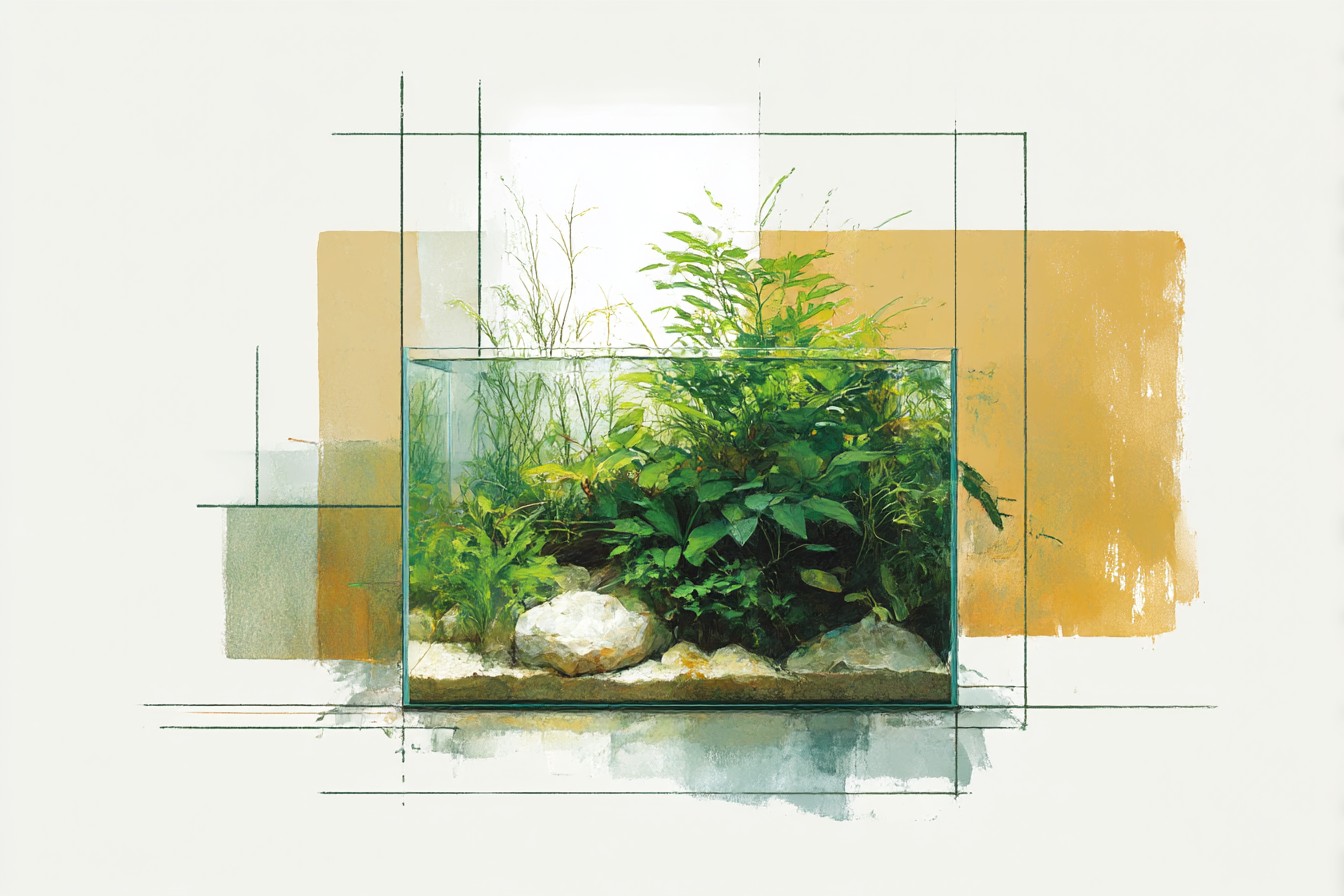
They looked just like the photos I’d seen in the contests, but as I stared at them something was missing.
Something just wasn’t right. Then it hit me. When I started reading what Amano had actually written about aquascaping, I learned that the Nature Aquarium style isn’t about recreating photos of nature.
It’s about recreating *how nature makes you feel* when you’re standing there. This matters, because when you start aquascaping with this philosophy in mind your aquariums take on a presence and atmosphere that is light years beyond staring at a picture that “kinda looks cool”. It’s all about restoring your mind, not wowing your visitors.
And restoring your mind was exactly what the Nature Aquarium was meant to do.
The Nature Aquarium Philosophy
Amano didn’t come up with the Nature Aquarium concept until the early 90s (ADA Global). However he had been thinking about and refining the ideas of what makes natural aquascapes truly beautiful since before he even started ADA back in 1982 (ADA Global). The Beauty of Nature What Amano realised was that when you’re walking through the woods or sitting beside a mountain stream you don’t feel awe-struck by the “technical perfection” of the scene. You feel the way the tree branches are scattered throughout the space, both balancing and contrasting with the angular rocks scattered about.
You’re drawn into the scape by how the light filters through the leaves and creates depth through shadow. All of these emotions were created by naturally occurring patterns that had been sculpted by millions of years of evolution, not by man-made decisions about what looks best when planted symmetrically in a tank. Beauty in Nature, Under Glass Amano was of course influenced by Japanese aesthetics. He spent a lot of time talking about concepts like wabi-sabi, or finding beauty in the imperfections around you.
In a Nature Aquarium, this means accepting that your plants will grow out of where you wanted them to be, that some of the leaves you planted will die and autumn off creating natural debris, or that your perfect carpet will eventually thin out and have rougher edges. Nature Aquarium takes terrestrial landscapes and recreates them under glass (Aquascaping Love), but more than that it recreates how it feels to stand within those landscapes. The Beauty of Succession Another key aspect of this philosophy is the passing of time. Many aquascapers focus on creating a specific picture, then maintaining that picture indefinitely.
Nature aquariums aren’t meant to stay the same year after year. Amano planned his aquascapes with succession in mind. He wanted his plants to grow and alter the feel of the scape over months and years.
He designed his aquascapes to be constantly evolving works of art, and knew that the most emotionally powerful scenes in nature are the ones where you can see both what was, and what is becoming. Taken together, this is why most wannabe Nature Aquariums autumn flat. They copy the aesthetic parts of Nature Aquascaping without understanding what it is about those aesthetics that make them beautiful to begin with.
Nature Aquarium Hardscape
When it comes to hardscape, Nature Aquarium does much more than provide support for carpeting plants or a place to perch your lucky fish.
Instead, hardscape creates the emotional framework of your aquascape. It builds perspective, creates mood, and establishes a sense of place for everything else to follow. Hardscape Tells a Story Hardscape pieces in Nature Aquarium are most often a combination of driftwood and stone (Green Aqua). However, the relationship between the wood and stone tells a story.
Was the wood a fallen tree trunk laying across a rocky mountain stream? Were the stones all that were left from a massive rockfall thousands of years ago? Your aquascape’s stones and driftwood should feel like they came from the same place, been weathered by the same elements, and for about the same amount of time. Perfect is… Average People love to talk about golden ratio placement of aquascaping elements (The Spruce Pets).
In nature, the most interesting points of focus occur at these approximate proportions. Perfect symmetry (or 1:1) is boring. Similarly, the exact opposite of perfect (meaning random) is also boring to look at.
Placing your main piece of wood or stone around 1/3 of your tank’s width creates a focal balance that feels “just right”. However the exact placement will vary based on your particular hardscape materials. Perspective If you leave an open area of sand in your foreground you’ll enhance depth perception (Practical Fishkeeping). The reason this works is because that open foreground is where you’re standing if you were staring into a natural space.
You start by looking at the space just in front of you. Then your eye moves past the intermediate layer and draws you further into the scape. Scale This is where most people go wrong when trying to make a Nature Aquarium. Sticking a full-sized branch in a 60-litre isn’t going to make you feel like you’re in the woods.
It’s going to feel like you’re looking into someone’s dollhouse. Every element of your hardscape needs to not only be scaled to your tank, but to the environment you want to bring under glass. Mountain shouldn’t look like woodland, and woodland doesn’t look like a reef.
Nature Aquarium Plants
Plants are more than just decorations in the Nature Aquarium.
They’re what take your randomly placed rocks and driftwood and turn them into a believable representation of your local woodland or mountain stream. Let’s take a look at how Amano thought about plant placement. Perspective, again If you remembered nothing else from this article, plant your largest plants in the background and work toward the smallest in the foreground. You use perspective by planting size gradients (Aquarium Gardens).
Nature works this way. There are specific plant species that grow close to the forest floor and thrive in open areas because they need a lot of light. These become your foreground carpeting plants.
There are taller plants that don’t need as much light, but can’t take full sun. These become your midground stem plants. Finally there are plants that tower over the rest and provide shade for all the plants beneath them.
These are your background plants. Natural Groupings Notice I didn’t say “one specimen of X here, one specimen of Y there”. Plants don’t naturally grow that way. Sure there may be that perfect spot in your aquascape that can only fit one plant, but generally if a species of plant likes a certain area it will grow in clusters.
As conditions change another species may start to slowly take it’s place. You should see your plants slowly transition from one to the other. The perfect scape will have areas where plants suddenly end and another plant takes over.
There should be no obvious line in the sand (pun intended) where you planted one species on one side and another on the other. Seasons When you plant a Nature Aquarium it should change over time as your plants grow, flower, and get cut back. Fast growing plants should be allowed to grow out and slowly be replaced by slower growing species. Think of how environments change with the seasons. Moss Magic Last but certainly not least are mosses and epiphytes.
They aren’t just there to pretty-up your hardscape. Slow growing moss spreading across a river rock shows continuity of your environment. It ages your aquascape in a natural way.
Nature Aquarium Mistakes to Avoid
If you didn’t know any better, you could probably look at the previous sections and think “easy stuff. anyone can do that.” The reason why people fail at Nature Aquarium has little to do with these ideas, but everything to do with misunderstanding why they matter.
Mistake #1: Approaching it as a photography project.
There’s nothing wrong with taking photos of your aquarium, but some people treat their Nature Aquascape like it’s a one shot deal. Get the perfect angle and take a picture. Problem is, real nature is interesting from many angles because it actually has depth and structure to it.
Doesn’t matter how nicely filtered and edited your photos are, a selfie taken with your aquarium in the background will always look fake. Mistake #2: Killing all the natural beauty by obsessively trimming and maintaing your aquascape. In nature fallen leaves rot on the ground, some stems don’t grow quite as full and lush as others, and sometimes plants crowd each other out and die off. Part of the beauty of a nature aquarium is embracing the little imperfections that Mother Nature herself would be proud of.
Learning the difference between what looks unkempt and what doesn’t is part of the challenge. Mistake #3: Planting for today and not planning for tomorrow. 9 times out of 10 people take all the cool plants and jam them into their aquarium then call it a day. Plants grow.
Even if you pick slow growers your aquascape will change as it matures and that’s ok. Plan for it. Think about how your aquascape will look in 6 months, not just how it looks when you plant it. Mistake #4: Stocking fish without thinking about their behaviour.
Sure, small schooling fish look great in nature style aquascapes (LiveAquaria), but if you’re going to add fish make sure their natural behaviours work with your aquascape, not against it. A tight school of tetras darting around your aquascape mimics the kind of fish you’d see schooling in a natural body of water. A random collection of individually wandering fish ruins the illusion. Mistake #5: Going super high tech just to grow plants.
You Might Also Like
CO2 is standard for high tech Nature Aquariums (Buce Plant) but your goal isn’t to grow perfect plants. It’s to grow healthy looking plant colonies that fit the natural environment you’re trying to build. Sometimes that means slower growing plants, and sometimes it means your plants aren’t perfectly green. Mistake #6: Copying contest aquarium layouts without considering the bigger picture.
Contest aquascapes are setup to be judged as a whole(Aquatic Gardeners Association). Harmony and natural impression are two of many judging criteria, but how does your aquarium look in 6 months? A year?
Will your pristine aquascape autumn apart if you holiday for a week and don’t tend to your perfect plants? Your Nature aquarium should be a self-sustaining ecosystem.
So… Why?
You might be wondering why Nature Aquarium style should matter to you. What difference does it make if you understand the “why” behind aquascaping like this or not?
Well allow us to present you with some peer reviewed research that might answer that question. Multiple studies have been conducted that attempt to understand how we as a species respond to nature, and what it is about natural spaces that can have such a powerful affect on us. Environmental Psychology research has shown that just viewing scenes of nature can significantly reduce stress compared to man made scenes.
Why? Well, it turns out there are certain things we as humans naturally respond to when looking at natural environments. Natural scenes are more likely to capture our attention because they have complexity without being chaotic.
Plants naturally follow fractal patterns and roughly adhere to golden ratio proportions. As stated previously, they have perfect imperfections. They reward continued study and exploration because there is always something new to see.
More importantly, natural scenes provide enough depth through perspective and layering to draw you in without creating feelings of anxiety. These are all aspects of Nature Aquarium style that Takashi Amano built into his aquascapes without even knowing he was doing it. Viewing natural aquascapes satisfies the same psychological needs that just walking through a forest or sitting by a mountain stream does.
Just like actually being in nature, a proper Nature Aquarium has the ability to restore your mind simply by viewing it.
Applicable To All TS Sizes?
Yes and no. All of the concepts discussed above can be applied to any size aquarium and any level of aquascaping tech. However the way you implement them will look different in a nano versus a 200 litre. Nano (under 40 litres): This is all about subtlety.
Suggesting rather than showing. One well placed piece of moss covered driftwood can be all you need to give the illusion of a forest floor. Pick materials that don’t feel too large for the space you have. Community (80-200 litres): This is where Nature aquascaping shines.
You have enough room to create distinct foreground, midground, and background areas of your aquarium. You also have enough volume to add the plant diversity that makes Nature Aquarium so rewarding. Fish aren’t out of the question, you can include multiple species as long as you don’t overcrowd your aquascape. Large Display (300+ litres): With more space you have more freedom to create complex geological stories.
However make sure you don’t create vast open spaces that just look empty. Low-Tech: You can certainly apply Nature Aquascaping principles to low-tech aquariums. In fact you might be surprised at how much more natural slow growing plants appear in a low-tech set-up.
Benefits of Figuring Out Nature Aquarium Style
So you’ve got all of this information. You understand the theory and philosophy of Nature Aquarium, how do you translate that into benefits to you the reader?
Well here are just a few of the positives you’ll see by creating aquascapes that actually fulfill Amano’s vision of the Nature Aquarium. You’ll actually feel less stressed Natural aquascapes have the power to bring you peace like a “regular” aquarium can’t. When you walk away from your Nature aquarium you’ll find your mind more easily able to focus on what’s important, not worry about what’s stressing you at work. Longer tank stability If you allow your aquascape to mimic natural growth patterns it will be more resilient. Plant groupings will naturally weave together to form solid roots systems that help prevent free floating algae.
Hardscape placements that look random, but actually follow natural patterns will stand the test of time rather than needing to be constantly adjusted as your scape matures. You’ll learn more about aquarium keeping Nature Aquariums teach you about the hidden complexities of natural ecosystems. You become better aquarists because you learn how to pay attention to the relationships between different plants. How changing one little thing effects the entire scape.
How environments change naturally over time, and how you can work with those changes rather than against them. It’s sustainable enjoyment Unlike some aquascaping styles that require you to constantly tweak and adjust your aquarium to keep it looking the way you want it to, Nature Aquarium gets better with time. Sure you’ll still need to maintain your aquarium, but you spend less time stressing over perfection and more time enjoying your aquascape. You become part of nature When you strip away all the marketing hype and buckets of RGB LEDs what you’re left with is a way to bring the natural world indoors. Nature aquariums allow you to become part of natural process rather than just an outside observer.
How to Get Started Aquascaping Nature Style
So you’re ready to give Nature Aquarium a shot.
Great! As with any aquascape you don’t want to dump a bunch of money into setting it up without even knowing if you’re going to like aquascaping. So here’s a 3 month plan to get you started without breaking the bank. Month 1: Observation.
Hit up your local woods, park, or wherever inspires you and take notes. See how the sticks relate to stones. How plants transition from open areas to thick tangled forests.
How water influences the growth of trees and structure of the land. Take lots of pictures and really study them when you get home. This part is free.
Next up, pick out your hardscape and buy your substrate. Don’t forget any upgrades you might need for your chosen tech level. Budget:
- Quality aquatic soil: £25-45
- Hardscape Materials: £30-80
- Basic Lighting upgrade: £40-120
Total: £95-245 Month 2: Build your geological story. Add stones and driftwood to your aquarium, but don’t add any plants.
Live with it that way for at least a week. Look at it from every angle possible. Make adjustments until it just feels right.
Once you’re happy with the rocks it’s time for plants.
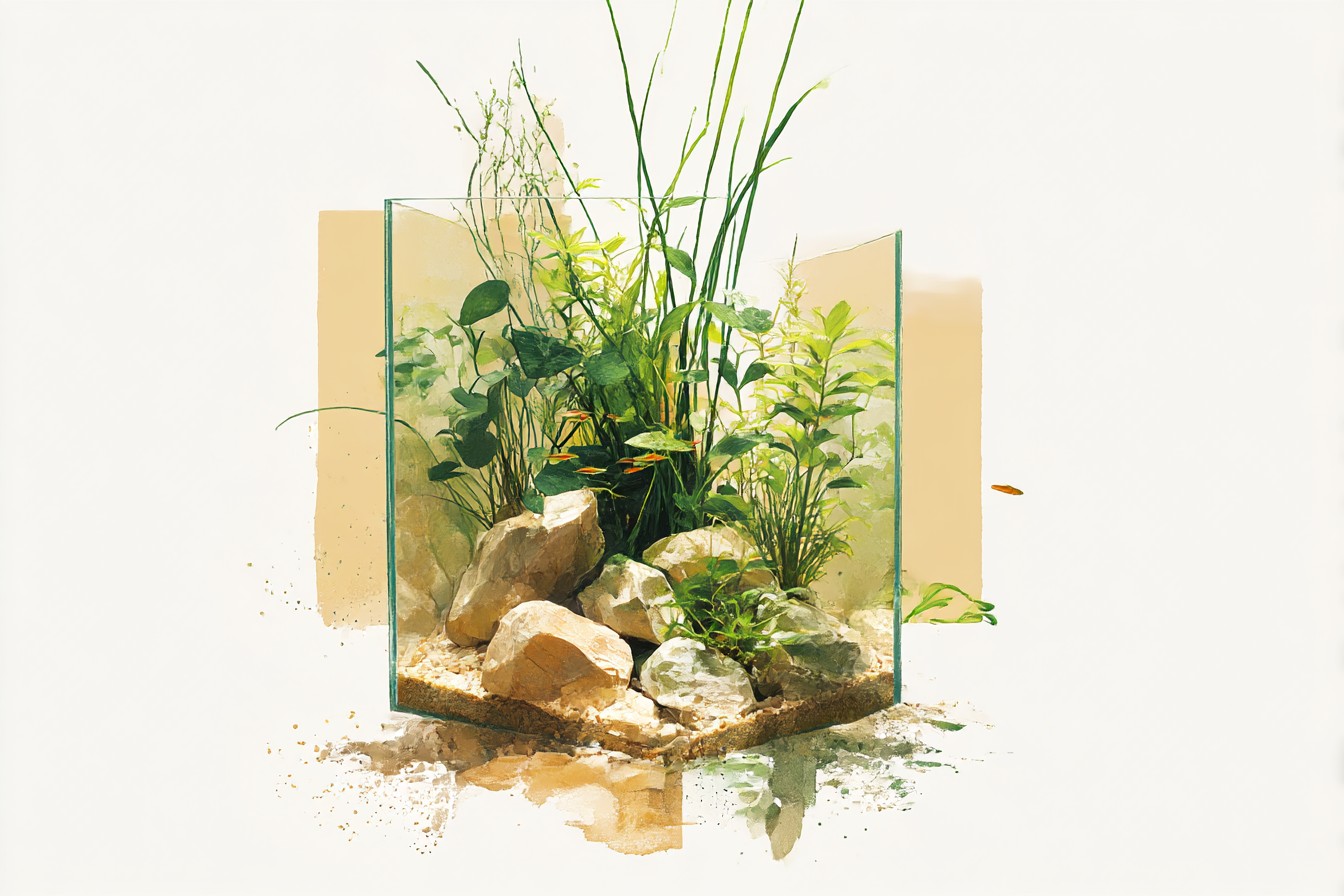
But instead of throwing them all in willy nilly, plant your background and some midground plants. Leave your foreground open for the moment. What you’re looking for: ** Your hardscape should draw your eye into the aquarium by creating clear lines of sight and using foreground depth. Month 3-4: Finish off by planting your foreground and slowly adding fish.
Make sure you’re fish choice is compatible with plants and plan on cycling your aquarium before adding anything that will produce waste. By planting slowly you’ll watch your aquascape come together over time rather than throwing it all in at once. How your plants fill in those open spaces you left in month 2 is part of the fun! Budget:
- Plants: £40-80
- Fish Stock: £30-60
- CO2 Setup (assuming high tech): £80-150
Total: £150-290 Month 4 onwards: Observation part 2.
Look at how your aquascape comes together. Which plants grew faster than you thought? Which ones suddenly died off?
Did anything work that you wouldn’t have expected? Use these observations to build your next aquascape. Also, trim plants to enhance natural shapes rather than geometric perfection.
Allow some open space to grow dense while keeping other areas more open. Budget:
- Replacement Plants / Equipment: £20-40 annually
- Specialty Nutrients or Additives: £25-50 annually
Total Annual Maintenance: £45-90 Creating a Nature Aquarium takes patience. but the end result will be well worth the wait.