# Amazon Sword and the Centrepiece Plant That Takes Over Your Entire Tank I bought my first Amazon sword because I needed something green and substantial for the back corner of a 120-litre tank. The little potted specimen looked modest enough in the shop, maybe fifteen centimetres tall with half a dozen leaves. Six months later it had forty-three leaves, reached the surface, and was sending out runners that were producing baby plants faster than I could give them away.
I’d created a monster, and I loved every inch of it. That’s the Amazon sword story in a nutshell. You think you’re getting a nice background plant.
What you actually get is a living sculpture that will redesign your tank for you whether you want it to or not. And somehow, despite the complete takeover, most of us end up keeping them anyway. | Care Level | Lighting Needs | CO2 Required | Growth Rate | Max Size | Our Rating | |————|—————-|————–|————-|———–|————| | Easy | Moderate | No | Moderate to Fast | 50cm+ | 8/10 | ## The South American Giant The Amazon sword, properly called Echinodorus bleheri, comes from the slow-moving waters and marshy areas of South America, where it grows both submerged and as an emergent marsh plant.
It’s been a staple of the aquarium trade for decades, and there’s a good reason for that persistence.
This is a plant that actually wants to grow underwater, unlike some species that merely tolerate it. In its natural habitat, it’s used to seasonal flooding and changing water levels, which explains why it adapts so readily to aquarium life. The broad, sword-shaped leaves that give it its common name can photosynthesize efficiently in relatively dim conditions, making it one of the more forgiving plants for hobbyists who haven’t invested in high-end lighting yet.
What made the Amazon sword particularly appealing to early aquascapers was its reliability. While other plants melted, yellowed, or simply gave up, the Amazon sword kept producing new leaves. It became the go-to choice for anyone who wanted a planted tank but couldn’t keep more demanding species alive.
That reputation has stuck, even as the hobby has moved towards more technical approaches and exotic species. The plant entered the aquarium trade in the mid-20th century and quickly established itself as the default background plant. Before CO2 injection became common, before specialised aquasoils, before high-output LED lighting, the Amazon sword was already thriving in community tanks with gravel substrates and basic fluorescent tubes. ## What Makes It Special The first thing you notice about an established Amazon sword isn’t the size, though that’s impressive enough.
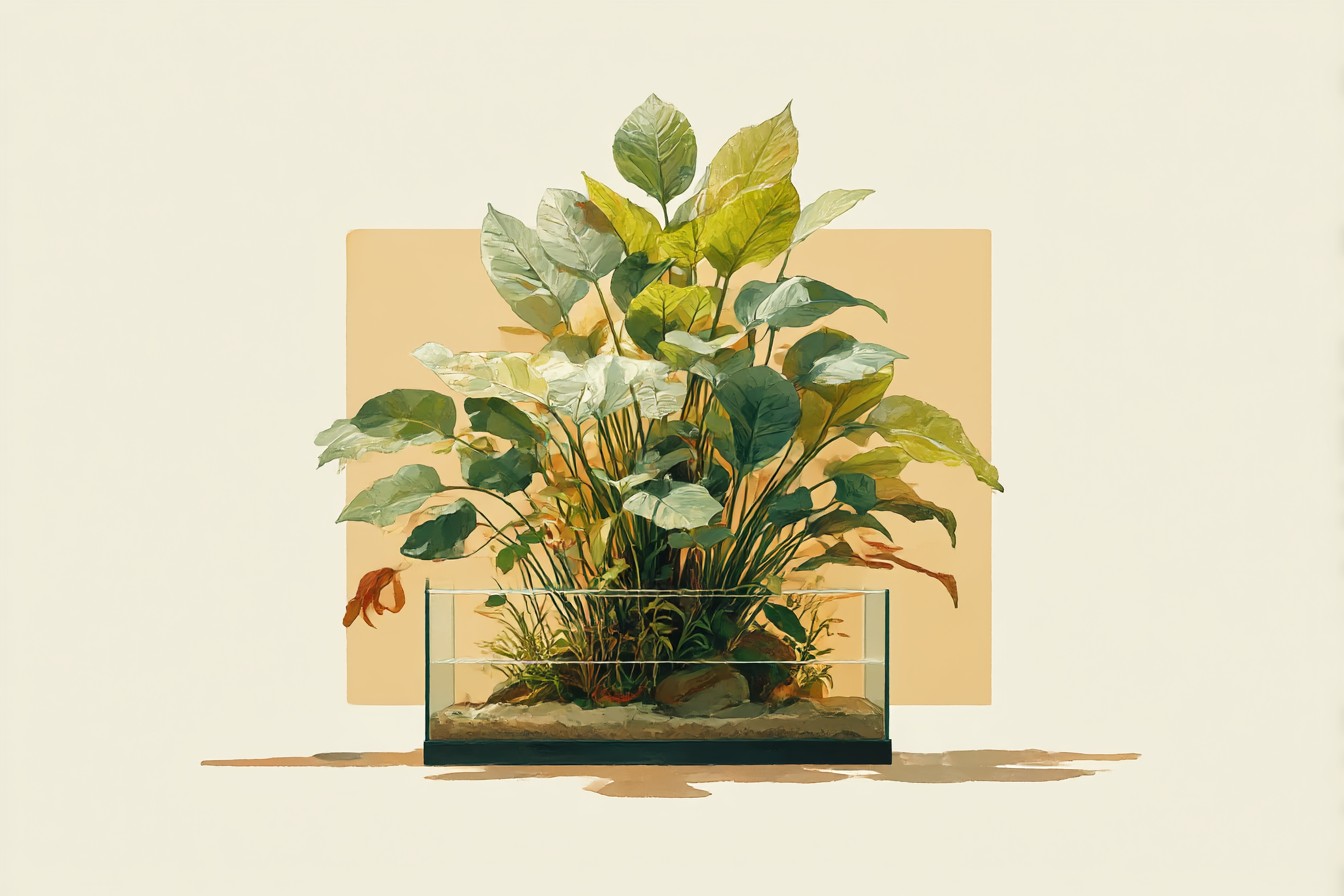
It’s the presence. A mature plant can consist of up to 30 leaves (Aquarium Gardens), each one broad and substantial, creating a focal point that draws the eye immediately. When backlit, the leaves show a beautiful translucent quality that makes them glow like stained glass windows.
But the real magic happens below the surface. The Amazon sword is one of the few aquarium plants that actively improves water quality as it grows. Those broad leaves are photosynthesis powerhouses, pulling CO2 from the water column during the day and releasing oxygen.
In a well-lit tank, you can actually see the bubble streams rising from healthy leaves. It’s one of the most satisfying sights in aquascaping: visual proof that your plant is working. The growth pattern is what sets Amazon swords apart from most aquarium plants.
Rather than spreading horizontally or growing in small clumps, they build upward and outward from a central crown, creating what amounts to an underwater tree. A single plant can reach 20-50 cm tall (Tropica), and mature specimens can grow 20 inches tall or more (Aquarium Co-Op). The leaves arrange themselves in a natural spiral, each one positioned to catch maximum light without shading its neighbours completely.
What surprised me most about my first Amazon sword was how quickly it established itself. Unlike stem plants that need time to root properly, or carpeting species that take months to spread, the Amazon sword gets to work immediately. New leaves appear weekly once it’s settled, and each one emerges bigger than the last until the plant reaches its full size potential.
The root system is equally impressive. Amazon swords develop thick, white roots that spread throughout the substrate, anchoring the plant securely and allowing it to draw nutrients from a wide area. These aren’t delicate feeder roots that break if you look at them wrong.
They’re substantial structures that can push through gravel, move lightweight substrate, and generally establish their territory with authority. Temperature tolerance is another major strength. While many aquarium plants have narrow preferences, Amazon swords handle anything from 20-30°C (68-86°F) (The Shrimp Farm) without complaint.
I’ve kept them in unheated tanks that dropped to 18°C in winter and in tropical setups that hit 28°C in summer. The growth rate changes, but the plant keeps producing healthy leaves regardless. Perhaps most importantly for many hobbyists, Amazon swords don’t require CO2 injection.
They’ll grow faster and larger with it, but they’ll thrive without it. This makes them perfect for low-tech setups where you want the benefits of live plants without the complexity of petrol systems, solenoids, and drop checkers. ## The Honest Assessment Here’s what the sellers don’t always tell you: Amazon swords are space hogs. That modest plant you bought for the corner of your tank has ambitions.
You Might Also Like
Big ones. A typical growth size of 8-20 inches (The Shrimp Farm) means it’s going to dominate whatever tank you put it in unless that tank is genuinely large. I learned this the hard way in a 60-litre tank where my Amazon sword went from charming background accent to total light-blocking monster in about four months.
The other plants started failing as the sword’s canopy blocked their access to light, and swimming space became minimal. Beautiful as it was, it had fundamentally changed what the tank could be. Mature plants can reach up to 50-60 cm in height with up to 50 leaves (Aqua Essentials).
Unless you’re running a very large tank, that means regular pruning becomes essential, not optional. And pruning an Amazon sword isn’t like trimming stem plants where you cut and replant. You’re removing entire leaves, each one a substantial piece of the plant’s structure.
The reproduction rate can become genuinely problematic. Established Amazon swords send out runners with baby plants attached, and these babies grow fast. I’ve counted six new plants from a single runner, each one capable of reaching full size within six months.
It’s impressive until you realise you now have seven full-sized Amazon swords and nowhere to put them. Nutrient requirements are higher than many people expect. While Amazon swords don’t need CO2, they do need substantial root feeding.
The broad leaves and rapid growth rate mean they’re pulling significant amounts of nitrogen, phosphate, and trace elements from the substrate. In nutrient-poor setups, you’ll see the older leaves yellowing and developing holes as the plant cannibalises itself to feed new growth. The pH range of 6.5-7.5 (The Shrimp Farm) suits most community tanks, but Amazon swords are sensitive to major parameter swings.
They’ll survive temporary changes, but rapid shifts in pH or hardness can trigger massive leaf drops that leave you with a bare stem and a substrate full of decomposing plant matter. Finally, there’s the aesthetic issue. Amazon swords have a very specific look: big, bold, and tropical.
They suit certain styles beautifully, but they’ll completely overwhelm delicate aquascapes or tanks designed around smaller, more subtle plants. They’re statement pieces, which means they need to fit your statement. ## Legacy and Influence The Amazon sword shaped the early hobby’s understanding of what aquatic plants could be in home aquariums. Before specialised plant foods, before CO2 systems, before full-spectrum LEDs, the Amazon sword was proving that you could keep thriving plants in a community tank with basic equipment.
It became the gateway plant for countless aquascapers who started with one Amazon sword and ended up with heavily planted tanks full of exotic species. The confidence that comes from successfully growing something substantial and beautiful can’t be overstated. For many hobbyists, the Amazon sword was proof that they could actually do this planted tank thing.
The plant also influenced tank design in practical ways. The need to accommodate a large, central feature plant pushed aquascapers towards larger tanks and changed how they thought about negative space and plant placement.
You can’t just scatter Amazon swords randomly around a tank the way you might with smaller species.
They demand intentional placement and sufficient room to develop. Modern aquascaping has moved towards more technical approaches and exotic plants, but the Amazon sword remains popular precisely because it bridges the gap between simple fish tanks and serious planted setups. It gives you impressive visual impact without requiring advanced techniques, making it perfect for hobbyists who want their tanks to look intentional and designed without mastering complex plant husbandry. ## The Verdict The Amazon sword is exactly what it appears to be: a big, bold plant that will become the centrepiece of whatever tank you put it in.
If you want something dramatic that doesn’t require CO2 injection or precise parameter control, and if you have the space for a plant that can reach up to 50 cm tall, then this is one of the most reliable choices in aquascaping. But be honest about your space and your intentions. This isn’t a background plant in any tank smaller than 200 litres.
It’s not subtle or delicate or easily ignored. It’s going to change how your tank looks and functions, and it’s going to keep growing whether your original aquascape design accounted for that or not. For someone with a large community tank who wants the benefits of live plants without the technical complexity, the Amazon sword is nearly perfect.
For someone trying to create a detailed, controlled aquascape with multiple species and careful proportions, it might be more plant than you bargained for. See where this placed in our full ranking of aquarium plants.


