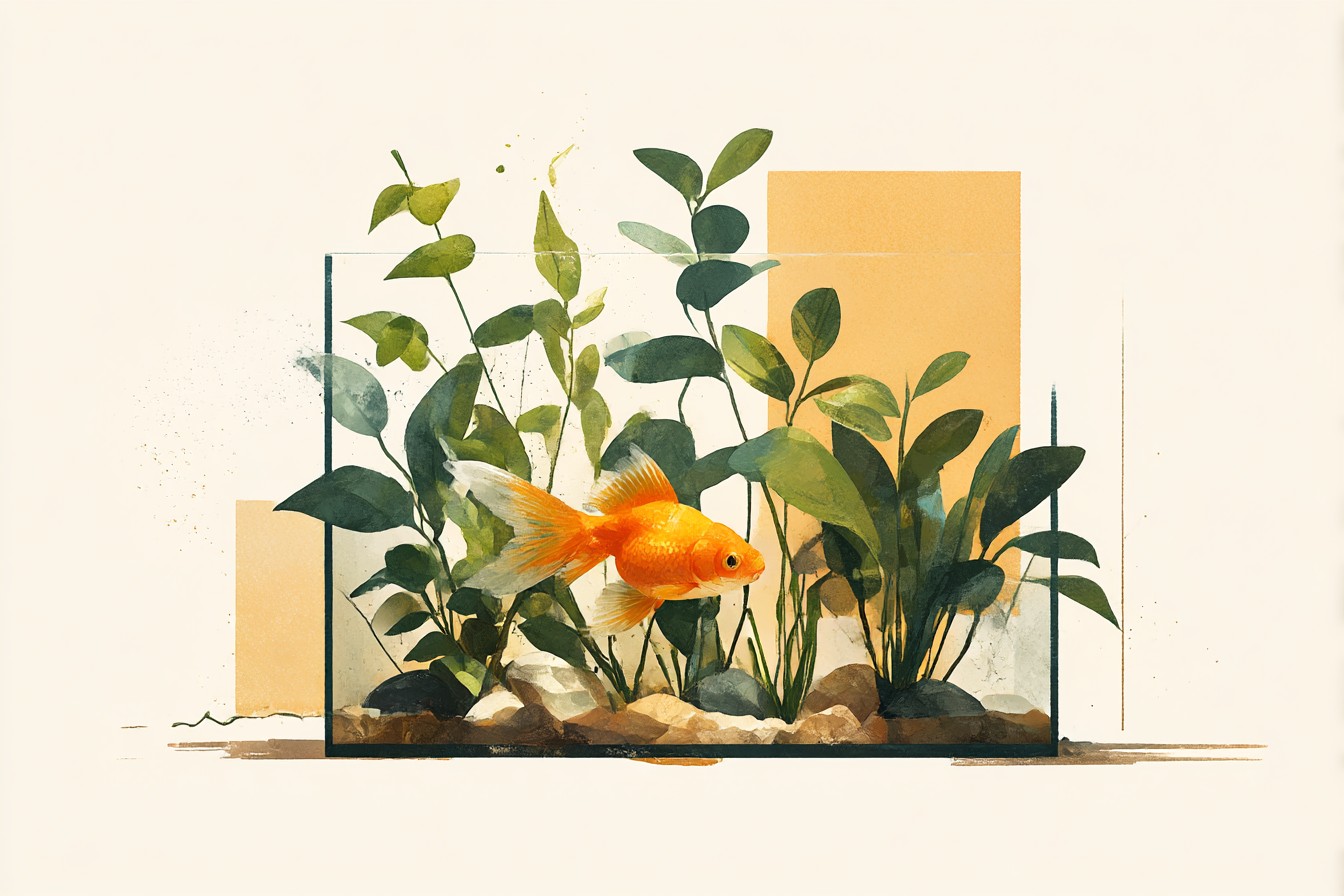
# Goldfish Planted Aquarium and the Plants That Survive Being Constantly Eaten Most people think goldfish and plants don’t mix. They’ve watched their prized Amazon sword disappear overnight, leaf by leaf, or found their expensive stem plants reduced to stumps by morning. The conventional wisdom says you can have goldfish or you can have plants, but not both.
That’s rubbish, frankly. You just need to understand what you’re working with. Goldfish are essentially aquatic cows.
They graze constantly, they dig relentlessly, and they produce enormous amounts of waste. But they’re also intelligent enough to learn routines, hardy enough to tolerate mistakes, and rewarding enough to keep you coming back.

Building a planted tank that actually thrives with goldfish isn’t about fighting their nature—it’s about working with it.
You need plants that can handle the constant nibbling, the digging, and the nutrient-rich water that comes with heavy fish loads. More importantly, you need to understand why some plants survive whilst others become expensive fish food within hours. I learned this the hard way.
My first attempt at a goldfish planted tank was a disaster that cost me nearly £200 in plants over six weeks. Everything I’d read online made it sound straightforward: just choose “hardy” plants and you’d be fine. What nobody mentioned was that hardy doesn’t necessarily mean goldfish-proof.
My beautiful cryptocoryne lawn became scattered substrate within days. The Vallisneria I’d spent a fortune on never even got a chance to root. But that failure taught me what actually works, and why. ## The Science Behind Goldfish Plant Interaction **Goldfish Feeding Behaviour**: Goldfish are omnivorous foragers with no stomach.
Food passes directly to their intestines, which means they need to eat frequently throughout the day. In the wild, they spend most of their waking hours searching for food, which includes plant matter, algae, insects, and organic detritus. This constant foraging behaviour doesn’t disappear in captivity—it just gets redirected to whatever’s available in your tank.
Research shows that goldfish will consume up to 3% of their body weight daily in plant matter when it’s available (Modest Fish). They’re not being destructive for the sake of it. They’re doing what evolution programmed them to do: graze constantly to meet their nutritional needs.
Understanding this helps you choose plants that either provide that grazing opportunity safely or are tough enough to withstand the attention. **Temperature Considerations**: Most goldfish are kept at room temperature, typically between 18-22°C in UK homes. This puts them at the lower end of the temperature range where most aquarium plants flourish at 72F to 82F which informs goldfish plant choices (The Aquarium Expert). This temperature differential affects plant growth rates, nutrient uptake, and recovery time after damage.
Plants that grow quickly enough to outpace goldfish munching at these temperatures are your friends. **Root System Impact**: Goldfish are notorious diggers. They’ll uproot plants whilst searching for food, often not even eating what they’ve disturbed. This behaviour makes substrate-rooted plants particularly challenging unless they’re either extremely well-established or have root systems too tough for goldfish to damage.
Plants that attach to hardscape or float freely avoid this problem entirely. ## Primary Plant Selection Strategy The key to success lies in choosing plants that either grow faster than goldfish can eat them or are simply too tough to be worth the effort. You want species that thrive in cooler water, can handle high bioloads, and either recover quickly from damage or are naturally resistant to it. **Fast-Growing Escape Artists**: Plants like hornwort exemplify this strategy. Hornwort rating given as 8.5 out of 10 for goldfish tanks (Modest Fish) because it grows so rapidly that even constant nibbling can’t keep up.
Hornwort is described as fast growing and useful for breeding tanks (Times of India), which makes it perfect for goldfish systems where you need plants that can outgrow the damage being done to them. Duckweed follows the same principle. Goldfish will eat it enthusiastically, but it reproduces so quickly that a small amount will colonise an entire tank surface within weeks.
It also provides excellent nitrate uptake, which is crucial in goldfish tanks where waste production is high. The trick is maintaining balance—too little and it disappears, too much and it blocks all your light. **Tough-As-Nails Survivors**: Java fern represents the other successful strategy. Java fern is described as thriving without soil and low maintenance (Times of India), but more importantly for goldfish keepers, its leaves are tough and bitter.
Most goldfish will take a few experimental nibbles and then leave it alone. The plant attaches to wood or stone rather than rooting in substrate, so it can’t be uprooted by digging. Anubias is described as hardy and beginner friendly plant (Times of India), and like Java fern, it’s simply too tough for most goldfish to bother with long-term.
Both plants are highlighted as beginner champions (Aquifarm), which makes them ideal for goldfish keepers who want plants that won’t need constant replacement. **Budget Considerations**: These survivor plants cost more upfront than soft stem plants, but they’re actually cheaper long-term. A decent-sized Anubias nana costs around £15-25 at most aquatics shops, but it’ll last years. A bunch of Cabomba costs £3 and disappears in a week.
Do the maths. **Placement Strategy**: Position tough plants like Java fern and Anubias in high-traffic areas where goldfish spend most of their time. They’ll provide visual interest without being destroyed. Use fast-growing plants like hornwort in the background or floating freely where they can absorb nutrients and provide cover whilst being partially consumed without harm to the overall display. ## Plant Species That Actually Work Based on years of trial and error—mostly error—these are the species that genuinely survive in goldfish tanks: **Hornwort**: The absolute champion.
Goldfish compatible plant list includes hornwort moss balls and duckweed (Aquarium Genius), and hornwort tops that list for good reason. It grows incredibly fast, doesn’t need substrate, and even if half of it gets eaten, the remainder continues growing. It’s also brilliant for nutrient uptake, which helps keep algae under control in high-bioload goldfish systems.
Expect to pay £5-8 for a decent portion, and within six weeks you’ll have enough to fill the tank. **Java Fern (Microsorum pteropus)**: Goldfish plants list includes java fern anubias and hornwort (Modest Fish), and Java fern earns its place through sheer toughness. The leaves are leathery and unpalatable to most goldfish. Attach it to bogwood or stone using cotton thread or plant glue—never bury the rhizome or it’ll rot.
Growth is slow but steady, and once established, it’s virtually indestructible. Budget around £8-15 for a plant large enough to make an impact. **Anubias Species**: Particularly Anubias nana and barteri. Hardy plants like java fern anubias and amazon sword are recommended (Voyo Pets), though Amazon sword is questionable in my experience—goldfish often destroy the roots before it establishes.
Anubias, however, is bombproof. Like Java fern, it attaches to hardscape rather than rooting in substrate. The thick, waxy leaves are unappealing to goldfish, and the plant tolerates low light well.
Expect £12-20 for a mature specimen. **Java Moss (Taxiphyllum barbieri)**: Java moss is listed among core freshwater aquarium plants (Aquatics World), and it works in goldfish tanks because it’s nearly impossible to completely eradicate. Goldfish will graze on it constantly, but moss spreads faster than they can eat it if you start with enough. It’s also incredibly cheap—a portion costs £3-5 and will eventually cover whatever surface you want.
You Might Also Like
Attach it to mesh or let it form free-floating balls. **Marimo Moss Balls**: Technically algae, not moss, but goldfish usually leave them alone after initial investigation. They’re nearly indestructible, require no special care, and help with nutrient uptake. At £8-12 each they’re not cheap, but they last for years and add interesting texture to the tank floor. **Vallisneria (with caveats)**: Some varieties work if you can get them established before the goldfish discover them.
Plant thickly and expect to lose some initially. Once the roots are deep, many goldfish can’t uproot healthy Vallisneria, though they’ll still graze the tips. This is hit-or-miss depending on your particular fish. ## Common Mistakes That Cost Money and Fish
Mistake #1: Trying delicate stem plants first. Cabomba, Hygrophila, and most other soft stem plants are goldfish candy.
They look beautiful in the shop and die within days in a goldfish tank. I burned through £80 worth of stem plants before accepting this reality. Start with the tough plants first, add delicate species later if at all.
Mistake #2: Insufficient plant mass at startup. A single Java fern in a tank with three goldfish will get nibbled to death through sheer persistence.
You need enough plant biomass that the fish can graze without destroying everything. Plan to plant heavily from the start, not gradually build up.
Mistake #3: Burying rhizome plants in substrate. Java fern and Anubias must attach to hardscape, not be buried. Burying the rhizome kills the plant within weeks, regardless of goldfish activity.
This mistake cost me four expensive Anubias plants before I learned proper attachment techniques.
Mistake #4: Underestimating goldfish intelligence. Goldfish learn patterns. If you keep adding the same delicate plant species, they’ll start eating them faster each time. They recognise tasty food when they see it.
Switch to survivor species instead of fighting this learning curve.
Mistake #5: Inadequate lighting for plant recovery. Plants that are constantly grazed need enough light to photosynthesize efficiently and recover quickly. The dim lighting that goldfish prefer often isn’t sufficient for damaged plants to bounce back. You need to find a balance that supports plant recovery without promoting algae growth.
Mistake #6: Ignoring seasonal growth patterns. Plant growth slows significantly in UK winters when room temperatures drop.
What works in summer might not provide adequate regrowth in winter. Plan your plant selection around year-round performance, not just warm-month success.
## Research Supporting Plant-Goldfish Systems Studies consistently demonstrate that planted aquariums provide superior water quality compared to bare tank setups, even with high bioload fish like goldfish. The plants act as biological filters, absorbing ammonia and nitrates directly whilst competing with algae for nutrients.
This is particularly valuable in goldfish systems where waste production is substantial. Research on goldfish behaviour shows they exhibit reduced stress indicators in planted environments compared to sterile tanks. The plants provide psychological benefits through environmental enrichment whilst serving as supplemental food sources.
The key finding across multiple studies is that the benefits persist only when plant biomass is sufficient to handle both the grazing pressure and the nutrient load—exactly why plant selection matters so much in these systems. Temperature studies confirm that most tropical aquarium plants can adapt to goldfish-appropriate temperatures, though growth rates decrease. This actually works in favour of goldfish compatibility, as slower-growing tough plants become more economically viable when they don’t need frequent replacement. ## Broader Applications Across Tank Types **Fancy Goldfish Tanks**: Slower-moving fancy varieties like orandas and bubble eyes are generally less destructive than common goldfish.
You can often succeed with a wider plant palette, including some careful trials with Amazon sword or larger cryptocoryne species. **Pond Transition Tanks**: For goldfish that split time between indoor tanks and outdoor ponds, focus on plants that handle temperature fluctuations well. Hornwort and Java moss are excellent choices as they adapt quickly to changing conditions. **Breeding Setups**: Dense plantings of hornwort and Java moss provide essential spawning surfaces and fry protection whilst handling the increased bioload that comes with breeding activity and frequent feeding. **Community Tanks with Goldfish**: When keeping goldfish with other species, plant selection becomes more critical as you’re balancing multiple sets of requirements. Stick to the proven survivors but increase density to accommodate varied grazing patterns. ## Benefits of Getting This Right **Stable Water Parameters**: Properly planted goldfish tanks maintain more consistent nitrogen cycle parameters because the plants absorb waste products directly.
You’ll see more stable ammonia and nitrate readings within 3-4 weeks of establishing adequate plant biomass. **Reduced Algae Issues**: Fast-growing plants like hornwort outcompete algae for nutrients, significantly reducing the green water and string algae problems common in goldfish tanks.

This benefit becomes noticeable after 6-8 weeks once plants are actively growing. **Natural Fish Behaviour**: Goldfish in planted tanks exhibit more natural foraging and exploration behaviours, which reduces stress and supports better long-term health. You’ll notice more active, engaged fish behaviour within weeks of adding appropriate plants. **Lower Maintenance Requirements**: Established planted goldfish tanks require less frequent water changes because the plants process waste products continuously.
Many keepers reduce water change frequency from twice weekly to weekly once the system matures. **Cost Savings Over Time**: Though initial plant costs are higher than plastic alternatives, living plants eliminate the need for constant replacement whilst providing biological filtration that reduces chemical filter media requirements. **Aesthetic Rewards**: A successfully planted goldfish tank achieves the natural look that most keepers want whilst proving it can be done despite conventional wisdom saying otherwise. ## Step-by-Step Implementation Guide **Phase 1: Foundation Plants (Weeks 1-2)** Start with the bulletproof species that form your tank’s backbone. Purchase Java fern, Anubias, and hornwort as your core plants. Attach the Java fern and Anubias to bogwood or large stones using cotton thread—never bury them.
Float the hornwort initially or weigh it down lightly with plant weights. **Budget Breakdown:** * 2-3 Java fern plants: £20-35 * 2-3 Anubias specimens: £25-45 * Large portion hornwort: £8-12 * Bogwood for attachment: £15-25 * Cotton thread and plant weights: £5-10 **Total Phase 1 Budget: £75-125** Watch for goldfish interest in the new plants. Some initial nibbling is normal, but excessive attention suggests you need more biomass or different placement. **Phase 2: Fast Growers (Weeks 3-4)** Add Java moss attached to mesh or stones, and introduce floating plants like duckweed if your lighting can handle it. These species provide additional grazing opportunities whilst growing fast enough to stay ahead of consumption. **Budget Breakdown:** * Java moss portions: £10-15 * Plastic mesh for attachment: £5-8 * Marimo moss balls: £15-25 * Duckweed starter portion: £3-5 **Total Phase 2 Budget: £35-55** Monitor plant establishment and goldfish behaviour.
Healthy plants should show new growth within 2-3 weeks at room temperature. **Phase 3: Optimisation (Weeks 6-8)** Once your foundation plants are established, consider adding more challenging species in small quantities to test your particular fish. Some goldfish are more plant-tolerant than others. **Budget Breakdown:** * Trial plants (Vallisneria, Amazon sword): £10-20 * Additional lighting if needed: £30-60 * Plant fertiliser for heavy bioload: £8-15 **Total Phase 3 Budget: £50-95** **Phase 4: Maintenance Routine (Ongoing)** Establish pruning schedules for fast-growing plants, monitor for plant health issues, and replace any casualties with proven species rather than continuing to experiment with delicate varieties. **Budget Breakdown:** * Monthly plant replacements: £10-20 * Fertiliser refills: £5-10 quarterly * New plant trials: £15-25 quarterly **Total Ongoing Budget: £35-65 per quarter** The entire system should be stable and self-maintaining within 8-12 weeks, with established plants growing fast enough to handle goldfish attention whilst providing the biological filtration and aesthetic appeal you want. Focus on success with proven species before branching out—your goldfish and your wallet will thank you for it.


