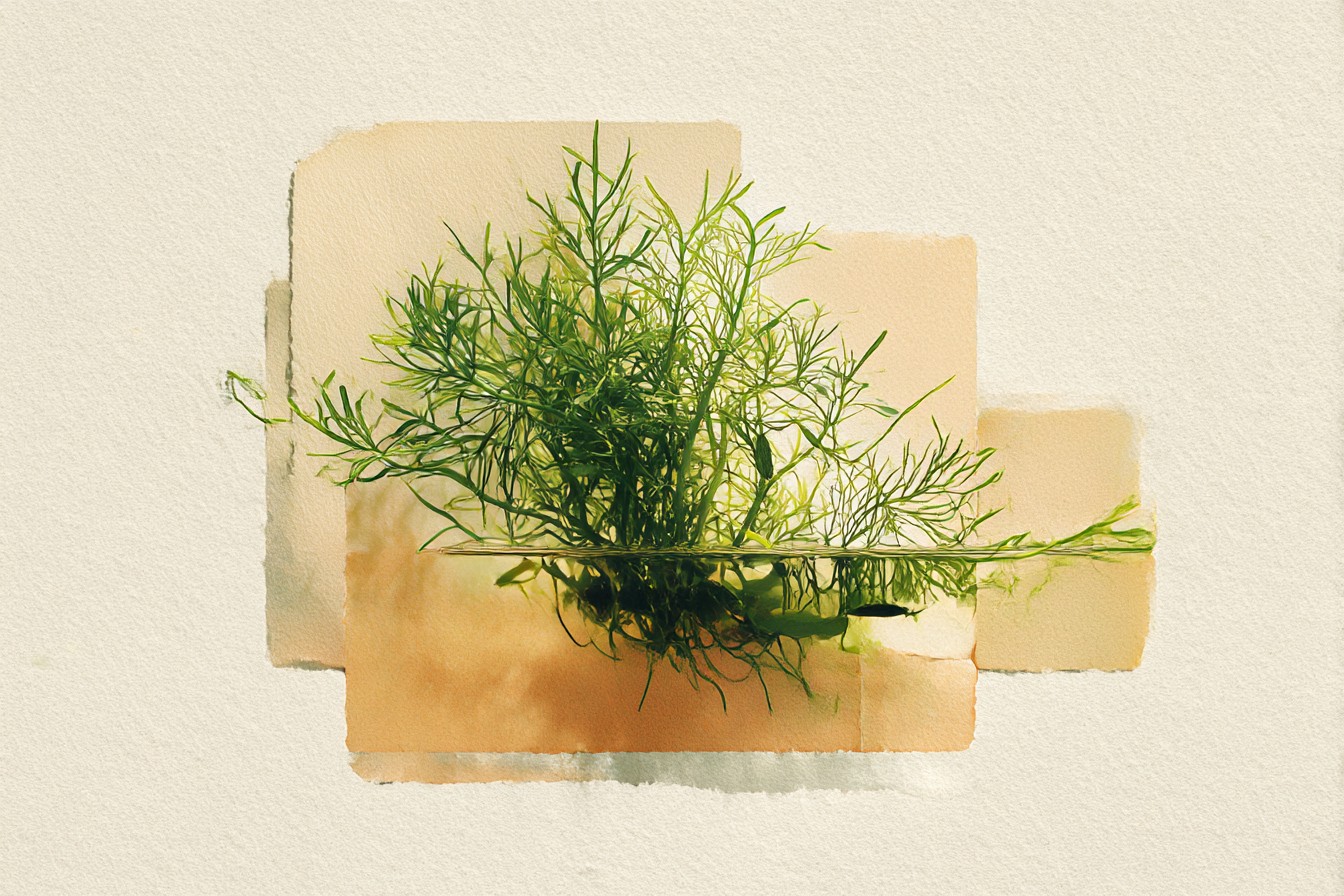
# Hornwort and the Floating Stem Plant That Grows Whether You Want It to or Not I bought my first bit of hornwort for three pounds fifty from a local shop because the tank looked bare and I needed something green that wouldn’t die immediately. That was eighteen months ago. The original strand has now colonised two tanks, filled a carrier bag that I gave to my neighbour, and still produces enough trimmings every month to stock a small aquatics shop.
I’ve never fertilised it, never worried about its lighting, and never once wondered if it’s getting enough CO2. It just grows. Whether you want it to or not.
That’s hornwort in a nutshell really. It’s the plant equivalent of that mate who turns up uninvited but makes himself so useful you end up grateful he came.

Unpredictable, occasionally irritating, but genuinely brilliant at what it does.
Which is grow fast, eat nutrients, and keep your water clean while looking surprisingly good doing it. | **Care Level** | **Lighting Needs** | **CO2 Required** | **Growth Rate** | **Max Size** | **Our Rating** | |—|—|—|—|—|—| | Beginner | Low to High | No | Fast | 80cm+ | 8.5/10 | ## The Accidental Aquatic Hornwort didn’t set out to be a aquarium plant. In the wild, it’s a proper floating plant that drifts around ponds, lakes, and slow-moving rivers across most of the world, doing what it’s been doing for millions of years. No roots, no fuss, just floating stems that photosynthesize like mad and absorb nutrients directly through their needle-like leaves.
The species name is *Ceratophyllum demersum*, which translates roughly to “horn leaf that stays underwater.” Someone clearly had a sense of humour when they named it, because the leaves do look a bit like tiny antlers if you squint. It’s been in the hobby almost as long as there’s been a hobby, imported originally as pond plant that someone realised would work perfectly well in a tank. What makes hornwort unusual is that it genuinely doesn’t care where it is.
Pond, lake, aquarium, that bucket you forgot about in the shed – if there’s water and a bit of light, it’ll grow. The temperature range is ridiculous: anything from 10–30°C (AquariumLesson) and it’s perfectly happy. pH anywhere from 6–9 (Aquatic Community) suits it fine. Most plants have preferences.
Hornwort has suggestions. ## What Makes It Special The first thing you notice about hornwort isn’t how it looks – though the feathery texture is quite attractive once you get used to it – it’s how it behaves. This is a plant that grows whether you’re paying attention or not. Fast growth and high nutrient consumption (Aquarium Co-Op) means it’s constantly pulling nitrogen, phosphates, and whatever else is floating around in your water column straight out of solution.
I learned this properly during my second winter keeping fish, when my tank went through what I now know was a mild algae outbreak. Green water, slightly cloudy, the sort of thing that makes you worry you’re doing everything wrong. Added more hornwort on a whim, mostly because it was cheap and I thought it might help.
Within two weeks, the water was crystal clear again. Not crystal clear because I’d finally mastered water chemistry, but crystal clear because the hornwort had eaten everything the algae wanted to eat. That’s the thing about hornwort – it’s a biological filter that happens to look like a plant.
Those needle-like leaves have an enormous surface area for something that doesn’t look particularly large, and every bit of that surface is pulling dissolved nutrients out of the water. It doesn’t need substrate fertilisers because it’s not rooted. It doesn’t need liquid fertilisers because it’s getting everything it needs from fish waste and uneaten food.
In most tanks, it grows so fast you have to trim it back regularly just to stop it taking over completely. The growth rate is genuinely impressive. Under good conditions, hornwort can add several inches per week, and it branches constantly as it grows.
What starts as a single stem becomes a bushy, tree-like structure that can reach 80cm or more (Aqua-Fish.Net) if you let it. I’ve never let it get that big, mostly because I run out of tank space first. What’s clever about this growth habit is that hornwort adapts to whatever light you give it.
Under bright light, it grows compact and bushy, with shorter internodes and denser foliage. Under lower light, it stretches more, getting longer and slightly more sparse, but still growing perfectly well. I’ve had pieces do fine under a basic LED strip that cost fifteen pounds, and other pieces under a proper aquascaping light that cost ten times that.
The expensive light makes it look better, but the cheap light keeps it alive and growing. The lack of true roots is initially confusing if you’re used to planted tank thinking, but it’s actually one of hornwort’s best features. You can float it at the surface, where it forms attractive floating mats that fish love to explore.
You can anchor it to the substrate with a small weight, where it behaves like a stem plant but doesn’t actually need any nutrients from the soil. You can tie it to wood or rocks, where it creates interesting vertical elements in a scape. Or you can just let pieces float around the tank wherever the current takes them, creating a natural, slightly chaotic look that’s surprisingly pleasing. ## The Honest Assessment Right, here’s where I have to admit that hornwort can be genuinely annoying.
You Might Also Like
The first problem is that it sheds. Constantly. Those needle-like leaves drop off at the slightest provocation – when you move it, when fish brush against it, when you look at it wrong on a Tuesday.
The result is a constant rain of tiny green needles that get sucked into your filter, stick to your glass, and generally make the tank look untidy until your next maintenance session. This isn’t just cosmetic either. If you’ve got a planted tank with a nice clean substrate, hornwort debris will mess that up pretty quickly.
The needles decompose eventually, but while they’re doing it they’re not particularly attractive. I’ve learned to live with it, but it was genuinely irritating when I was still trying to keep everything pristine. The second issue is that hornwort is completely unpredictable about where it wants to be in your tank.
You can weight it down to keep it in one spot, but if it decides it prefers floating, bits will break off and float anyway. You can float it at the surface, but if the conditions are right, it’ll grow down toward the substrate whether you want it to or not. It has its own ideas about what your aquascape should look like, and those ideas don’t always match yours.
Temperature tolerance might be wide, but hornwort does have opinions about extremes. Below 15°C (Modest Fish) it starts to slow down noticeably, and above 26°C it can get a bit stressed and shed more than usual. Most tropical tanks sit comfortably in the 22–25°C range where hornwort is happiest, but if you’re running something cooler or warmer, it might not be the best choice.
The growth rate that makes hornwort so useful as a biological filter can also make it a maintenance headache. In a heavily stocked tank with good lighting, hornwort can literally outgrow your ability to trim it back. I’ve had weeks where I’m pulling out carrier bags full of excess growth, which feels wasteful even though I know it’s doing exactly what I wanted it to do.
And finally, if you decide you don’t want hornwort anymore, getting rid of it completely is nearly impossible. Those tiny fragments that break off when you remove the main plant will root themselves in the strangest places and start new colonies. I’m still finding baby hornwort plants in tanks that I thought I’d completely cleared months ago. ## Legacy and Influence Hornwort might not be the prettiest plant in the hobby, but it’s probably done more to keep beginner tanks stable than any other species.
It’s the plant that keeps growing when everything else melts, the biological filter that works even when you forget to clean the mechanical one, the safety net that catches your mistakes before they become disasters. In the planted tank community, hornwort has earned a reputation as the ultimate beginner plant (AquaTerra Obsession), but it’s also found its way into some surprisingly sophisticated setups. Dutch-style aquascapers use it as a background plant that grows fast enough to balance slower-growing foreground species.
Breeding setups rely on it to keep water quality stable and provide cover for fry. Even high-tech CO2 systems often include a bit of hornwort as insurance against nutrient spikes. The fact that it grows in such a wide range of conditions – pH 6–9, temperature 10–30°C (Aquatic Community) – has made it a go-to solution for problem tanks.
That goldfish bowl that’s been running for years without a proper filter? Add hornwort.

That hard water tank where nothing else will grow?
Hornwort will thrive. That overstocked tank that keeps developing algae problems? Hornwort will outcompete the algae for nutrients and probably win. ## The Verdict Eighteen months on from that first three-pound-fifty purchase, I can honestly say hornwort has earned its place in every tank I run.
It’s not the most beautiful plant in the hobby, and it certainly isn’t the most well-behaved, but it’s probably the most useful. If you’re starting out with planted tanks, or if you’re dealing with persistent water quality issues, or if you just want something green that grows reliably without fuss, hornwort delivers. The shedding is annoying until you get used to it.
The unpredictable growth habit is frustrating until you learn to work with it rather than against it. But the trade-off – a plant that keeps your water clean, grows in almost any conditions, and costs less than a pint – makes those irritations seem pretty minor. It’s not glamorous, but hornwort works.
And sometimes, that’s exactly what you need. See where this placed in our full ranking of aquarium plants.


