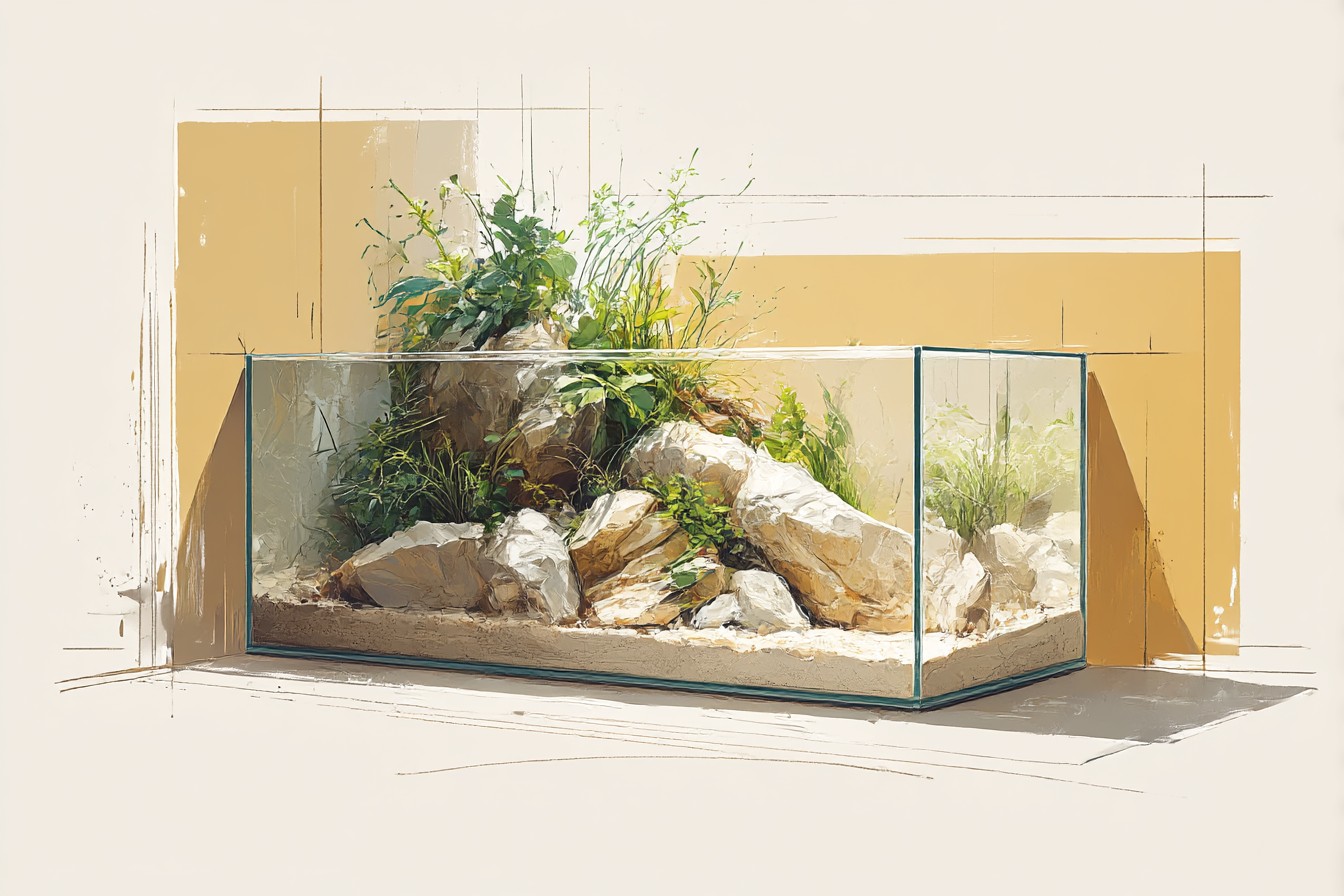
# How to Hardscape a Tank and the Basic Principles That Make or Break Your Layout You can mess up the hardscaping stage and spend months trying to fix it later, or you can get it right from the start and watch everything else autumn into place. The difference isn’t luck or artistic talent. It’s understanding a handful of principles that determine whether your tank looks like a natural underwater landscape or a pile of rocks with some plants stuck around it.
I’ve rebuilt the hardscape in my main tank three times because I didn’t grasp these fundamentals early on. Each rebuild meant moving fish, replanting everything, and starting the cycle process again. Not exactly fun when you’re working in four square feet of flat space with nowhere to temporarily house a colony of shrimp that took eight months to establish.
The popularity of aquascaping has grown considerably, with interest increasing 27% between 2020 and 2023 (Grand View Research). Most of that growth comes from people discovering that a well-designed underwater landscape creates something genuinely beautiful in their living space.
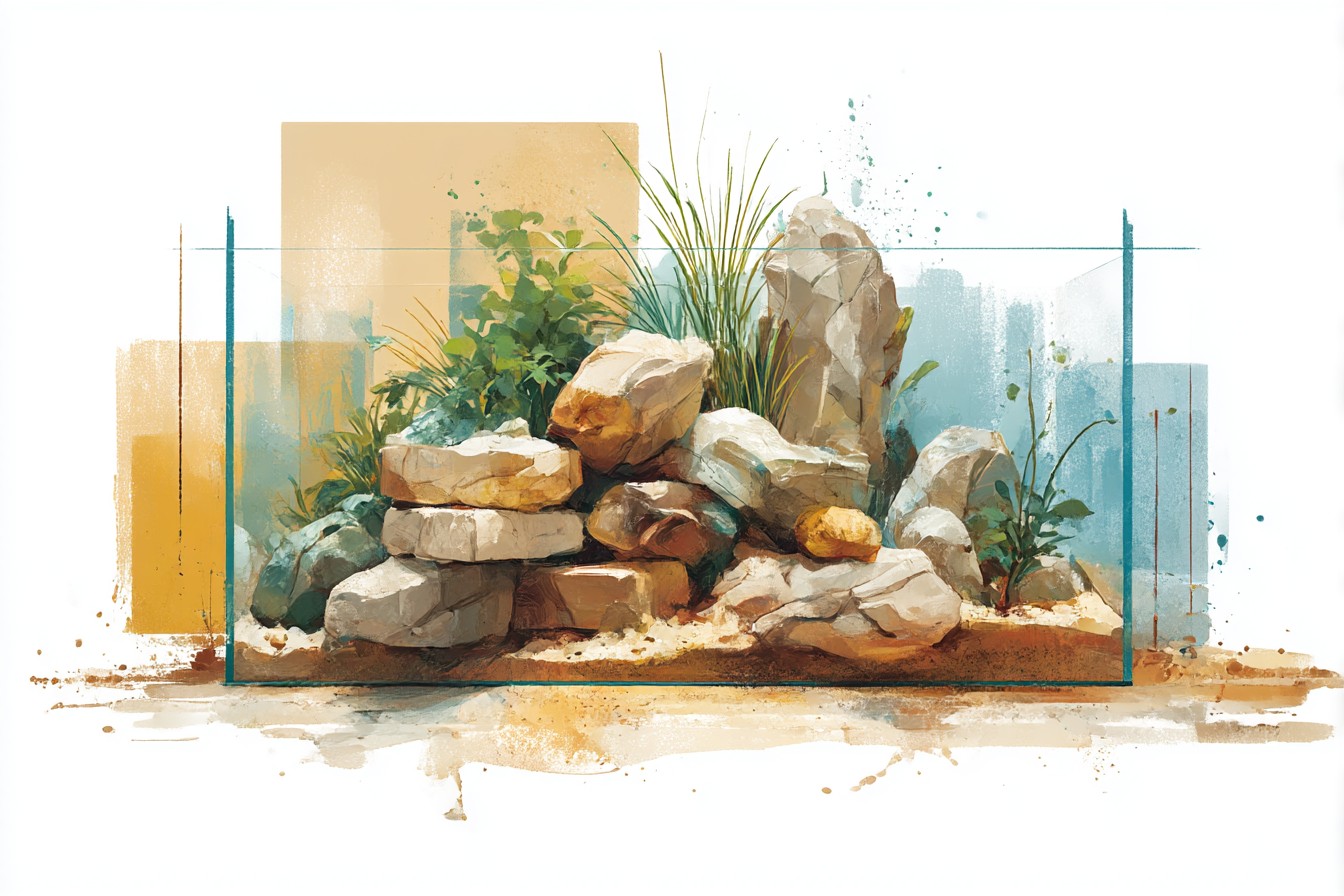
But the majority of those attempts fail at the hardscaping stage because people jump straight to arranging rocks and wood without understanding the basic composition rules that separate amateur attempts from professional-looking results. ## The Science Behind Visual Composition in Aquascapes Creating a hardscape that actually works isn’t about copying someone else’s design or randomly arranging materials until something looks right.
There’s solid research behind why certain arrangements feel natural and balanced while others look forced or chaotic. **Mathematical Proportions in Nature** The golden ratio appears throughout natural formations, from spiral shells to tree branch patterns, because it reflects optimal space utilisation in biological systems. In aquascaping, the golden ratio of 1.618 is commonly used for focal point placement (The Spruce Pets). This means your primary focal point, whether it’s the tallest piece of wood or most dramatic rock formation, should sit roughly 62% across the tank from either side rather than dead centre. **Rule of Thirds Framework** The rule of thirds divides your tank into nine equal sections using two horizontal and two vertical lines.
Placing key elements along these lines or at their intersections creates natural-looking balance because it mimics how our eyes scan landscapes in nature. The rule of thirds is a core aquascaping composition principle (Aquascaping Love) that prevents the symmetrical, artificial look that screams “someone arranged this.” **Depth Perception Through Layering** Your brain interprets depth based on overlapping elements and size relationships. Larger objects appear closer while smaller ones seem distant.
This biological response to spatial cues means you can create the illusion of a much larger space by carefully sizing and positioning your hardscape materials. Research shows that sloping substrate increases perceived tank depth by up to 30% (UKAPS) by working with these natural visual processing patterns. **Negative Space Psychology** Empty areas aren’t wasted space in a hardscape. They provide visual rest points that prevent compositions from feeling cluttered or overwhelming.
Negative space improves depth perception in aquascapes (Aquarium Co-Op) by giving your eye places to travel between focal points, creating the sense of exploring a natural environment rather than viewing a display case. ## Core Hardscaping Principles and Implementation Getting hardscaping right means understanding both the technical requirements and the aesthetic principles, then combining them properly. Miss either side and you end up with a tank that’s either unstable or ugly. **Foundation Planning Before Materials Touch Water** The biggest mistake I see is people buying rocks or wood first, then trying to figure out what to do with them. Start with your layout concept instead.
Are you building a mountain slope, a river valley, or a forest floor? That decision determines everything else. Triangular composition is one of the three classic layout styles (Aquarium Gardens) and the most forgiving for beginners.
You create one tall focal point, usually on the left or right third line, then slope everything down toward the opposite corner. This mimics natural hillsides and automatically creates the depth and flow that makes layouts work. Plan your substrate slope before adding any hardscape materials.
The substrate should be deepest at the back and shallowest at the front, with the slope following your planned composition. For a triangular layout, you want the deepest substrate under your tall focal point, gradually decreasing toward the opposite foreground corner. **Strategic Hardscape Placement** Your hardscape materials need to be placed before substrate in most layouts (Aqua Forest Aquarium). This seems counterintuitive since you’ll bury parts of rocks and wood, but it’s crucial for stability and natural appearance.
In nature, substrate settles around existing geological features, not the other way around. Start with your primary focal point. This is typically your largest or most interesting piece, placed according to the golden ratio rule.
Position it first, ensuring it’s stable against the glass and won’t shift when you add substrate or water pressure. Add secondary elements next, following the triangular composition line from your focal point toward the opposite corner. Each piece should feel related to the others through size, angle, or material, but not identical.
You’re creating a family of related forms, not setting up a display shelf. **Material Safety and Stability** Stone stability prevents glass stress and tank cracking (Practical Fishkeeping). Every piece needs to sit securely without pressure points against the glass. Use aquarium-safe silicone to bond stacked pieces together, or create stable contact points where pieces rest against each other naturally.
All hardscape materials must be aquarium safe and inert (LiveAquaria). Test unknown rocks with white vinegar. If they fizz or bubble, they contain carbonates that will raise pH and hardness continuously.
Woods need to be aquarium safe species like Malaysian driftwood, Mopani, or spider wood. Avoid any wood collected from outdoors unless you’re certain of the species and curing process. **Substrate Integration for Natural Appearance** Layered substrate helps create elevation and perspective (ADA Global). Use a base layer of aquarium soil or sand, then add varying amounts to create your planned slope.
The key is making the transitions look natural rather than obviously terraced. Build up substrate around hardscape pieces so they appear to emerge naturally from the bottom. In nature, rocks don’t sit on top of soil like decorations.
They’re partially buried, with soil and debris accumulated around their base. Recreate this by building substrate up around the bottom third of rocks and the root areas of driftwood pieces. ## Common Hardscaping Mistakes
You Might Also Like
Mistake #1: Centring everything. Placing your focal point dead centre creates a static, artificial look that immediately reveals human arrangement. Natural landscapes have asymmetrical focal points with supporting elements that create visual flow.
Use the rule of thirds or golden ratio for focal point placement instead.
Mistake #2: Identical spacing and sizing. Arranging rocks or wood pieces with equal spacing between them, or using similarly sized elements, creates a pattern that screams artificial. Natural environments have irregular spacing and varied sizes. Group some elements closely together while leaving larger gaps elsewhere.
Mistake #3: Ignoring scale relationships. Using hardscape materials that are too small for your tank size makes everything look miniaturised rather than natural.
Your primary focal point should be roughly one-third the height of your tank. Smaller tanks need proportionally larger hardscape pieces than you’d initially think.
Mistake #4: Flat, uniform substrate depth. Level substrate destroys any sense of depth or natural topography. Even small variations in substrate depth create visual interest and make plants look more natural when they’re established at different heights throughout the tank.
Mistake #5: Overfilling with hardscape. Cramming too many rocks or pieces of wood into the space eliminates negative space and creates visual chaos.
A successful hardscape should have substantial empty areas that provide visual breathing room and swimming space for fish.
Mistake #6: Poor stability planning. Stacking rocks or balancing wood pieces without secure foundations leads to collapses that can crack glass or crush fish. Every element needs a stable base that won’t shift when fish swim against it or substrate settles.
## Research Supporting Composition Principles Multiple studies in environmental psychology confirm that humans respond positively to natural patterns and proportions in designed spaces. The golden ratio appears consistently in natural formations because it represents optimal resource distribution and growth patterns.
Our brains have evolved to recognise these patterns as indicators of healthy, stable environments. Research on visual perception shows that asymmetrical compositions with clear focal hierarchies feel more dynamic and interesting than symmetrical arrangements. This explains why aquascapes following traditional composition rules consistently appear more natural and engaging than randomly arranged alternatives.
Studies of depth perception confirm that layered elements with size gradients and overlapping forms create stronger three-dimensional illusions than flat arrangements. The specific finding that sloping substrate increases perceived depth by 30% demonstrates measurable benefits from applying these principles systematically rather than hoping good arrangement happens by accident. ## Broader Applications Across Tank Types **Nano Tanks (under 40 litres):** Use fewer, proportionally larger hardscape pieces. A single dramatic piece of wood or 2-3 carefully arranged rocks often works better than trying to recreate complex compositions at small scale. **Community Tanks (100-200 litres):** Standard triangular or valley compositions work well.
You have enough space for complex arrangements but still need restraint to avoid overcrowding. **Large Display Tanks (200+ litres):** Can support more complex compositions with multiple focal points, but maintain clear hierarchies. Don’t just scale up smaller arrangements, use the additional space for more dramatic depth and flow. **Species-Specific Tanks:** Adapt compositions to fish behaviour.
Cichlid tanks need territorial boundaries created by hardscape placement.
Schooling fish need open swimming areas preserved in the composition. **Heavily Planted Tanks:** Plan for plant growth when hardscaping. Leave appropriate spaces for foreground, mid-ground, and background plants. Your hardscape should complement planned plant placement rather than compete with it. ## Benefits of Proper Hardscaping **Long-Term Stability:** Properly planned hardscapes remain stable for years without shifting or collapsing.
You won’t spend weekends rebuilding arrangements that have fallen apart or developed unstable elements that stress fish. **Enhanced Fish Behaviour:** Well-designed hardscapes provide natural territorial boundaries, hiding spots, and swimming paths that reduce fish stress and encourage natural behaviours. Fish appear more active and display better colouration in appropriately hardscaped environments. **Improved Plant Success:** Thoughtful substrate layering and hardscape placement create optimal conditions for different plant species. Background plants get the depth they need while foreground species have appropriate shallow areas. **Easier Maintenance:** Good hardscaping creates logical flow patterns that help with debris management and make plant trimming more accessible.
Poorly arranged hardscapes create dead zones where waste accumulates and areas that are impossible to reach for maintenance. **Genuine Aesthetic Appeal:** Hardscapes following natural composition principles look better from every viewing angle and remain visually interesting over time. Random arrangements may look acceptable initially but become boring or irritating as you live with them. **Higher Success Rate for Beginners:** Following established composition rules dramatically improves your chances of creating something that looks professional on the first attempt, reducing the frustration and expense of multiple rebuilds. ## Step-by-Step Implementation Guide **Phase 1: Planning and Design (Week 1)** – Decide on your composition style (triangular is most beginner-friendly) – Sketch your planned layout from front and side views – Mark focal point placement using rule of thirds – Plan substrate slope and depth variations **Budget Breakdown:** * Planning materials (paper, pencils): £5-10 * Total Budget: £5-10 **Phase 2: Material Selection and Preparation (Week 1-2)** – Source hardscape materials based on your tank size and composition plan – Test all rocks with white vinegar for aquarium safety – Clean and prepare all materials – Dry fit arrangement outside the tank **Budget Breakdown:** * Aquarium-safe rocks: £20-60 per tank depending on size * Driftwood pieces: £15-40 per piece * Aquarium silicone for bonding: £8-12 * Total Budget: £43-112 **Phase 3: Foundation Installation (Day 1 of tank setup)** – Install primary focal point first, ensuring stability – Add secondary hardscape elements following composition plan – Bond stacked elements with aquarium silicone where necessary – Cheque stability of all pieces before proceeding **Phase 4: Substrate Integration (Day 1 continued)** – Add base substrate layer across tank bottom – Build up substrate around hardscape elements for natural appearance – Create planned slope variations and depth changes – Smooth transitions between different substrate depths **Phase 5: Final Adjustments and Water Addition (Day 2)** – Make final positioning adjustments before water addition – Add water slowly to avoid disturbing substrate placement – Monitor for any shifting or instability during filling – Document successful arrangement for future reference **Budget Breakdown:** * Aquarium substrate: £25-50 depending on tank size and type * Total Phase Budget: £25-50 * **Complete Project Budget: £73-172** The initial investment seems substantial, but quality hardscape materials last for years and form the foundation for every future rescape. Getting this stage right saves money and frustration compared to repeated rebuilds using cheap materials that don’t work properly.
Done properly, hardscaping transforms your tank from a fish container into a natural-looking underwater landscape that gets better as plants establish and fish settle into the environment you’ve created for them. The principles aren’t complicated, but they need to be applied systematically rather than left to chance.


