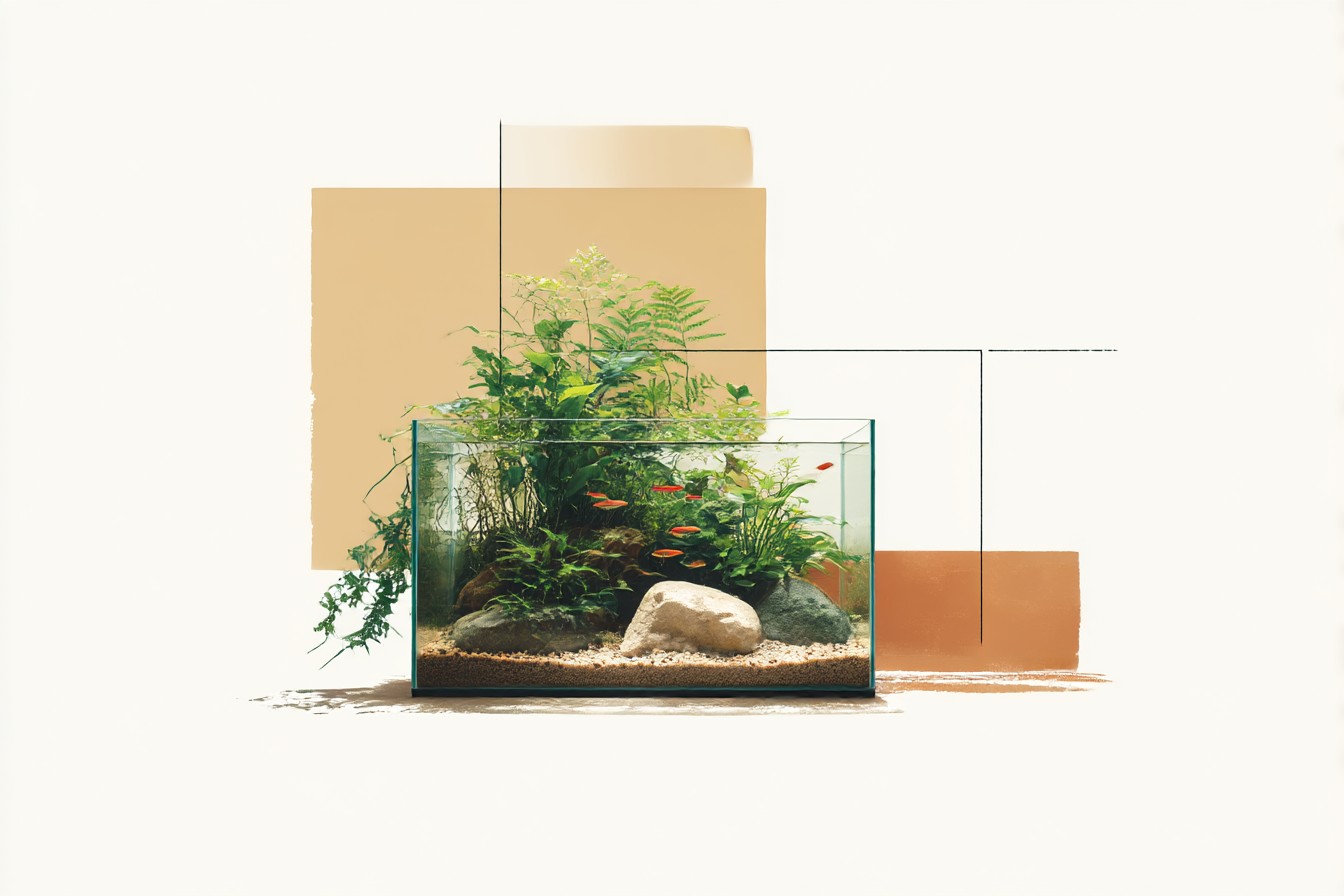
I stumbled into Japanese aquascaping styles because I was broke and bored. I’d been running a basic planted tank for months, mostly java fern and whatever else wouldn’t die under my clip-on light. Then I saw an iwagumi layout online and thought “that’s just rocks and grass, how hard can it be?” Three failed attempts and one properly humbling experience later, I realised I’d been looking at something that only appears simple.
Japanese planted aquarium styles aren’t just aesthetic choices. They’re entire philosophies about what an aquascape should be and how you achieve it. They’ve shaped everything we think we know about planted tanks, from the equipment we buy to the way we position our hardscape.
Understanding them properly means understanding why half the hobby does things the way it does, and why the other half spends so much money trying to replicate something that looks effortless. | **Aspect** | **Details** | |————|————-| | **Origin** | Japan, 1990s | | **Difficulty** | High – requires precision | | **Typical Tank Size** | 45-120cm optimal | | **Key Elements** | Negative space, natural materials, restraint | | **Time to Establish** | 3-6 months minimum | | **Our Rating** | Essential understanding | ## The Amano Revolution Takashi Amano, born in 1954 (ADA Japan), didn’t invent planted aquariums but he fundamentally changed what they could be. When he founded Aqua Design Amano in 1992 (ADA CELESTA), the aquascaping world was still thinking in terms of Dutch styles—dense plantings, bright colours, every available space filled with something growing.
Amano looked at that and essentially said “what if we did the opposite?” His approach drew heavily from Japanese gardening principles, bonsai aesthetics, and landscape photography.
Instead of filling space, he celebrated empty space. Instead of using every plant species he could fit, he used restraint. Instead of symmetry, he created tension through careful asymmetry.
The impact was immediate and lasting. His Nature Aquarium World book series, first published in 1994 (Wikipedia), became the aquascaping bible for a generation of hobbyists. Today, the International Aquatic Plants Layout Contest that bears his influence received 1533 entries in 2025 (IAPLC Official Site) from 77 countries and areas (IAPLC Official Site), with results announced on 30 Aug 2025 (AquaLibs).
That’s the reach of what he started. But Amano didn’t work in isolation. Japanese aquascaping styles represent a broader cultural approach to design that values suggestion over statement, negative space as much as positive space, and the beauty of imperfection within careful structure.
These aren’t just design choices—they’re philosophical positions about what makes something beautiful and why. ## What Makes Japanese Styles Different The fundamental difference isn’t in the plants or the equipment, though both matter. It’s in the thinking. Western aquascaping traditions, whether Dutch or German or British, tend toward abundance.
More colour, more variety, more visual impact per square centimetre. Japanese styles work in the opposite direction—toward essence, toward what you can remove while still maintaining the emotional impact you’re after. Take iwagumi, probably the most recognised Japanese aquascaping style.
At its core, it’s an exercise in restraint. A typical iwagumi uses an odd number of stones with a minimum of 3 (TIAS Summit), often 3, 5, or 7 stones (Aquascaping Academy), positioned according to principles borrowed from Japanese rock gardening. The golden ratio, described as about 1 to 1.618 (Aquascaping Academy), governs the relationship between elements.
Plant variety is typically limited to 1 to 3 species (Aquarium Lesson). But restraint isn’t the same thing as simplicity. Creating visual tension with three rocks and one type of carpeting plant requires understanding proportion, balance, and flow in ways that a heavily planted Dutch tank simply doesn’t.
You can’t hide mistakes behind a wall of rotala. Every placement decision is visible and permanent. The Japanese approach also differs in its relationship with time.
Western aquascaping often aims for immediate impact—the tank should look stunning from the moment it’s planted. Japanese styles acknowledge that the best layouts develop slowly. An iwagumi might look sparse and unconvincing for the first two months, then gradually reveal its structure as the carpet fills in.
The patience required isn’t just practical, it’s aesthetic. You’re designing for how the tank will look in six months, not six days. Then there’s the concept of wabi-sabi—finding beauty in imperfection and impermanence.
A stone with an interesting weathering pattern, a piece of driftwood with natural wear marks, plants that grow slightly asymmetrically. These aren’t flaws to be hidden but features to be celebrated. It’s a completely different relationship with natural materials than the Western preference for pristine, uniform elements.
The use of negative space is perhaps the most distinctive element. In a nature aquarium, the areas where nothing grows are as carefully planned as the areas where everything grows. Open sand, clear water, the visual breathing room that lets your eye rest—these aren’t empty spaces waiting to be filled, they’re integral parts of the composition.
You Might Also Like
Learning to see negative space as compositional element rather than wasted opportunity is one of the hardest mental shifts for hobbyists coming from other traditions. ## The Honest Assessment Here’s what nobody tells you about Japanese aquascaping styles: they’re significantly more difficult than they look, require better equipment than most hobbyists have, and demand a level of patience that runs counter to how most people approach the hobby. The equipment requirements alone are substantial. Japanese styles rely heavily on high-quality lighting, pressurised CO2, and precise control over water parameters.
You can approximate the look with budget kit, but you can’t achieve the refined execution that makes these styles work. The difference between a successful iwagumi and a failed one often comes down to the ability to maintain consistent growth rates across the entire carpet, which means consistent light, consistent CO2, and consistent fertilisation. The plant limitations that define these styles can become frustrating quickly.
When your iwagumi carpet starts showing patches or your hairgrass grows unevenly, you can’t just add more species to hide the problem. You have to solve the underlying issue or start over. This is character-building if you’re into that sort of thing, but genuinely maddening if you just want a nice-looking tank.
Maintenance is more demanding than it appears. That pristine carpet needs regular trimming to maintain its shape. Those carefully positioned stones need algae cleaning that doesn’t disturb their placement.
The high light and CO2 that make Japanese styles possible also make them susceptible to algae problems if your technique isn’t spot on. The time scales involved can be discouraging. A proper nature aquarium might not hit its stride for four to six months.
An iwagumi can look genuinely terrible for the first two months as the carpet establishes. If you’re used to the immediate gratification of adding a new plant and seeing instant results, the Japanese approach to gradual development can feel like watching paint dry. There’s also a cultural barrier that’s easy to underestimate.
These styles emerged from specific Japanese aesthetic traditions that don’t always translate directly. What looks like natural, effortless arrangement is actually the result of centuries of cultural development around concepts like ma (negative space), wabi-sabi (imperfect beauty), and mono no aware (the pathos of things). You can learn the technical rules, but internalising the aesthetic principles takes longer. ## Legacy and Influence The influence of Japanese planted aquarium styles on the modern hobby is impossible to overstate.
Before Amano, aquascaping was largely about horticulture—how many different plants you could grow successfully in one tank. After Amano, it became about composition, about creating underwater landscapes that worked as visual art. The equipment we use today exists largely because Japanese styles created demand for it.
High-end LED lighting systems designed for planted tanks, precise CO2 regulation equipment, substrate systems optimised for root development—all of this became standard because Japanese aquascaping demonstrated what was possible with proper tools. The way we think about hardscape placement, the golden ratio in tank design, the use of odd numbers of focal elements, the concept of foreground-midground-background layering—these have become so standard in aquascaping that most hobbyists don’t realise they’re applying Japanese design principles. Even heavily planted Dutch-style tanks now incorporate negative space and asymmetrical composition techniques that would have been foreign to the hobby before the 1990s.
The competition scene that drives much of aquascaping innovation today was fundamentally shaped by the IAPLC and similar contests that used Japanese aesthetic principles as their judging criteria.
When contest layouts from 77 countries (IAPLC Official Site) all show similar attention to composition and restraint, it’s because Japanese styles have become the international language of aquascaping excellence. Perhaps most importantly, Japanese aquascaping styles legitimised the idea that aquariums could be art, not just successful plant cultivation.
They elevated the hobby from “keeping aquatic plants alive” to “creating underwater landscapes,” and that shift in perspective opened up possibilities that are still being explored today. ## The Verdict Understanding Japanese planted aquarium styles isn’t optional if you want to engage seriously with aquascaping. They’re not just one tradition among many—they’re the foundational approach that shaped everything that came after. Even if you never build an iwagumi or attempt a nature aquarium, the principles of composition, restraint, and respect for natural materials that define Japanese styles will improve whatever you do build.
That said, they’re not for everyone. If you enjoy the abundance and variety of heavily planted tanks, if you like immediate visual impact, if you prefer a more forgiving approach to plant selection and maintenance, then Japanese styles might feel restrictive rather than liberating. There’s nothing wrong with that.
The hobby has room for different approaches. But if you’re drawn to the idea of creating something that looks effortless while being anything but, if you’re interested in composition as much as horticulture, if you can appreciate the beauty of what’s not there as much as what is there, then Japanese aquascaping styles offer a depth of possibility that’s worth the effort to understand properly. Just don’t expect it to be easy, cheap, or quick.
The patience alone will teach you things about the hobby that no amount of equipment can.



[…] them requires significant experience and often specific equipment for proper implementation. Our Japanese aquascaping styles guide breaks down the specific techniques and how to apply them regardless of tank size. ## Almost Made […]