
# Lucky Bamboo in an Aquarium and the Difference Between Real and Lucky Bamboo Standing in an aquatics shop last year, I watched someone confidently explaining to their friend how “lucky bamboo grows underwater just like in nature.” I nearly said something, then thought better of it. We’ve all been there—you see something that looks like it belongs in an aquarium, and you assume it works the same way actual aquatic plants do. The truth about lucky bamboo is more interesting and more useful than the myths floating around online, but it requires understanding what this plant actually is and what it can genuinely do for your tank.
Lucky bamboo isn’t bamboo at all. It’s Dracaena sanderiana, a houseplant that’s become popular in aquascaping despite being fundamentally misunderstood (Biology Insights). The confusion comes from its appearance and the way it’s marketed, but treating it like a true aquatic plant will kill it.
Treating it properly, however, can give you an attractive emergent feature that actually helps with water quality. The key is knowing the difference between what works and what’s just aquarium shop folklore.
If you’re setting up your first planted tank, our complete beginner’s guide covers the fundamental principles that apply to all plant choices, including emergent species like this one. ## The Science Behind Dracaena in Aquatic Systems **Root Development in Hydroponic Conditions** The biological reality is that Dracaena sanderiana evolved as a terrestrial plant but has remarkable adaptability to hydroponic conditions.
In controlled hydroponic culture, Dracaena can develop a complete root system within two months (Real Simple). This adaptation allows it to function effectively as an emergent plant in aquarium systems, where the roots remain submerged while the foliage stays above water. **Nutrient Processing Mechanisms** The plant’s ability to process aquarium waste products comes from its natural nitrogen metabolism. Like other houseplants adapted to hydroponic systems, Dracaena sanderiana can absorb dissolved nutrients directly through its root system.
In aquarium applications, this translates to measurable nitrate reduction, with forum reports showing results within approximately four weeks of proper installation (Aquarium Co-Op Forum). **Growth Response in Aquatic Environments** The growth potential in aquarium setups can be substantial. Documented cases show lucky bamboo growing from 24-inch stalks to 6 feet tall when given proper conditions in an aquatic system (Aquarium Co-Op Forum). This vigorous growth indicates the plant’s ability to effectively utilise the nutrient-rich environment of an established aquarium, but it also means you need to plan for ongoing maintenance. **Water Chemistry Sensitivities** The plant’s terrestrial origins create specific vulnerabilities in aquarium applications.
Dracaena sanderiana is notably sensitive to both fluoride and chlorine commonly found in tap water (The Plant Aide). Fluoride, which is stable in water and harmful to Dracaena sanderiana, can accumulate over time if tap water contains high fluoride levels (Biology Insights). Since chlorine is used as a drinking water disinfectant in municipal supplies (US EPA), proper water preparation becomes essential for success. ## Proper Implementation for Aquarium Use **Tank Requirements and Setup** The minimum recommended tank size for incorporating lucky bamboo is 5 gallons (Fish Tank Advisor).
This isn’t arbitrary—smaller tanks don’t provide enough water volume to dilute the plant’s waste products or maintain stable conditions around the root zone. In practise, I’ve found that 60 litres or larger works better, particularly if you’re keeping fish that are sensitive to water parameter fluctuations. The installation method matters more than most people realise.
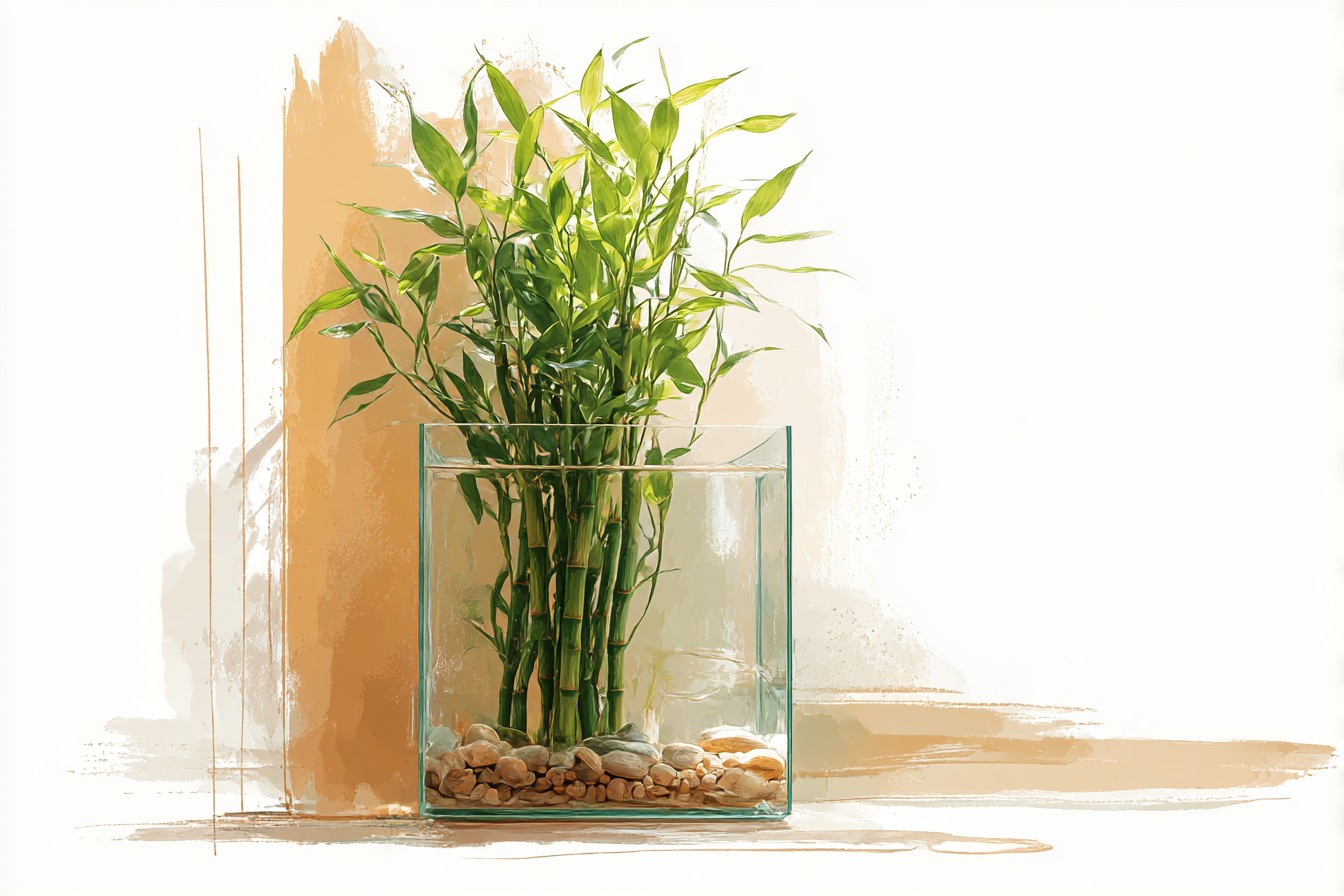
The established guidance recommends partial submersion rather than fully submerged leaves (Aquarium Store Depot). This means the root system and lower stem sections remain underwater while all foliage stays above the waterline. Submerging the leaves leads to rot within weeks, regardless of lighting or water conditions. **Placement and Support Systems** Position the stalks so roughly two-thirds of each stem length is submerged.
You’ll need some form of support system to maintain this positioning—the plants will shift over time without proper anchoring. I use suction cup plant holders positioned about 5cm below the intended waterline, which allows for minor water level fluctuations without exposing roots or submerging leaves. For multiple stalks, space them at least 8-10cm apart to prevent overcrowding as the root systems develop.
The roots become quite extensive and will compete for space and nutrients if placed too closely together. **Water Preparation Protocol** Standard dechlorination isn’t sufficient due to the fluoride sensitivity issue. If your local water supply has moderate to high fluoride levels, you’ll need either RO water or a specific fluoride-removing treatment. Most standard aquarium dechlorinators handle chlorine and chloramine but don’t address fluoride.
Test your tap water’s fluoride content before committing to lucky bamboo. If it’s above 1 ppm, you’ll need alternative water sources or additional treatment. This adds to the ongoing cost and complexity, which is worth factoring into your decision. **Lighting and Environmental Factors** Lucky bamboo tolerates lower light conditions than most aquatic plants, which makes it suitable for tanks without high-intensity lighting systems.
Standard aquarium lighting is typically sufficient, though the plants will grow more slowly in low-light conditions. This can actually be an advantage if you want to minimise pruning frequency. Temperature stability matters more than specific temperature ranges.
The plant adapts to normal tropical aquarium temperatures (22-26°C) without issues, but sudden temperature swings can stress the root system and lead to yellowing leaves. ## Common Implementation Mistakes
Mistake #1: Fully submerging the foliage. This is the most common error and leads to inevitable plant death. The leaves will start yellowing within a week and progress to complete rot within a month. The plant cannot photosynthesise underwater despite what some online sources suggest.
You Might Also Like
Keep all green foliage above the waterline regardless of tank setup.
Mistake #2: Using untreated tap water. Standard dechlorination isn’t enough due to fluoride sensitivity. Many people assume that if their tap water is safe for fish, it’s automatically safe for lucky bamboo. The fluoride levels that don’t affect fish can cause gradual decline in Dracaena sanderiana, often taking months to become obvious.
By then, you’ve wasted time and money on a failing plant.
Mistake #3: Expecting immediate nitrate reduction. The plant needs time to establish its root system and begin effectively processing nutrients. Expecting results within the first couple of weeks leads to disappointment and premature removal. Allow at least 6-8 weeks for the plant to settle in and begin contributing to water quality.
Mistake #4: Inadequate support and positioning. Many people simply drop the stalks into the tank without proper anchoring.
The plants shift position, leaves end up underwater, or the entire setup becomes unstable. Proper positioning requires planning and dedicated support equipment, not improvisation with whatever’s handy.
Mistake #5: Ignoring growth management. The vigorous growth potential means these plants need regular pruning to prevent them from taking over the tank area. Failing to plan for this leads to overgrown installations that become difficult to maintain and can block lighting for other plants or create flow issues.
## Research Support The evidence base for using Dracaena sanderiana in aquarium applications combines horticultural research on the plant’s hydroponic adaptability with practical aquarium community documentation.
The controlled studies on root development in hydroponic conditions demonstrate the plant’s biological suitability for aquatic environments, while the fluoride and chlorine sensitivity data explains the specific water quality requirements that differentiate this application from standard aquatic plant care. The aquarium community documentation, particularly regarding nitrate reduction timelines and growth responses, provides practical context for implementation expectations. These sources collectively demonstrate that while lucky bamboo can function effectively in aquarium systems, success requires understanding its specific requirements rather than treating it like a conventional aquatic plant. ## Application Across Different Tank Types **Nano Shrimp Tanks:** Suitable for tanks 20 litres and above, but growth must be managed aggressively to prevent overgrowding.
Single stalks work better than multiple plantings in smaller systems. **Community Planted Tanks:** Works well as background emergent feature in tanks 60 litres and larger.

Can complement other emergent plants like pothos for varied textures and improved nutrient processing. **Low-Tech Setups:** Particularly suitable for low-tech tanks where lighting limitations make other emergent plants difficult to maintain. The lower light tolerance is an advantage in these applications. **Cichlid Tanks:** The robust root system can handle the higher nutrient loads typical in cichlid setups, though the increased bioload means more frequent water changes to manage fluoride accumulation. **Coldwater Systems:** Less suitable for unheated tanks due to temperature sensitivity.
Growth slows significantly below 18°C and the plant becomes more vulnerable to water quality issues. ## Benefits Summary **Established Nitrate Processing:** After the initial establishment period, lucky bamboo provides measurable nitrate reduction without the lighting and CO2 requirements of submerged plants. This benefit becomes noticeable within 4-6 weeks and continues as long as the plant remains healthy. **Low Lighting Requirements:** Unlike most aquatic plants, lucky bamboo thrives under standard aquarium lighting without supplementation. This makes it particularly valuable for tanks where high-intensity lighting isn’t practical or desired. **Attractive Emergent Feature:** The above-water foliage adds vertical interest and natural appearance to tank installations.
The green foliage provides visual contrast against typical aquatic plants while maintaining a cohesive natural aesthetic. **Robust Root Development:** Once established, the extensive root system provides stable nutrient processing and can handle temporary water quality fluctuations better than many aquatic plants. The roots also provide beneficial bacteria colonisation sites. **Extended Maintenance Intervals:** Compared to fast-growing submerged plants, lucky bamboo requires less frequent intervention once properly positioned. Pruning is needed monthly rather than weekly, reducing overall maintenance burden. **Cost Effectiveness:** Initial purchase cost is typically £3-8 per stalk, with no ongoing substrate or fertilisation requirements.
The main ongoing cost is water preparation if your tap water requires fluoride removal. ## Step-by-Step Implementation Guide **Phase 1: Assessment and Planning (Week 1)** – Test tap water for fluoride and chlorine levels using appropriate test kits – Measure tank dimensions to determine positioning for 2/3 submersion ratio – Purchase support equipment (suction cup holders, weights, or custom brackets) – Source appropriate stalks from reputable suppliers, avoiding grocery store versions treated with preservatives **Budget Breakdown:** * Water test kits: £15-25 * Lucky bamboo stalks (2-3 pieces): £8-20 * Support equipment: £10-15 * Water treatment supplies: £10-30 **Total Budget: £43-90** **Phase 2: Installation (Week 2)** – Prepare water using dechlorinator and fluoride removal if necessary – Position support systems at calculated depths – Install stalks with proper spacing and secure positioning – Monitor initial stability and adjust anchoring as needed **Phase 3: Establishment Monitoring (Weeks 3-8)** – Cheque positioning weekly and adjust supports as needed – Monitor leaf colour for early signs of fluoride toxicity or inadequate conditions – Begin weekly water parameter testing to establish baseline values – Document any early root development visible through tank glass **Phase 4: Integration Assessment (Weeks 9-12)** – Evaluate nitrate reduction effectiveness by comparing pre and post-installation levels – Assess growth rate and plan first pruning intervention – Fine-tune positioning based on plant response and tank flow patterns – Establish long-term maintenance schedule based on observed growth rates **Phase 5: Long-term Optimisation (Month 4 onwards)** – Implement regular pruning schedule to manage growth – Monitor for signs of nutrient deficiency or excess that might indicate system imbalance – Adjust water change frequency based on plant nutrient uptake rates – Consider expansion or additional stalks based on success of initial installation The reality is that lucky bamboo can work well in aquarium systems, but only if you understand what it actually is and what it needs. It’s not a substitute for proper aquatic plants, and it’s not maintenance-free despite what some sources suggest. What it is, when done properly, is an attractive emergent plant that can contribute meaningfully to tank stability while adding visual interest above the waterline.
Just don’t expect it to behave like bamboo, and don’t try to grow it underwater.


