
# Mangrove Plants in an Aquarium and the Brackish Setup Nobody Explains Properly Most aquarium guides treat mangroves like some exotic decoration you stick in the back corner and hope for the best. They’ll mention the propagules, suggest some brackish water, and move on to easier plants. What they don’t explain is that keeping mangroves properly means understanding an entirely different kind of aquatic ecosystem.
One where salinity isn’t constant, where the plant actively changes your water chemistry, and where the usual freshwater or marine rules simply don’t apply. If you’re considering mangroves, you’re probably dealing with one of two scenarios. Either you want to try something genuinely different from the standard planted tank setup, or you’re keeping brackish fish and wondering if mangroves might help with water stability.
Both are valid reasons, but both require you to understand what you’re actually setting up. This isn’t a plant that tolerates brackish conditions.

This is a plant that defines them.
The problem is that most aquarium information treats brackish as some middle ground between fresh and salt water. Mix half marine salt, half freshwater, job done. That’s not how mangrove ecosystems work, and it’s not how mangrove plants function in aquariums either.
Get this wrong and you’ll spend months wondering why your expensive propagules are slowly dying while your water parameters seem fine. ## The Science Behind Mangrove Salt Management Mangroves exist in one of the most chemically complex aquatic environments on the planet. Natural mangrove ecosystems see salinity readings that range from 0.5 parts per thousand in freshwater areas up to full seawater at 35 ppt (National University of Singapore Mangrove Guidebook). But that’s not the challenging part.
The challenging part is that these levels change constantly with the tides, sometimes moving from near-freshwater conditions to hypersaline pools exceeding 30 ppt (NUS Mangrove Guidebook) within the same ecosystem. **Salt Excretion Through Leaf Tissue**: The key mechanism that makes mangroves work is active salt excretion. Unlike freshwater plants that die in salt water, or marine plants that can’t function in fresh water, mangroves pump excess salt out through specialised cells in their leaves (Bulk Reef Supply). This isn’t passive tolerance.
It’s an energy-intensive process that the plant uses to maintain internal water balance regardless of external salinity. **Dynamic Salinity Response**: This salt excretion means your tank’s salinity will fluctuate based on plant activity, evaporation rates, and how much salt the mangroves are processing. The plant literally changes your water chemistry as it grows (The Aquarium Expert). Most aquarium plants consume nutrients and produce oxygen.
Mangroves do that plus actively alter salt concentration. **Temperature Dependencies**: The entire salt management system only functions properly above 60°F (LiveAquaria). Below that threshold, the energy-intensive salt excretion slows down, internal salt concentrations can become toxic, and the plant begins failing even if water parameters look correct. This biological complexity explains why you can’t just treat mangroves like any other aquarium plant.
You’re not adding a plant to your tank. You’re adding a living salt processing system that will actively change your tank’s chemistry based on its own metabolic needs. ## Setting Up the Brackish Environment Properly The standard advice about mixing marine salt with freshwater at some ratio misses the point entirely. Mangrove tanks need to be set up around salinity management, not just salinity levels.
Here’s how to build a system that actually works with the plant’s biology rather than fighting it. **Salinity Range Selection**: Red mangroves can survive in fresh, brackish, or full seawater, but they cannot be moved between these salinities quickly (LiveAquaria). Choose your target salinity based on your fish, not the plant. If you’re keeping mollies or brackish gobies, aim for 1.005-1.008 specific gravity (roughly 8-12 ppt).
For brackish puffers or scats, 1.010-1.015 (15-20 ppt) works better. The mangroves will adapt to whatever you choose, but they need consistent long-term salinity ranges, not constant fluctuations. **Water Top-off System**: Because mangroves actively excrete salt, evaporation will gradually increase salinity over time (Bulk Reef Supply). You need an automated top-off system using freshwater, not just occasional manual additions.
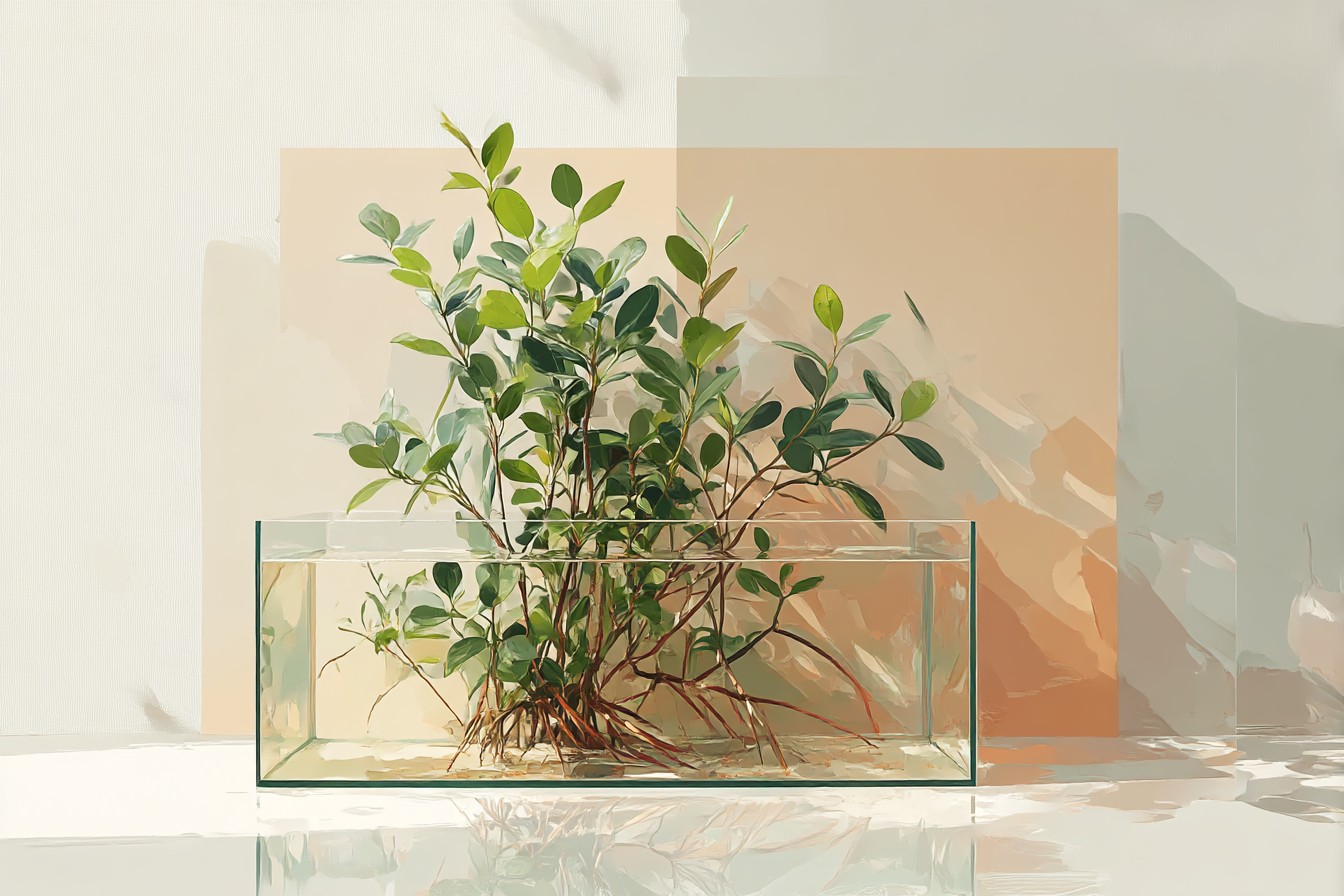
A simple float switch connected to a small dosing pump works for most setups. Without this, you’ll find yourself testing salinity weekly and manually adjusting constantly. **Propagule Preparation**: Red mangrove propagules arrive as 6-8 inch tubers (LiveAquaria). Don’t plant these immediately.
Float them at your target salinity for 2-3 weeks, changing water gradually if your target salinity differs significantly from their shipping water. Roots will begin developing during this period. Only plant once you see healthy root development and the first signs of leaf formation. **Substrate and Placement**: Unlike rooted aquarium plants, mangroves in nature grow in unstable, shifting sediments.
Use a mix of sand and small gravel, nothing too fine or too coarse. The roots need to anchor but also need water flow around them. Plant the propagule so the developing shoot points upward, but bury the root section completely.
Position near strong water flow from your filter output. **Lighting Requirements**: Mangroves need intense lighting for the salt excretion process to work efficiently. A standard planted tank light won’t cut it. Plan for metal halide, high-output T5, or very strong LED arrays.
The leaves need to be above water level for proper salt excretion, so either plan for an open-top tank or ensure your lighting can penetrate the water surface effectively. ## Tank Maintenance and Monitoring Maintaining a mangrove tank requires different monitoring than standard freshwater or marine setups. You’re tracking a dynamic system where the plant actively changes water chemistry, rather than a stable system where you make periodic adjustments. **Salinity Testing Schedule**: Test salinity every other day for the first month, then weekly once the system stabilizes (The Aquarium Expert). Use a refractometer, not hydrometers or test strips.
Salinity changes in mangrove tanks happen gradually but consistently, so you need precise measurements to catch trends before they become problems. **Leaf Management**: Mangrove leaves will drop regularly as part of normal growth. These must be removed immediately (Bulk Reef Supply). Decaying mangrove leaves release tannins and can crash water quality quickly in closed systems.
Cheque daily and remove any yellowing or fallen leaves before they start decomposing. **Growth Control**: Mangroves will outgrow most aquariums quickly if left unchecked. Plan to prune regularly, cutting back aerial roots and trimming height. The plant will develop both underwater roots and aerial roots above the water line.
You Might Also Like
The aerial roots can be trimmed without harming the plant, but underwater roots should be left alone unless they’re blocking equipment.
Mistake #1: Ignoring salinity drift. Many aquarists set their initial salinity and assume it will stay stable. Mangroves actively excrete salt while evaporation removes freshwater, causing gradual salinity increases over weeks or months. Without regular testing and freshwater top-off, salinity can drift well above safe ranges for both fish and the mangroves themselves.
Mistake #2: Inadequate lighting planning. Standard aquarium lighting is insufficient for proper mangrove metabolism.
Weak lighting means poor salt excretion, which leads to internal salt toxicity and eventual plant death. The symptoms look like general decline rather than obvious light deficiency, so many aquarists don’t connect the problem to lighting intensity.
Mistake #3: Rapid salinity changes during setup. Moving propagules directly from shipping water to significantly different salinity levels causes osmotic shock. Even though mangroves tolerate wide salinity ranges, they need gradual transitions over weeks, not immediate changes.
This kills more mangroves than any other single factor.
Mistake #4: Treating brackish like diluted seawater. Most aquarists mix marine salt with freshwater at some ratio and call it brackish. Real brackish water has different ionic compositions and trace element profiles. While mangroves will survive in artificial brackish mixes, they perform better with more complex water chemistry that includes trace elements found in natural estuarine environments.
## Research Support Multiple studies confirm that successful mangrove cultivation requires understanding their salt management biology rather than just providing appropriate salinity levels.
Research from the National University of Singapore demonstrates that natural mangrove habitats experience dramatic salinity fluctuations, with some areas ranging from near-freshwater conditions to hypersaline pools exceeding normal seawater salinity (NUS Mangrove Guidebook). This variability has shaped the plants’ physiology to actively manage salt through leaf excretion rather than passive tolerance. Commercial aquarium guidance consistently emphasizes the dynamic nature of mangrove salt management and the resulting need for continuous monitoring rather than set-and-forget water parameters (Bulk Reef Supply).
The consensus across multiple sources is that successful mangrove keeping requires treating salinity as a managed process rather than a fixed parameter. ## Broader Applications The principles of dynamic salinity management apply beyond mangrove-specific setups. Understanding how plants actively alter water chemistry provides insights for other specialised aquarium environments. **Estuary Simulation Tanks**: These same salinity management techniques work for recreating other estuary environments with different plant species, creating more authentic habitats for brackish fish breeding programs. **Marine Refugium Applications**: Mangrove salt excretion can be useful in marine refugiums where controlled salinity reduction helps with certain coral propagation techniques or provides brackish zones within larger marine systems. **Brackish Fish Breeding**: The gradual salinity changes that mangroves create naturally can trigger breeding behaviours in species like scats and monos that require salinity fluctuations for successful reproduction. **Research and Education**: Mangrove tanks provide excellent demonstrations of osmoregulation principles for educational purposes, showing students how plants and animals manage salt balance in changing environments. ## Benefits of Proper Mangrove Setup **Natural Water Quality Management**: Established mangroves process nitrates and phosphates effectively while their salt excretion helps maintain trace element balance. Water quality becomes more stable after the initial 8-10 week establishment period. **Authentic Brackish Ecosystem**: Unlike artificial brackish mixes, mangrove systems create genuinely dynamic water chemistry that better matches natural brackish habitats, leading to more natural fish behaviour and better breeding success. **Educational Value**: Watching salt excretion through the leaves and observing how the plant responds to salinity changes provides genuine insights into plant physiology that you can’t get from standard aquarium plants. **Long-term Stability**: Once established, mangrove systems require less intervention than standard planted tanks.
The plant’s salt management creates a buffer against parameter swings, though initial setup requires more attention to detail. **Fish Health Benefits**: Brackish fish kept in properly managed mangrove systems show better coloration, more natural behaviour, and improved disease resistance compared to those kept in static artificial brackish water. ## Step-by-Step Implementation Guide **Phase 1: Planning and Equipment (Weeks 1-2)** Plan tank size, lighting, and filtration based on adult mangrove size, not propagule size. A single red mangrove can grow 18 inches in its first year. Minimum tank size is 40 gallons for one plant, 75+ gallons for multiple specimens.
Install strong lighting system, efficient protein skimmer rated for brackish use, and automated freshwater top-off system. Budget Breakdown: * Red mangrove propagules: £15-25 each * Refractometer: £25-40 * Automated top-off system: £45-80 * High-output lighting: £120-200 **Phase 2: Water Preparation and Cycling (Weeks 3-6)** Mix target salinity water using marine salt and RO water. Cycle the system using standard marine cycling methods.
Begin floating propagules in target salinity water, changing water gradually if needed. Monitor ammonia, nitrite, and salinity daily. Add live rock or established filter media to speed cycling.
Budget Breakdown: * Marine salt mix: £25-35 * Live rock: £40-60 * RO system or ongoing RO water: £60-100 * Test kits: £30-50 **Total Budget: £365-590** **Phase 3: Planting and Initial Growth (Weeks 7-12)** Plant propagules once roots develop and cycling completes.
Begin daily salinity monitoring and weekly water changes. Remove fallen leaves immediately.
Adjust lighting schedule based on plant response. First leaves should appear within 3-4 weeks of planting. Begin reducing monitoring frequency as system stabilizes. **Phase 4: Fish Introduction and System Maturation (Weeks 13-20)** Add brackish fish gradually, monitoring salinity stability closely.
Established mangroves will begin significantly affecting water chemistry at this stage. Fine-tune top-off system based on actual evaporation and salt excretion rates. System should be fully stable and requiring minimal intervention by week 20.
If you’re planning to try mangroves, understand that you’re setting up a fundamentally different kind of aquarium system. The plant doesn’t just live in your water – it actively manages and changes it. That’s either fascinating or frustrating, depending on whether you understand what’s happening and plan for it properly.


