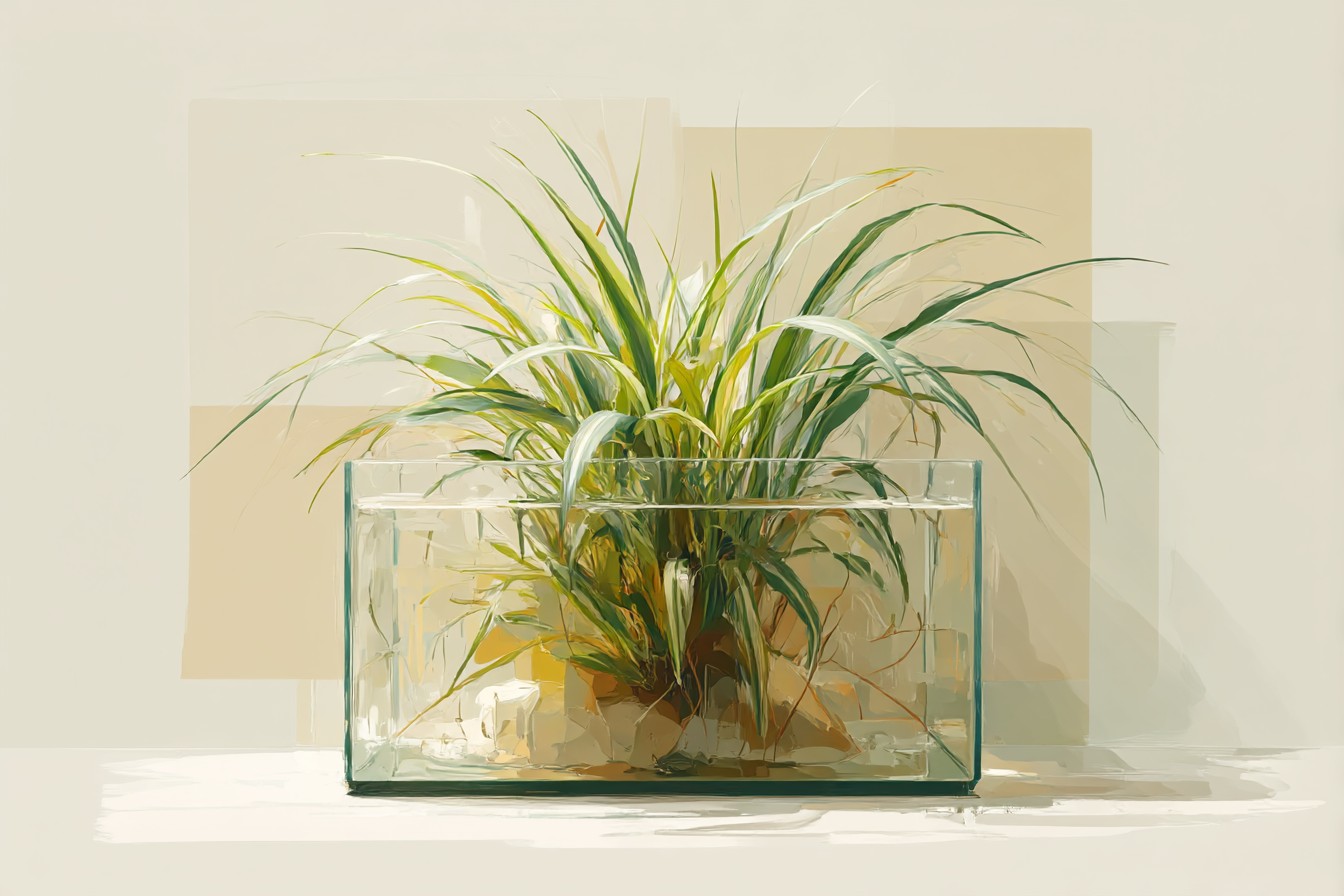
# Spider Plants in an Aquarium and Whether They Actually Survive Submerged I’ve been running low-tech planted tanks for three years now, always looking for ways to add interesting plant combinations without breaking the budget. When I came across mentions of spider plants in aquariums online, my first thought was that it sounded like one of those ideas that looks good in theory but falls apart when you actually try it. Spider plants are houseplants.
They grow in soil. Putting them in fish tanks seemed like the sort of thing that would work for a few weeks in a YouTube video and then quietly fail when nobody was filming. But I kept seeing it mentioned.
Not just in clickbait articles, but in actual aquascaping forums where people generally know what they’re talking about. So I decided to dig into the science and see if this was genuinely workable or just another internet aquascaping myth.

What I found was more nuanced than I expected, and definitely worth understanding if you’re thinking about trying it.
The key point that most people miss is that spider plants don’t actually survive fully submerged. The common mistake is thinking you can just stick the whole plant underwater like an Anubias or Java fern. That kills them fairly quickly.
But with the right setup, keeping just the roots submerged while the foliage stays above water level, they can actually thrive in aquarium conditions for years. ## Understanding Spider Plant Biology in Aquatic Environments Spider plants (Chlorophytum comosum) are naturally terrestrial plants, but they have some characteristics that make partial aquatic growing possible under specific conditions. To understand why this works at all, you need to look at how they’ve adapted to handle moisture stress in their native environment. **Root Structure and Water Uptake**: Spider plants have developed thick, fleshy roots that store water and nutrients. This adaptation originally helped them survive periods of drought in their native South African habitat.
In an aquarium setting, these same roots can absorb nutrients directly from the water column, similar to how they would take up dissolved nutrients from soil moisture. **Chlorophyll Distribution**: The leaves contain high concentrations of chlorophyll and can photosynthesize efficiently as long as they receive adequate light and CO2. In a partial aquatic setup, they can access atmospheric CO2 while the roots access dissolved nutrients from the tank water. This creates an interesting hybrid growing environment that can actually be more nutrient-rich than typical houseplant conditions. **Oxygen Requirements**: The critical factor is that spider plant leaves and crown require access to atmospheric oxygen.
The tissues aren’t adapted for underwater petrol exchange like true aquatic plants. When the foliage is submerged, the plant literally suffocates. Research guidance consistently emphasises that only the roots should be submerged and the crown kept above water (Biology Insights). **Growth Adaptation**: Plants growing in this partial aquatic environment show different characteristics from their soil-grown counterparts.
Spider plants in water culture may only reach about half the usual 12-24 inches height and spread (Homes and Gardens). This more compact growth actually works well for aquarium applications where you want the plant present but not dominating the entire setup. **Root Development Timeline**: When establishing spider plants in aquatic conditions, root development follows predictable patterns. Propagation rooting in water commonly occurs after about 2 weeks for water-grown houseplant cuttings (Real Simple).
This gives you a clear timeline for when a newly introduced spider plant should be showing signs of successful adaptation. ## Setting Up Spider Plants in Your Aquarium The practical implementation requires more consideration than just dropping a plant into your tank. I’ve tried several approaches and found that success depends heavily on getting the positioning and water chemistry right from the start. **Positioning and Support Systems**: The biggest challenge is keeping the crown and leaves above water while allowing root access to the tank. I use a combination of suction cup plant holders and floating platforms.
For a 30-litre tank, a simple acrylic shelf positioned about 2cm below the water surface works well. The spider plant sits on the shelf with roots trailing down into the water column. Another approach that works is using the rim of the tank itself.
Spider plants naturally produce plantlets on long runners, and you can position the mother plant outside the tank with runners trailing down so the plantlets can root in the water. This gives you more flexibility with lighting since the main plant isn’t constrained by the tank dimensions. **Water Chemistry Considerations**: Spider plants aren’t particularly demanding about water parameters, but they do respond to nutrient availability. In my experience, they actually help with nutrient export from the tank.
They’re efficient at pulling nitrates and phosphates from the water column, which can help control algae in planted tanks. However, chlorine tolerance is important to consider. Since chlorine is used in tap water disinfection (US EPA), you need to ensure any water changes use dechlorinated water, just as you would for fish.
The spider plant roots are directly exposed to the tank water and can be damaged by chlorine residues. **Lighting Requirements**: This is where things get interesting. Spider plants need decent light for photosynthesis, but they’re more tolerant of lower light than many houseplants. In an aquarium setup, they can benefit from both the tank lighting and room lighting.
I found that positioning them where they get some natural light from windows, combined with the tank LED system, gives better results than tank lighting alone. For a typical planted tank LED system running 6-8 hours daily, the spider plants do fine as long as they’re not shaded by the tank rim or other equipment. They actually seem to prefer the slightly filtered light they get from this positioning compared to direct bright light. **Maintenance and Water Changes**: Here’s where spider plants in aquariums differ from traditional water culture.
In regular water culture, guidance says change the water every week for spider plants in water (Homes and Gardens). But in an established aquarium, the biological filtration and regular tank maintenance schedule handles water quality for the plant as well as the fish. I do weekly 25% water changes on my tank anyway, which seems to provide adequate fresh nutrients for the spider plant.
The key difference is that the aquarium provides a much more stable and biologically active environment than a simple glass of water. ## Common Implementation Mistakes Most failures with spider plants in aquariums come from fundamental misunderstandings about how to set them up properly. These mistakes are predictable and avoidable once you know what to watch for.
Mistake #1: Submerging the entire plant. This is the big one. People see “aquarium plant” and assume the whole thing goes underwater.
Spider plants are not aquatic plants. Submerging the leaves and crown kills them within a few weeks as they can’t access atmospheric oxygen. Only the roots should be in the water, with foliage above the surface.
Mistake #2: Using plants that are already stressed. Spider plants from garden centres are often pot-bound, overwatered, or have damaged root systems.
These plants struggle to adapt to new growing conditions. Start with healthy plants or better yet, use plantlets from an established spider plant that are already showing good root development.
Mistake #3: Expecting immediate results. People get impatient when the plant doesn’t show obvious growth in the first few weeks. Spider plants need time to adapt their root system to the aquatic environment.
You should see new root growth within 2-3 weeks, but significant foliage development takes 6-8 weeks.
Mistake #4: Inadequate support systems. Trying to balance a spider plant on the tank rim or using flimsy supports that shift when you do maintenance. The plant needs stable positioning that won’t change when you’re working on the tank. Invest in proper plant holders or build a stable shelf system.
Mistake #5: Ignoring fish compatibility. Some fish species are notorious for eating or damaging plants.
Large cichlids, goldfish, and some catfish will destroy spider plant roots trailing in the water. Consider your fish species before adding any plant material to the tank.
You Might Also Like
Mistake #6: Poor lighting planning. Positioning the plant where it’s heavily shaded by equipment or the tank rim. Spider plants need reasonable light levels to photosynthesize effectively.
Plan the lighting setup before installing the plant, not after.
## Research Evidence for Long-Term Viability The question of whether this actually works long-term has been addressed by several aquascaping sources, and the evidence is encouraging for properly implemented setups. Multiple sources confirm that spider plants can survive and even thrive in aquarium conditions when set up correctly. Research notes that spider plants develop in aquariums as long as only roots are submerged (Ready To DIY), and that survival long-term is possible if foliage does not touch water (Life Of Fish).
More optimistically, dedicated aquascaping sources report that spider plants can thrive in aquariums for several years with proper care (Aquatics Kingdom). This suggests that with the right setup and maintenance, this isn’t just a short-term novelty but a genuinely viable long-term addition to planted tank systems. The evidence indicates that success depends heavily on implementation rather than fundamental biological incompatibility.
Plants fail when set up incorrectly, not because the concept itself is flawed. ## Applications Across Different Tank Types The principles of partial aquatic spider plant growing can be adapted to various aquarium setups, though some work better than others. **Community Planted Tanks**: Best application. The diverse nutrient load from fish waste provides good nutrition for the spider plant, while the plant helps with nutrient export. Works well in tanks from 40 litres upward where there’s space for proper positioning systems. **Shrimp Tanks**: Excellent compatibility.
Shrimp don’t damage plant roots, and the spider plant provides additional biological filtration. The plant is also non-toxic to invertebrates, making it safe for breeding colonies. Spider plant is listed as non-toxic to dogs and cats (ASPCA), suggesting general low toxicity. **Goldfish Tanks**: Problematic.
Goldfish are notorious for eating and destroying plant material. The trailing roots would likely be eaten or damaged regularly. Not recommended unless you can protect the root system completely. **Cichlid Tanks**: Depends on species.
Aggressive or large cichlids will destroy the roots. Smaller, less destructive cichlids like German Blue Rams might be compatible, but this needs careful monitoring. **Nano Tanks**: Challenging due to space constraints for positioning systems. In tanks under 30 litres, the support structure for keeping the plant properly positioned often takes up too much space or interferes with equipment placement. **Paludarium Setups**: Ideal application.
The partial terrestrial, partial aquatic environment is exactly what spider plants need. They can be integrated into the terrestrial section with roots accessing the aquatic section naturally. ## Key Benefits of Spider Plants in Aquarium Systems Understanding why you might want to try this helps justify the effort and setup complexity involved. The benefits go beyond just aesthetic appeal. **Biological Filtration Enhancement**: Spider plants are efficient at removing dissolved nutrients from water.
They absorb nitrates and phosphates directly through their root systems, providing additional biological filtration beyond what bacterial filtration achieves. This can help maintain water quality in heavily stocked tanks. **Natural Algae Control**: By competing for the same nutrients that fuel algae growth, established spider plants can help control nuisance algae. This is particularly useful in tanks that receive natural light or have higher nutrient loads from fish waste. **Unique Aesthetic Appeal**: The combination of terrestrial plant foliage above water with roots trailing into the aquatic environment creates visual interest that pure aquatic plants can’t provide.
The plantlets that spider plants naturally produce add to this effect. **Cost-Effective Plant Addition**: Spider plants are inexpensive and readily available. A single plant from a garden centre typically costs £3-5, much less than many aquatic plants. They also propagate easily, so one plant can eventually provide material for multiple tanks. **Low Maintenance Requirements**: Once established, spider plants in aquarium systems require minimal additional care beyond normal tank maintenance.
They don’t need separate fertilisation schedules or special care routines. **Educational Value**: For anyone interested in plant biology or aquaponics principles, spider plants in aquariums demonstrate how terrestrial plants can be integrated into aquatic systems. It’s a good introduction to hybrid growing methods. ## Step-By-Step Implementation Guide Getting this right requires a planned approach rather than just hoping for the best. I’ve broken this down into phases that build from basic setup to fully established system. **Phase 1: Planning and Equipment Setup (Week 1)** First, assess your tank and fish compatibility.
Measure available space above the waterline and plan your support system. You need at least 5-8cm of clearance above the water surface for the spider plant crown and initial leaf growth. Purchase or build support systems.
Simple acrylic shelves work well and cost £8-12 from aquarium suppliers. Alternatively, suction cup plant holders designed for riparian plants cost £5-8 and work for smaller spider plants. Select a healthy spider plant or plantlets.
Look for plants with white, healthy roots and no signs of pest damage or disease. Garden centre plants typically cost £3-5. Alternatively, ask other aquascapers if they have plantlets available, as spider plants propagate readily. **Budget Breakdown Phase 1:** * Support system (acrylic shelf or holders): £5-12 * Spider plant: £3-5 * Total Budget: £8-17 **Phase 2: Installation and Initial Setup (Week 2)** Install support systems during a regular maintenance session.
Position them so the spider plant crown will be 1-2cm above the maximum water level, accounting for any variation in water level during maintenance. Prepare the spider plant by gently cleaning the roots and removing any damaged tissue. If using a garden centre plant, gently remove soil from the roots and rinse thoroughly.
This prevents introducing contaminants to the tank. Position the plant and allow roots to trail into the water. Initially, only the tips of the roots should be submerged.
As the plant adapts, more of the root system will develop and extend into the water column. Monitor for signs of stress in both the plant and fish. Watch for leaf yellowing or wilting in the spider plant, and ensure fish behaviour remains normal. **Budget Breakdown Phase 2:** * No additional costs unless replacement plants needed * Total Budget: £8-17 **Phase 3: Establishment and Growth (Weeks 3-8)** During this phase, the spider plant should develop new root growth specifically adapted to the aquatic environment.
You should see white root tips appearing within 2-3 weeks if the setup is working correctly. Maintain normal tank maintenance schedules. The weekly water changes provide fresh nutrients for the spider plant without requiring additional fertilisation.
Monitor water parameters to ensure the plant isn’t negatively affecting tank chemistry. Watch for plantlet development. Healthy spider plants will begin producing runners and plantlets within 6-8 weeks if conditions are suitable.
These can be used to expand the setup or share with other aquascapers. Temperature considerations become important during winter months. General guidance notes bring spider plants indoors when temps drop below 50°F (Better Homes and Gardens).
In UK conditions, unheated fish rooms may need attention during winter to maintain suitable temperatures. **Phase 4: Long-Term Management (Months 3+)** By this point, you should have a well-established system that requires minimal additional attention.

The spider plant should show consistent growth and may need occasional trimming to prevent it overwhelming the tank area. Consider propagation opportunities.
Healthy spider plants produce numerous plantlets that can be harvested and used to establish new plants. This provides material for other tanks or trading with fellow aquascapers. Monitor for any changes in fish behaviour or water chemistry over the long term.
Well-established spider plants should contribute positively to water quality rather than causing problems. Plan for seasonal variations in growth rates. Spider plants tend to grow more actively during spring and summer months, which may require more frequent trimming or adjustment of positioning systems. **Budget Breakdown Phase 4:** * Occasional replacement of support systems: £0-5 annually * Total ongoing costs: Minimal This approach provides a realistic timeline and budget for implementing spider plants in aquarium systems.
The total initial investment is modest, and ongoing costs are essentially zero if the system is set up correctly from the start. The key insight from trying this myself is that it works better than expected when done properly, but fails predictably when people skip the planning phase or misunderstand the basic requirements. Like most aquascaping techniques, the devil is in the implementation details rather than the fundamental concept.


