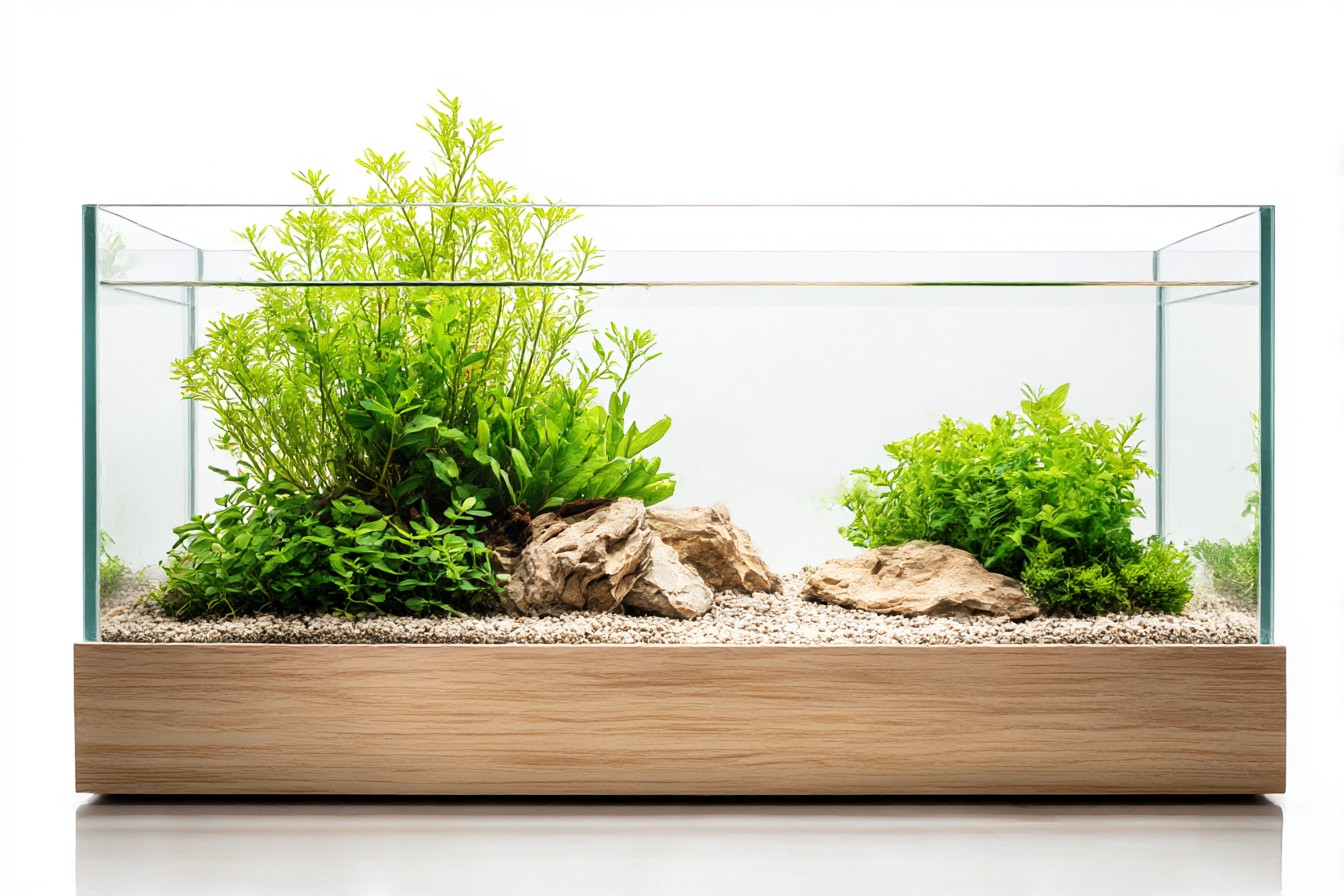
# 20 Gallon Planted Aquarium and Why This Size Gives You the Most Options I’ll admit it – I set up my first 20 gallon because it was the biggest tank I could afford that would still fit on my existing desk. Three years and seven tanks later, it’s still the one I spend the most time watching. My kids cheque it every morning before school, and I find myself tweaking the scape during video calls because I can see it from my workspace.
It’s the tank that taught me most of what I know about aquascaping, and if I had to pick just one size to keep for the rest of my life, this would be it. The 20 gallon sits in a sweet spot that most other tank sizes miss entirely. Big enough for proper aquascaping with distinct foreground, midground, and background zones.
Small enough that you can actually see the whole composition from a normal viewing distance. Manageable for weekly maintenance without requiring a full afternoon.

Light enough that most furniture can handle it without modification.
And crucially, it gives you enough water volume to keep things stable while still letting you experiment without massive consequences when things go wrong. **Quick Reference Table** | Volume | Dimensions (L x W x H) | Weight (filled) | Surface Area | Suitable Fish Load | Lighting Needs | Our Rating | |——–|————————|—————–|—————|——————|—————-|————| | 20 gallons / 76 litres | 30″ x 12″ x 12″ (long) or 24″ x 12″ x 16″ (high) | 222 lb / 101 kg | 360 sq in (long) / 288 sq in (high) | 15-20 small fish | Medium intensity LED | 9/10 | ## Why Twenty Gallons Works So Well The magic of a 20 gallon tank isn’t immediately obvious when you’re standing in the aquatics shop comparing it to everything else on display. It looks modest next to the 55 gallon show tanks. It seems barely bigger than the 10 gallons that are often marketed as starter tanks.
But once you get it home and start planning your first proper planted aquascape, the advantages become clear. Twenty gallons equals 75.7 litres (UnitConverters), which puts you well into the territory where water chemistry stays reasonably stable between maintenance sessions. You’re not fighting daily parameter swings like you would with smaller volumes.
At the same time, you can still manage complete water changes manually if you need to, without requiring pumps or external drainage systems. The standard dimensions work brilliantly for aquascaping (Aquariawise). Whether you go with the long format at 30 inches by 12 inches by 12 inches (MuchFish) or the high version at 24 inches by 12 inches by 16 inches (The Aquarium Expert), you get enough horizontal space for a proper foreground-to-background composition without the tank becoming so wide that the back corner becomes a maintenance nightmare.
The weight factor matters more than most people realise until they’re trying to move house. At 221.9 pounds when filled (Fish Tank Focus), it’s substantial enough to feel serious but not so heavy that you need to worry about floor loading in most homes. The water alone weighs about 166.8 pounds (Backstabber Lures), leaving around 55 pounds for the tank, substrate, hardscape, and equipment – perfectly manageable for standard furniture. ## The Aquascaping Advantage This is where the 20 gallon really shines, and it’s why I ended up with one on my desk rather than tucked away in a corner somewhere.
The proportions work for human-scale viewing in a way that larger tanks often don’t. You can see the entire composition clearly from three feet away, which means you can actually appreciate the detail work that goes into a proper planted aquascape. The long version gives you 360 square inches of surface area (Aqua Initium), which is enough space for distinct zones without feeling cramped.
I can fit a proper carpet plant foreground, a rocky outcrop or driftwood feature for the midground, and tall stem plants for the background. The high version offers 288 square inches (Aqua Initium) but gives you that extra height for dramatic vertical compositions that work particularly well with hanging plants or tall, sculptural pieces of driftwood. The footprint means you can get good light coverage without needing multiple fixtures.
A single quality LED unit will cover the entire tank evenly, which eliminates the patchy growth issues that plague larger tanks with inadequate lighting setups. You can run CO2 effectively because the volume is manageable – a small pressurised system will give you proper distribution throughout the water column without requiring multiple diffusers or circulation pumps. For someone learning aquascaping principles, the scale is perfect.
Mistakes are visible quickly enough that you can learn from them, but the tank isn’t so small that every adjustment affects everything else immediately. You can experiment with different plant combinations, try various hardscaping approaches, and develop your eye for composition without the expense and time commitment of a larger system. ## Stocking Flexibility That Actually Makes Sense The fish selection possibilities in a 20 gallon are where this tank size really proves its worth. You’re past the limitations of nano tanks but you’re not dealing with the complexities of managing larger community setups.
This is the smallest tank where you can keep most of the species that make planted aquariums genuinely interesting to watch. A school of 12-15 small tetras or rasboras gives you proper shoaling behaviour without overwhelming the tank. Six to eight corydoras catfish can exhibit their natural social dynamics.
A pair of dwarf cichlids can establish territory and potentially breed. Shrimp colonies can thrive without being instantly decimated by fish that see them as expensive snacks. More importantly, you can combine species in ways that create actual ecosystem dynamics.
Bottom dwellers, mid-water swimmers, and surface fish can all coexist comfortably. The bioload is manageable with reasonable filtration, but there’s enough biological activity to keep the nitrogen cycle running smoothly and provide nutrients for plant growth. The tank is large enough that fish don’t feel constantly stressed by the boundaries, but small enough that you can observe their behaviour closely.
I’ve learned more about fish personalities and social hierarchies from watching my 20 gallon than from any of the larger tanks I keep. There’s something about the scale that makes individual fish behaviour visible and memorable. ## Maintenance Reality Cheque Here’s what nobody tells you about tank maintenance until you’ve been doing it for a while: the ideal tank is one that you can manage consistently without it becoming a burden. Too small, and you’re constantly tweaking parameters.
You Might Also Like
Too large, and maintenance sessions become weekend projects that you start avoiding. Twenty gallons hits the sweet spot. Weekly 25% water changes are about five gallons, which you can handle with a bucket and siphon without needing pumps or hose connections.
The substrate area is manageable for thorough cleaning without requiring an entire afternoon. Plant trimming stays reasonable because even fast-growing species can’t completely overwhelm the space between maintenance sessions. The parameter stability means you’re not constantly testing water chemistry or dealing with emergency interventions.
Established 20 gallon planted tanks are remarkably stable systems that tolerate the normal variations in feeding, lighting schedules, and maintenance timing that come with real life. Equipment maintenance is straightforward because everything is accessible. Filter cleaning, CO2 system cheques, and light fixture adjustments can all be handled quickly.
You’re not crawling behind a massive tank or trying to reach into deep corners that have been colonised by algae because you can’t maintain them properly. ## The Equipment Sweet Spot The equipment requirements for a 20 gallon planted tank autumn into the range where you have good options without needing professional-grade gear. A single medium-intensity LED fixture provides adequate PAR across the entire footprint. A canister filter rated for 30-40 gallons gives you proper biological and mechanical filtration without over-circulating the water.
A small CO2 system with a basic diffuser will maintain adequate levels throughout the tank. This is important from a cost perspective, but it’s equally important from a reliability standpoint. Simple systems fail less often and are easier to troubleshoot when they do fail.
The equipment that works well for 20 gallons tends to be mature technology that’s been refined over years rather than cutting-edge gear that might have unexpected quirks. Heating is straightforward with a single adjustable heater. Circulation needs are modest enough that the filter return usually provides adequate flow.
Even backup systems are manageable – a battery-powered air pump and airstone can keep things stable during power outages, and emergency heating isn’t the life-or-death issue it becomes with larger volumes of water. ## Where It Falls Short The 20 gallon isn’t perfect, and being honest about its limitations prevents disappointment. The biggest constraint is fish selection. Anything that grows beyond about four inches is going to outgrow the tank eventually.
Most medium-sized cichlids, larger tetras, and certainly anything approaching six inches will need more space to be properly comfortable. Breeding projects are challenging because you don’t have room for proper grow-out tanks or adequate space to separate breeding pairs from the main community. If fish breeding becomes a serious interest, you’ll outgrow this tank size quickly.
The plant selection isn’t unlimited either. Large Echinodorus species will dominate the entire tank. Fast-growing stem plants can fill the available space quickly during optimal growing periods.
Very slow-growing species like Anubias can take months to establish visually interesting compositions because there isn’t room for large specimens from the start. Community complexity is limited by space. While you can keep several species together, you can’t create the elaborate multi-level communities that larger tanks allow.
Territory-holding species need to be chosen carefully because there isn’t unlimited space for fish to establish separate areas. ## Long Term Perspective I’ve been running my main 20 gallon for three years now, and it’s evolved through several complete rescapes without ever feeling limiting. It’s taught me plant propagation, fish behaviour, aquascaping composition, and equipment management.

The lessons learned here transfer directly to larger tanks, but the tank itself remains satisfying in ways that many larger systems aren’t.
The viewing experience stays fresh because the scale allows you to notice small changes. New leaf growth, subtle behaviour patterns, the way light plays through different plant textures – these details get lost in larger tanks where you’re focused on the overall effect rather than intimate observations. From a practical standpoint, it’s the tank that’s still running when work gets busy, when family commitments pile up, or when travel schedules become unpredictable.
The maintenance requirements are manageable enough that it doesn’t become a source of stress during hectic periods. ## The Final Word The 20 gallon planted aquarium works because it balances ambition with practicality. It’s large enough for proper aquascaping principles but small enough for consistent maintenance. Complex enough for interesting community dynamics but simple enough that you can understand what’s happening.
Impressive enough to be a genuine focal point in a room but manageable enough that it enhances your daily routine rather than dominating it. This isn’t the biggest tank you can fit or the smallest tank that will work. It’s the tank that gives you the most options within reasonable constraints.
For most people discovering planted aquariums, for experienced hobbyists who want something manageable, or for anyone who wants to understand aquascaping principles without massive time and financial commitments, this is the size that delivers the most satisfaction per pound of effort invested. See where this approach fits in our complete guide to planted aquarium sizing.


