
# 40 Gallon Planted Aquarium and When You’re Ready to Commit to the Hobby I’d been running a 20-gallon for about eight months when I realised I was already planning the next tank. Not upgrading. Adding to.
The 20-gallon was doing fine with its little school of neons and that Java fern I’d managed not to kill, but I kept finding myself browsing plant catalogues and sketching layouts on napkins during lunch breaks. That’s when I knew I’d crossed a line somewhere. The move to a 40-gallon breeder wasn’t an upgrade so much as an admission.
I wasn’t just keeping fish anymore. I was properly into this.

The 40-gallon was where I learned that substrate matters more than I’d realised, that CO2 injection isn’t optional if you want certain plants, and that the difference between a tank that looks okay and one that actually works is usually about six months of patience I didn’t think I had.
Four tanks later, the 40-gallon is still running. It’s become the testing ground for new ideas and the fallback when experiments in the other setups go wrong. It taught me more about planted aquariums than any amount of reading ever could have. ## Quick Reference Table | Care Level | Tank Size | Footprint | Filled Weight | Typical Stocking | Our Rating | |————|———–|———–|—————|——————|————| | Intermediate | 151 litres | 36″ x 18″ x 16″ | 458 lb | 15-25 fish | ★★★★★ | ## The Sweet Spot for Serious Beginners The 40-gallon breeder occupies a particular place in the planted tank world.
It’s described as mid-sized (The Aquarium Guide), but that classification doesn’t capture what it actually represents. This is the tank you move to when you’ve decided that keeping aquatic plants isn’t just something you’re trying out anymore. The dimensions tell part of the story.
At 36 inches by 18 inches by 16 inches (The Aquarium Guide), it’s got a footprint of 648 square inches (MyAquariumBuilder). That’s enough space for proper aquascaping without overwhelming someone who’s still figuring out fertiliser dosing. The 151-litre capacity (UnitConverters) gives you room to experiment with plant combinations that need different conditions without everything affecting everything else immediately.
But the real significance is what this tank allows you to attempt. In a 20-gallon, you’re mostly limited to easy plants and simple layouts. The 40-gallon is where you can try a proper Dutch-style arrangement, or attempt something that needs serious CO2 supplementation, or create the kind of layered planting that actually looks like an underwater landscape rather than just some greenery in a box.
The weight becomes relevant here too. Empty, you’re looking at 58 pounds (Fish Tank Focus). Filled, it’s 458 pounds (The Aquarium Guide).
This isn’t something you set up on a whim or move around when you fancy a change. When you commit to a 40-gallon setup, you’re committing to a particular spot in your living space for the foreseeable future. ## What Makes It Special The 40-gallon breeder works because it hits several practical sweet spots simultaneously. The proportions are nearly perfect for aquascaping.
That 36-inch length gives you enough horizontal space to create proper depth in a layout without the tank overwhelming a room. The 18-inch width means you can plant background, midground, and foreground species without everything crowding together within a month. More importantly, it’s deep enough front to back that you can create actual layers.
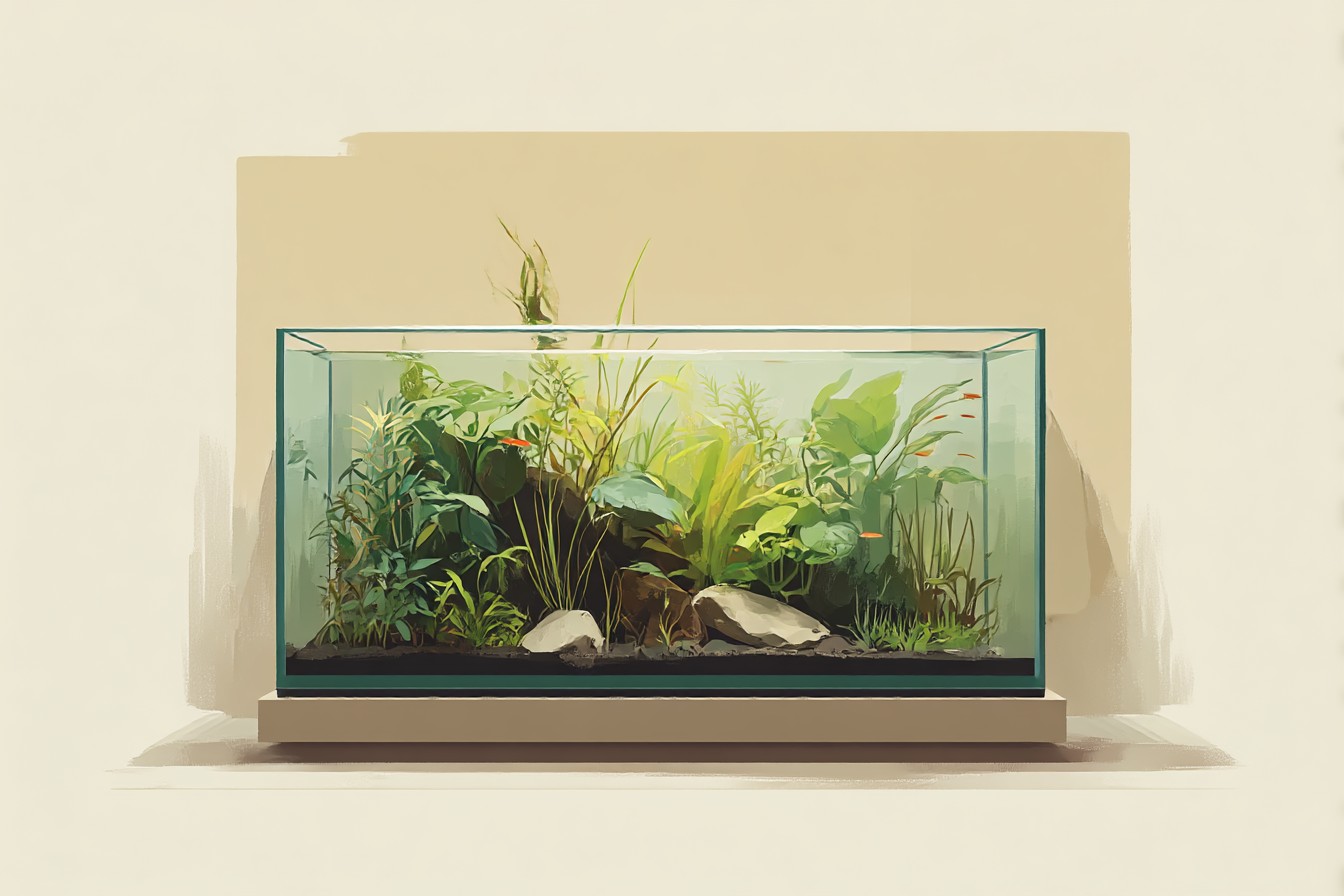
In my setup, I’ve got carpet plants at the front, a midground of Cryptocorynes and smaller swords, and background stems that actually stay in the background because there’s room for them to establish properly. In smaller tanks, everything tends to grow into everything else. Here, plants can develop their natural forms.
The volume gives you stability that’s hard to appreciate until you’ve experienced it. Water parameters don’t swing as dramatically when something goes wrong. A CO2 system that’s slightly off won’t crash the tank overnight.
If you overdose fertiliser or miss a water change, you’ve got some buffer before things get serious. This is particularly important when you’re learning to balance light, CO2, and nutrients, because getting that relationship right takes time and involves some trial and error. From a livestock perspective, 151 litres opens up stocking possibilities that smaller tanks simply can’t accommodate.
You can keep schooling fish in proper numbers. A group of 15 tetras looks completely different from a group of six, and you need this much space for the larger group to behave naturally. You can also combine species that need their own territories without everything being cramped.
The lighting requirements scale well too. A single decent LED unit can cover the entire tank effectively, but you’re not limited to single units like you might be with larger setups. I’m running a Fluval Aquasky at about 70% intensity, and it provides even coverage across the entire footprint without creating the harsh shadows that can plague deeper tanks.
Temperature stability is another advantage. The thermal mass means day-night temperature swings are gentler, and if your heater fails, you’ve got more time to notice and respond before things get critical. When you’re growing plants that are sensitive to sudden changes, this stability matters more than you might expect.
For aquascaping specifically, this is where you can start attempting styles that need real space to work. Island layouts, valley compositions, proper driftwood arrangements that create multiple levels – all of these need the kind of horizontal and vertical space that the 40-gallon provides. You can create viewing angles and depth effects that just aren’t possible in smaller volumes. ## The Honest Assessment The move to a 40-gallon isn’t without complications.
You Might Also Like
The most immediate is cost. Everything scales up. Substrate, plants, CO2 consumption, fertiliser usage – you’re looking at roughly double the ongoing expenses of a 20-gallon setup, and that’s before considering the initial equipment costs.
The CO2 question becomes unavoidable at this scale. While you can run smaller planted tanks without CO2 supplementation, a 40-gallon with serious lighting almost demands it if you want to grow anything beyond the most basic species. That means regulators, diffusers, drop checkers, and the ongoing cost of CO2 refills.
The system becomes more complex and there are more points of potential failure. Maintenance time increases significantly. A full water change on a 20-gallon might take 20 minutes.
On the 40-gallon, you’re looking at 45 minutes to an hour, especially if you’re doing proper gravel vacuuming and plant trimming. The tank demands more regular attention because there’s more going on in it. Plant selection becomes more critical.
You can’t just buy whatever looks nice at the shop and hope it works. You need to understand growth rates, light requirements, and how different species will interact as they mature. I learned this the hard way when some fast-growing stems took over half the tank in about six weeks and started blocking light from everything underneath.
The filtration requirements are more demanding too. You need equipment that can handle the bioload and water circulation without creating too much flow for the plants. Finding that balance takes experimentation, and good filtration equipment suitable for planted tanks isn’t cheap.
Location flexibility disappears almost entirely. At 458 pounds when filled (The Aquarium Guide), this needs to sit on proper furniture in a spot where you can access it for maintenance. You’re also committed to that location for electrical requirements – CO2 systems, timers, filters, and lighting all need power, so you need to be near adequate outlets. ## The Learning Curve Tank What the 40-gallon breeder really represents is the point where keeping planted aquariums stops being casual and becomes methodical.
This is where you learn that plant growth isn’t just about light and water, but about the balance between light intensity, CO2 concentration, and nutrient availability. Get one element wrong and everything shows you immediately. I spent the first three months fighting algae because I had the lighting too high without enough CO2 to match.
The plants couldn’t use all the available light, so algae did instead. Learning to read those signs – which type of algae indicates what kind of imbalance – happens faster in a larger tank because the effects are more obvious and develop more slowly. This is also where you start understanding water chemistry in practical terms rather than just testing numbers.
You learn what your local tap water actually contains, how your substrate affects pH over time, and why some plants thrive in your setup while others struggle despite identical care. The larger water volume means changes happen gradually enough that you can observe and adjust rather than just reacting to crises. The plant varieties you can successfully grow expand considerably.
Species that need stable conditions, higher CO2 levels, or specific water chemistry become viable. You can attempt red plants that actually stay red, experiment with carpet species that need high light, or try stems that require regular trimming to maintain their form. From an aquascaping perspective, this is where you develop an eye for composition and proportion.
You learn why certain plants work together visually and others don’t, how to create sight lines that draw the eye through the tank, and what happens when different growth rates interact over months rather than weeks. ## The Verdict The 40-gallon planted aquarium is where the hobby gets serious.
It’s not the tank for someone who wants to add a few plants to brighten up their goldfish bowl. It’s for people who’ve caught themselves researching Dutch aquascaping techniques at work, or who’ve started thinking about plant growth rates when they look at other people’s setups.
It demands more time, more money, and considerably more attention than smaller planted tanks. But it rewards that investment with the space to create something genuinely impressive and the stability to maintain it long-term. This is where you learn the skills that translate to larger planted systems, and where you discover whether aquascaping is something you want to pursue seriously.
If you’re coming from a smaller planted tank and finding yourself limited by space or stability, the 40-gallon breeder is probably the right next step. If you’re new to planted aquariums entirely, consider starting smaller and working up to this when you understand what you’re committing to. See where this placed in our full ranking of planted aquarium sizes.
The 40-gallon taught me that planted aquariums aren’t just about keeping plants alive. They’re about creating and maintaining complex miniature ecosystems that happen to be beautiful. Four years in, I’m still learning something new from it every month.
That, more than anything, tells you what you’re signing up for.


