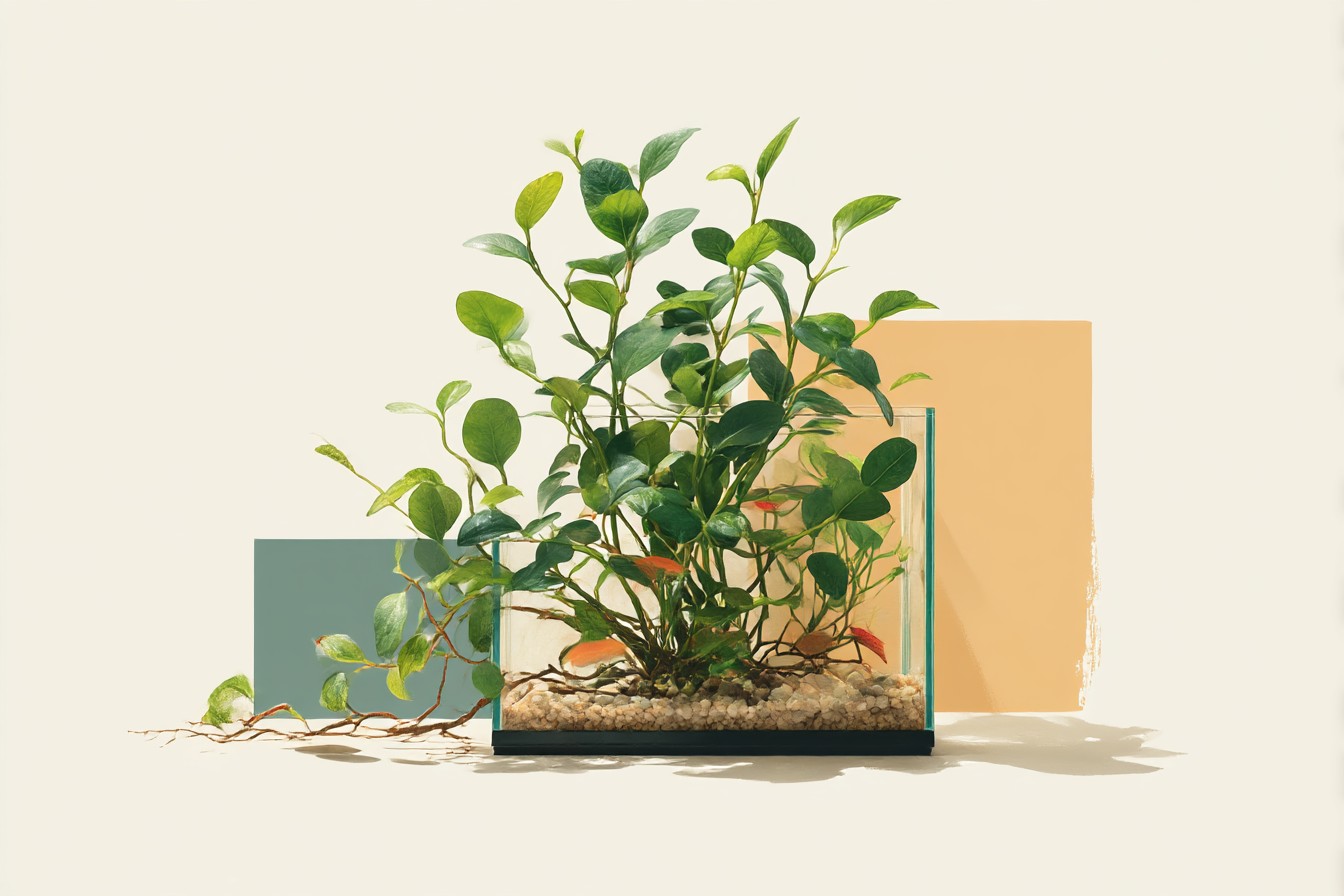
# Aquarium Plant Growth Rates and What Affects How Fast Your Plants Fill In When I first started with planted tanks in my tiny San Jose flat, I made the classic mistake of expecting instant gratification. I’d plant something on Sunday and by the following weekend I’d be staring at it wondering if it was actually growing or just sitting there plotting its own demise. Three years and multiple tank iterations later, I’ve learned that understanding plant growth rates isn’t just about managing expectations – it’s about setting up conditions that actually support the growth speeds you’re hoping for.
The truth is, aquarium plant growth varies wildly depending on species and conditions. Some plants like hornwort can genuinely grow several inches in a week under the right circumstances, while others take months to show meaningful progress. More importantly, the factors that control these growth rates are largely within your control, even if you’re working with basic equipment and a modest budget.
Getting this right means the difference between a tank that fills in beautifully over a few months and one that stagnates indefinitely while you wonder what you’re doing wrong. ## The Science Behind Aquatic Plant Growth **Light, CO2, and Nutrient Relationships** The foundation of plant growth comes down to photosynthesis, but in aquariums the relationship between light, CO2, and nutrients becomes much more critical than most people realise. Plants need light, nutrients, and CO2, and lacking one leads to deterioration (2Hr Aquarist).

This isn’t just theoretical – it means if you increase lighting without adequate CO2 and nutrients, you’ll trigger algae rather than plant growth.
The PAR (photosynthetically active radiation) requirements vary significantly by plant type. Low light plants function well with PAR ranges of 20-40 umol m2 s (The Aquarium Expert), which is achievable with basic LED fixtures. Higher light plants need considerably more, but also proportionally more CO2 and nutrients to match that light intensity. **CO2 and Growth Rate Correlation** Target CO2 levels are often cited around 30 ppm (Charterhouse Aquatics) for planted tanks, and the difference this makes to growth rates is substantial.
Additional CO2 positively influences plant growth and development (Aquarium Breeder), but the effect isn’t linear. Going from 5 ppm to 15 ppm makes a bigger difference than going from 25 ppm to 35 ppm. **Photoperiod Impact** Lighting duration affects growth rates independently of intensity. A photoperiod baseline of 6-8 hours (Aquascaping Academy) works for most setups, but extending this without adequate CO2 typically produces algae rather than faster plant growth.
I learned this the hard way when I cranked my cheap clip-on LED to 12 hours daily and ended up with a green hair algae nightmare that took weeks to clear. ## Fast-Growing Plants: What to Expect and How to Support Them **Hornwort Growth Rates** Hornwort represents the extreme end of aquatic plant growth. Under typical aquarium conditions, hornwort can grow 1-4 inches per week (Biology Insights). In optimal conditions, it can reach up to an inch per day (Aquifarm), with a general rule of 1-6 inches every week (eFishkeeping).
This aggressive growth rate makes hornwort excellent for new tanks where you want quick nutrient uptake to prevent algae, but it also means constant maintenance. In my 20-litre shrimp tank, I harvest handfuls of hornwort weekly and either compost it or give it away to other hobbyists. The biological benefit is significant – fast-growing plants like this strip nutrients from the water column before algae can use them – but you need to be prepared for the maintenance commitment. **Supporting Fast Growth** For plants like hornwort to achieve these growth rates consistently, they need sufficient nutrients in the water column.
Liquid fertilisers become essential, and the consumption rate is surprisingly high. What lasted a month in my slow-growing low-tech tank gets used up in two weeks when hornwort is growing aggressively. **Vallisneria Growth Patterns** Vallisneria represents a different growth pattern – slower vertical growth but aggressive horizontal spreading through runners. Vallisneria spiralis reaches heights of 30-50 cm (Guppys Life) but the initial establishment period can be frustrating.
The key insight is that once established, vallisneria propagates rapidly through the substrate via runners, requiring spacing of 3-6 inches apart (Aquatikus) to allow for this spreading. In my main community tank, it took about three months for the original vallisneria plantings to show significant height growth, but once they started sending out runners, I had new plants appearing weekly. The patience required for the initial establishment pays off with a self-sustaining background that eventually needs thinning rather than additional planting. ## Common Growth Rate Mistakes
Mistake #1: Expecting uniform growth across all plants. Different plant species have completely different growth patterns and timelines.
Planting hornwort alongside cryptocoryne and expecting both to fill in at the same rate leads to disappointment and often premature replanting. Crypts can take 2-3 months just to recover from planting shock, while hornwort might double in size during that same period.
Mistake #2: Increasing light without matching CO2 and nutrients. This is probably the most expensive mistake I see people make. They buy powerful LED fixtures expecting faster growth but don’t adjust their CO2 or fertilisation accordingly.
The result is usually algae blooms that set the tank back weeks. Every lighting upgrade needs to be matched with appropriate CO2 and nutrient increases.
Mistake #3: Impatience with establishment periods. Many aquatic plants have an initial establishment phase where visible growth is minimal while they develop root systems. Disturbing plants during this period – replanting, moving, or assuming they’re dying – resets this process.
You Might Also Like
Most stem plants need 2-4 weeks to establish properly, and rosette plants like Amazon swords can need 6-8 weeks.
Mistake #4: Underestimating maintenance requirements of fast growers. Plants that grow quickly also consume nutrients quickly and need frequent pruning. Many people plant hornwort or water sprite for quick results but don’t plan for weekly harvesting. Left untrimmed, these plants can overwhelm smaller tanks and create dead zones where debris accumulates.
Mistake #5: Confusing melting with slow growth. Cryptocurrency and some other plants undergo “crypt melt” when first planted, losing most of their leaves before regenerating.
This looks like plant death but is actually normal adaptation. Many people replant during this phase, preventing recovery. True slow growth means healthy plants that simply increase in size gradually, not plants that lose biomass.
## Research Support Multiple studies demonstrate that aquatic plant growth rates depend heavily on the balance between light intensity, CO2 availability, and nutrient supply.
The data shows significant variation even within species – hornwort growth rates spanning from 1 inch to 6 inches per week depending on conditions illustrates how dramatically environmental factors affect outcomes. The PAR requirements research indicates that many hobbyists operate with insufficient light for their expectations, while the CO2 studies show that even modest increases in dissolved CO2 can substantially improve growth rates. The photoperiod research suggests that duration matters less than intensity for most species, but both need to be matched to available CO2 and nutrients to prevent algae issues. ## Application Across Different Tank Types **Low-tech community tanks:** Focus on naturally slow-growing species like cryptocoryne, anubias, and java fern.
Accept 2-3 month establishment periods and minimal visible growth for the first month. Budget for basic liquid fertiliser but don’t expect dramatic growth spurts. **High-tech planted displays:** Fast growers like hornwort and cabomba can achieve their maximum growth rates, but require CO2 injection, quality LED lighting, and comprehensive fertilisation. Plan for weekly maintenance and significant ongoing fertiliser costs. **Nano shrimp tanks:** Java moss and small cryptocoryne work well, with moss showing visible growth within 2-3 weeks under basic lighting.
Avoid aggressive growers that can overwhelm small volumes quickly. **Cichlid tanks with plants:** Stick to hardy, slow-growing species that can handle disruption. Vallisneria works well due to secure root systems, but expect slower establishment due to substrate disturbance. **Quarantine and hospital tanks:** Fast-growing plants like hornwort provide rapid nutrient uptake but need frequent removal to prevent decay in temporary setups. ## Benefits of Understanding Growth Rates **Realistic Timeline Planning**: Knowing that cryptocoryne takes 8-12 weeks to establish properly prevents premature concern and unnecessary replanting. Understanding that hornwort can grow 4+ inches weekly helps you plan for maintenance and prevents overstocking. **Better Budget Allocation**: Fast-growing plants consume fertilisers rapidly, requiring larger fertiliser purchases but providing quicker visual results.
Slow growers need less ongoing feeding but may require initial patience that some find frustrating. **Effective Algae Prevention**: Fast growers strip nutrients quickly, helping prevent algae in new setups. However, they also need consistent pruning to prevent die-back and nutrient release that can trigger algae blooms. **Appropriate Tank Planning**: Matching plant growth rates to your available maintenance time prevents situations where fast growers overwhelm your schedule or slow growers leave you waiting months for visual progress. **Species Selection**: Understanding growth patterns helps choose plants that work together visually and practically. Combining plants with similar nutrient requirements and growth rates creates more stable, manageable tanks. ## Step-by-Step Growth Rate Optimisation **Step 1: Assessment and Planning (Week 1)** Evaluate your current lighting using a smartphone PAR metre app or basic measurements.
Test baseline water parameters including nitrate, phosphate, and CO2 levels. Document current plant growth over one week to establish baseline rates. **Budget Breakdown:** * PAR metre app: Free-£3 * Basic test kit: £15-25 * CO2 drop checker: £8-12 **Total Budget: £25-40** **Step 2: Lighting Optimisation (Weeks 2-3)** Adjust photoperiod to 6-8 hours for most setups.

If plants show minimal growth after two weeks, consider upgrading lighting rather than extending duration.
Focus on PAR values appropriate for your plant selection – 20-40 for low light species, 40-80 for medium light requirements. What to watch for: Increased plant activity (pearling, new growth shoots) within 10-14 days. Algae appearance suggests too much light for available CO2 and nutrients. **Budget Breakdown:** * LED upgrade (if needed): £40-120 * Timer: £10-15 **Step 3: CO2 and Nutrient Balance (Weeks 4-6)** Add liquid CO2 supplement or consider pressurised CO2 if lighting has been increased.
Start comprehensive liquid fertilisation matched to plant biomass and growth rate. Monitor plant response and adjust feeding frequency. **Budget Breakdown:** * Liquid CO2: £12-18 * Comprehensive fertiliser: £15-25 * Pressurised CO2 kit (alternative): £80-150 **Step 4: Fine-tuning and Maintenance (Weeks 7-8)** Establish pruning schedules based on observed growth rates. Fast growers may need weekly attention, slow growers monthly.
Adjust fertiliser dosing based on actual consumption rates rather than package recommendations. **Budget Breakdown:** * Quality pruning tools: £15-25 * Additional fertiliser stocks: £10-20 **Total Budget Range: £75-200 depending on current equipment** The key insight I’ve gained from managing multiple small setups is that plant growth rates are predictable once you understand the relationships between light, CO2, and nutrients. Fast growth isn’t automatically better – it requires more maintenance and higher ongoing costs. Slow, steady growth often produces more stable, easier-to-manage tanks, especially when you’re working with limited space and time like I am.
The goal should be matching your plant selection and growth expectations to your actual circumstances, not trying to replicate the high-maintenance showcase tanks you see on social media. For our complete guide to planted tank basics, understanding growth rates is just one piece of creating sustainable systems that work within your constraints rather than against them.



[…] that also happens to look brilliant in a tank. | Care Level | Lighting Needs | CO2 Required | Growth Rate | Max Size | Our Rating | […]
[…] learn to read the subtle signs—slight changes in plant growth rates, minor shifts in water clarity, the way fish behaviour changes when conditions aren’t […]
[…] said, there are definite cases where targeted supplementation can help out your plants and improve growth rates. Knowing when those cases apply to you and your aquarium will save you money and spare you the […]