
# 10 Gallon Planted Aquarium and the Sweet Spot for Getting Started I still remember the moment I knew I’d found my size. Standing in the aquatics shop, overwhelmed by the wall of tank options stretching from tiny desktop cubes to room-dominating monsters, I kept coming back to that modest 10-gallon rectangle. Not because it was the cheapest—though it nearly was—but because something about its proportions just felt right.
Four years later, after tanks ranging from nano shrimp setups to a 180-litre Dutch scape that nearly broke my back moving house, I keep coming back to tens. They’re the sweet spot nobody talks about enough. There’s something perfectly balanced about a 10-gallon planted tank.
Big enough to create a proper aquascape with depth and layers, small enough that you can actually maintain it without dedicating your weekend to water changes. Forgiving enough for beginners to learn without killing everything, challenging enough to keep you engaged as you develop your skills.
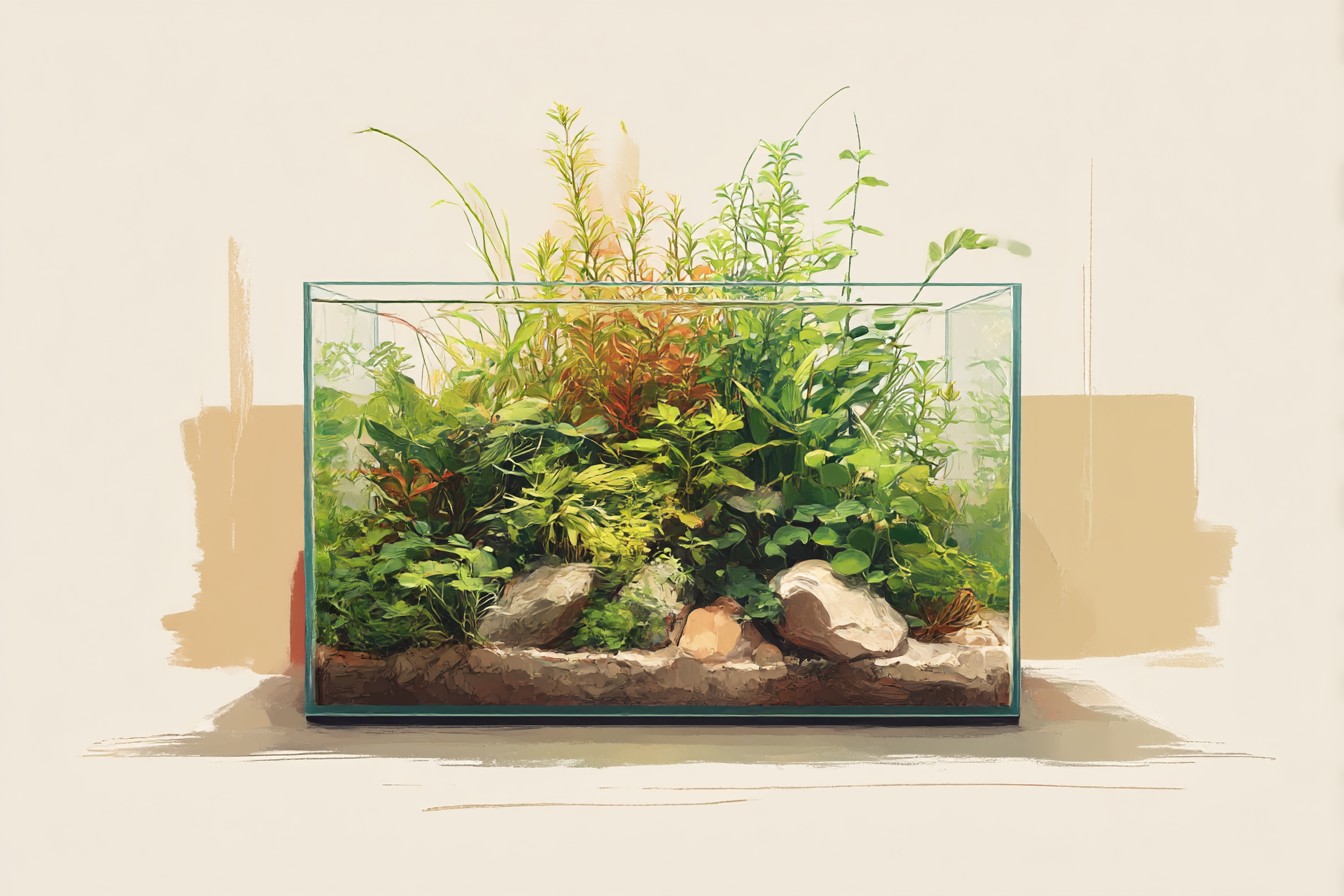
After running dozens of setups, I’m convinced the humble 10-gallon is where most people should start their planted tank journey. | **Tank Capacity** | **Dimensions (L×W×H)** | **Weight When Filled** | **Footprint** | **Maintenance Time** | **Our Rating** | |——————|————————|————————|—————|———————|—————-| | 10 gallons (38L) | 20″ × 10″ × 12″ | 111 pounds | Desk-friendly | Under 2 minutes | 9/10 | ## The Perfect Learning Canvas The standard 10-gallon aquarium measures 20 inches by 10 inches by 12 inches (MeasuringStuff), which translates to roughly 38 litres (Aquarium Nexus).
Those dimensions aren’t arbitrary—they represent decades of the aquarium industry working out what actually works for most people’s homes and budgets. What makes this size special is the ratio between length and height. That 20-inch length gives you proper horizontal space to create a sense of depth in your aquascape.
You can establish a foreground with carpet plants, build up a midground with stem plants or small pieces of hardscape, and create a background that actually recedes into the distance. Try doing that in a 5-gallon cube and you’ll understand why so many nano tanks end up looking cramped. The 12-inch height is equally important.
It’s shallow enough that most LED lights designed for planted tanks will penetrate properly to the substrate level, but deep enough that you can layer your planting without everything fighting for the same vertical space. I learned this the hard way with a 5-gallon tall that was 16 inches high—my carpet plants never thrived because the light couldn’t reach them properly through the water column. But here’s what really matters: a 10-gallon is small enough that you can see the entire tank at once and understand what’s happening.
When I was learning to balance CO2, lighting, and fertilisation, being able to observe how the whole ecosystem responded to changes made all the difference. In larger tanks, problems can develop in one corner while the rest looks fine. In a 10-gallon, everything is connected and visible.
The size also means your mistakes aren’t catastrophic. Overdose fertiliser in a 180-litre tank and you might be dealing with algae blooms for months. Do it in a 10-gallon and you can perform a 50% water change and reset things in an afternoon.
When you’re learning to read your tank’s signals, that quick feedback loop is invaluable. ## Physical Reality and Practical Considerations Before we get carried away with the romantic aspects of planted tank keeping, let’s talk about the practical reality of living with one. A 10-gallon tank weighs around 111 pounds when filled (MuchFish), with the water alone accounting for roughly 83.4 pounds of that total (The Aquarium Expert). That’s substantial enough to require a proper stand, but not so heavy that you need to reinforce your floor or worry about your upstairs flat’s structural integrity.
The footprint is genuinely desk-friendly. At 20 by 10 inches, it’ll fit comfortably on most surfaces without dominating the room. I’ve run 10-gallons on IKEA desks, kitchen counters, and purpose-built stands, and they work in all these situations.
The key is ensuring your surface is level and can handle the weight safely—111 pounds isn’t something you want shifting unexpectedly. Water changes become almost trivial at this size. The hobby press claims you can perform a proper water change in less than 2 minutes (The Spruce Pets), and while that’s optimistic unless you’ve got your routine dialed in perfectly, it’s not far off.
I can drain and refill my 10-gallon in about 5 minutes with a simple siphon tube and watering can setup. Compare that to the 45-minute ritual my 180-litre requires, and you’ll understand why I keep coming back to smaller tanks. The lighting requirements are equally manageable.
A single quality LED fixture will light a 10-gallon properly, where larger tanks often need multiple units or expensive high-wattage systems. The same principle applies to heating, filtration, and CO2 systems—everything scales down to hobby-friendly prices and complexity levels. ## What This Size Actually Allows Here’s where the 10-gallon really shines: it’s big enough to create genuine aquascapes, not just planted tanks. Those 20 inches of length give you room to establish proper proportions using the golden ratio principles that underpin most successful aquascaping styles.
You can create an Island-style scape with hardscape positioned at the intersection points, or attempt a Nature Aquarium approach with proper foreground, midground, and background zones. The plant selection becomes interesting rather than restrictive. You can grow proper stem plants like Rotala rotundifolia or Ludwigia repens and actually trim them into attractive shapes rather than just letting them reach the surface.
Carpet plants have enough area to establish properly—I’ve successfully carpeted the entire foreground of a 10-gallon with Hemianthus callitrichoides, something that’s impossible in smaller tanks where the carpet area is measured in square inches rather than square feet. You can also keep fish that actually matter. Not just a single betta looking lonely in an otherwise empty tank, but a proper school of small tetras or rasboras that create movement and life throughout the water column.
You Might Also Like
Six to eight cardinal tetras in a well-planted 10-gallon create the kind of dynamic display that reminds you why this hobby is worth the effort. The biological stability improves dramatically over smaller tanks too. That extra water volume buffers pH swings, provides more room for beneficial bacteria to establish, and creates thermal mass that prevents temperature fluctuations.
I’ve had 10-gallons cruise through equipment failures that would have been disasters in nano tanks. ## The Learning Curve Sweet Spot What I didn’t appreciate when I started was how much a 10-gallon would teach me about the fundamental relationships in planted tank keeping. The size is forgiving enough that minor mistakes don’t cascade into tank crashes, but responsive enough that you can see the effects of your decisions clearly and quickly. CO2 injection becomes manageable rather than intimidating.
The petrol requirements are low enough that a small pressurised system will run for months, and you can actually see how plants respond to different concentration levels without needing expensive monitoring equipment. I learned to read the subtle signs of CO2 deficiency and excess by watching how my plants behaved over weeks and months. Fertilisation follows the same pattern.
The nutrient requirements are modest enough that you can experiment with different approaches—dry fertilisers, liquid supplements, nutrient-rich substrates—without huge financial commitments. More importantly, you can observe how different plants respond to changes in your fertilisation routine and begin to understand what each species actually needs. Algae problems, when they occur, are manageable rather than overwhelming.
A outbreak of green spot algae on the glass is annoying but easily addressed with a bit of extra cleaning and parameter adjustment. In larger tanks, the same problem can cover square feet of glass and hardscape, turning maintenance into a major undertaking. The 10-gallon teaches you to think systematically about your tank’s health.
You learn to read the subtle signs—slight changes in plant growth rates, minor shifts in water clarity, the way fish behaviour changes when conditions aren’t optimal. These observation skills transfer directly to larger tanks, but they’re much easier to develop when you can see and understand the entire ecosystem at once. ## Where It Falls Short Let’s be honest about the limitations, because understanding them matters for making good decisions. The narrow 10-inch width can feel restrictive if you want to create dramatic depth effects or complex hardscape arrangements.
Some of the most impressive aquascapes I’ve seen use tank widths of 18 inches or more to create proper perspective and layering. The fish selection, while much better than nano tanks, is still limited compared to what you can do in larger systems. You’re not keeping angelfish, bigger cichlids, or really any fish with substantial bioload requirements.
School sizes are constrained—eight cardinal tetras look great, but you can’t have the massive shoals that create the stunning displays in competition tanks. Maintenance frequency can actually be higher than larger tanks in some ways. The smaller water volume means parameters shift more quickly, so you need to stay on top of water changes and general maintenance.
Miss a week and you’ll notice, which isn’t always true with bigger systems that have more biological momentum. Plant growth can outpace the available space quickly. Fast-growing stem plants like Hygrophila or Limnophila will need weekly trimming to prevent them from overwhelming other plants or reducing light penetration.
In larger tanks, the same plants can grow for longer before requiring intervention. The heating can be tricky in colder climates or poorly insulated homes. The small water volume loses heat quickly, and finding heaters that maintain stable temperatures without overheating can require some trial and error. ## Why This Size Endures After four years of keeping planted tanks ranging from 5-gallon nanos to systems approaching 200 litres, I keep returning to 10-gallons because they represent the sweet spot between ambition and reality.
They’re large enough to satisfy your creative instincts and small enough to maintain without it becoming a second job. The 10-gallon has introduced more people to planted tank keeping than any other size, and there’s a good reason for that.

It strikes the perfect balance between being approachable for beginners and sophisticated enough to keep experienced aquascapers engaged.
The proportions work aesthetically, the maintenance requirements are reasonable, and the biological stability is sufficient to support genuinely thriving ecosystems. Every serious aquascaper I know still runs at least one 10-gallon, often as a testing ground for new techniques or a showcase for particularly prized plants. There’s something pure about working within those constraints that forces you to focus on fundamental design principles rather than relying on sheer size for impact. ## The Verdict The 10-gallon planted tank isn’t just a good starting point—it’s a format that many aquascapers return to throughout their journey in this hobby.
It teaches you everything you need to know about plant care, aquascaping principles, and ecosystem management without overwhelming you with complexity or costs. If you’re new to planted tanks, start here. If you’ve been keeping fish for years and want to explore aquascaping, start here.
If you’re an experienced aquascaper looking for a new challenge within tight constraints, definitely start here. The humble 10-gallon will teach you more about this hobby than any other size, and it’ll do it without breaking your back, your budget, or your schedule. Four years later, I still have that first 10-gallon running on my kitchen counter.
It’s taught me everything I know about reading plants, balancing nutrients, and creating something beautiful in a small space. Every time I walk past it, I remember why I fell in love with this hobby in the first place.


