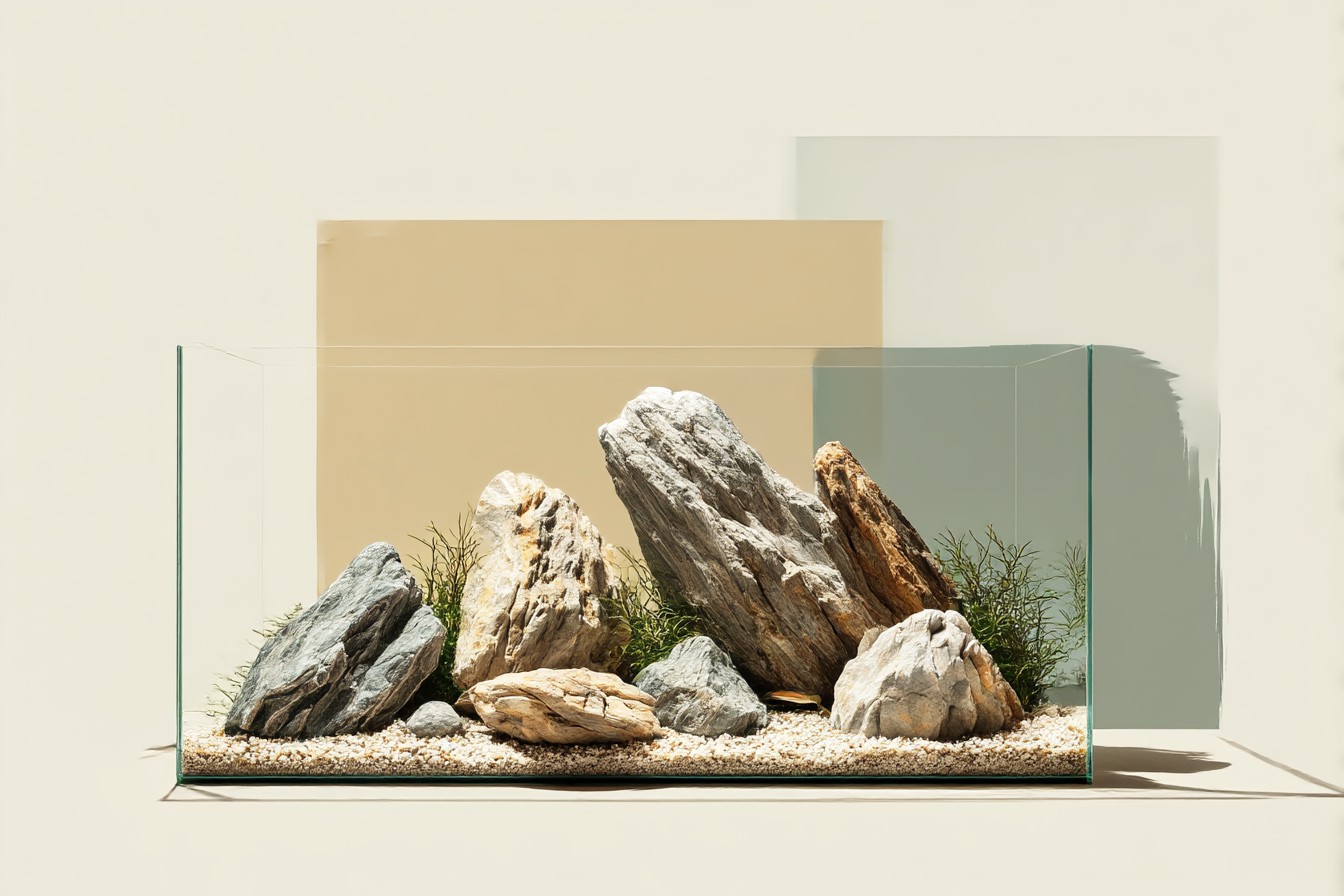
If you’ve never seen a good Iwagumi aquascape up close, they can seem deceivingly simple. Some strategically placed rocks, a perfect green carpet, maybe a pair of tiny fish darting around the open space. Clean lines, pleasing proportions and nothing cluttering the background.
Frankly, they’re enough to make anybody want to set up one of these minimalist masterpieces in their own home. That is until you actually get around to buying your own rocks. I bought some rocks.
They didn’t look right together. So I bought some more rocks and tried again.
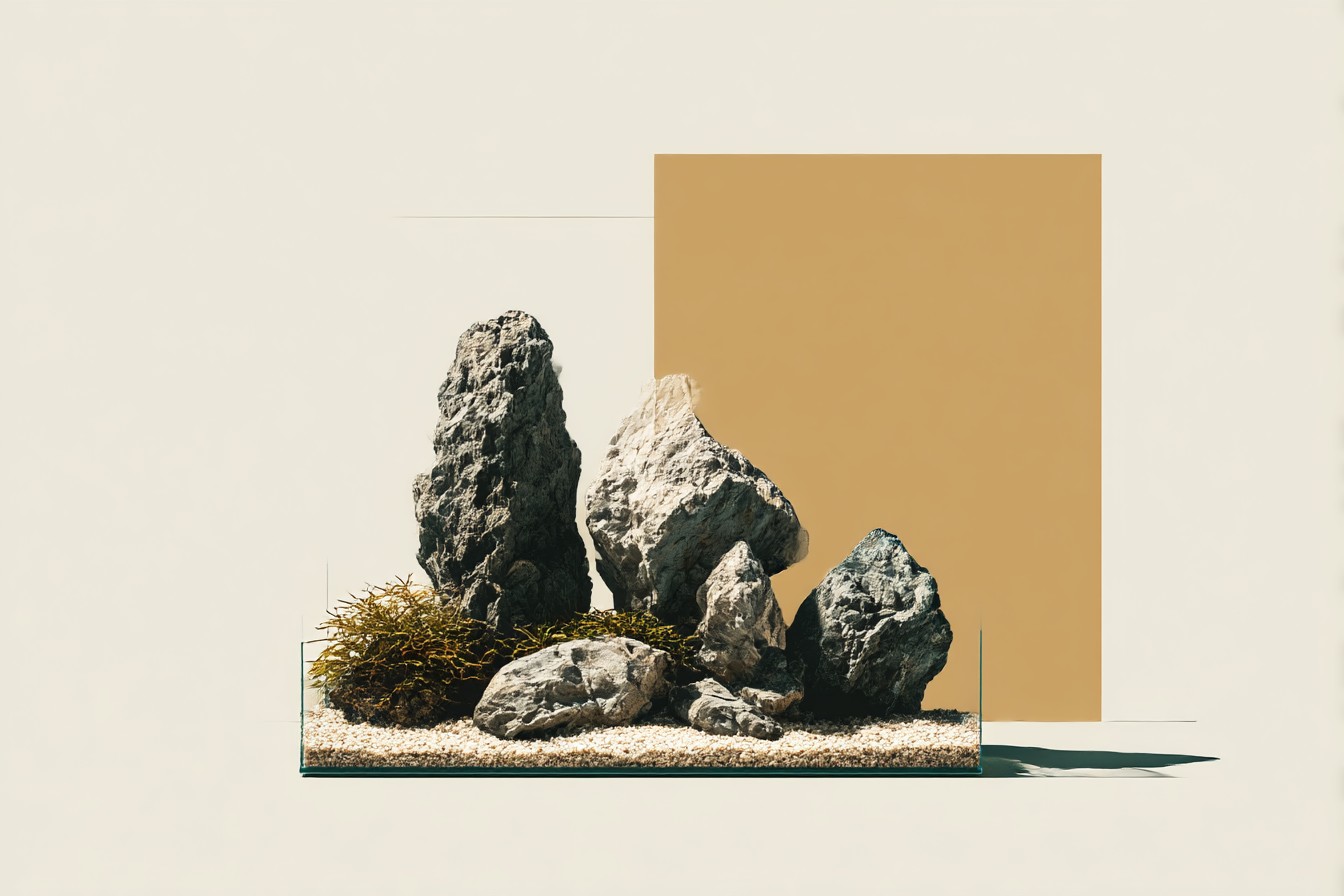
Same problem.
This went on for months until I gave up and filled the tank with plants. At least my ‘rock garden biofilter’ looked like I knew what I was doing. My old man always told me that impatience was my biggest weakness and boy did he ever look proud when my Iwagumi was still crunching substrate months after my Dragonstone ‘ jungle aquascape ’ was flourishing.
It turned out that my idea of a ‘simple’ layout was anything but simple. They said Floral Foam was the weed killer of propagation. I say that Iwagumi is the kryptonite of aquascaping.
If you’ve never tried to aquascape in the Iwagumi style, you should probably know what you’re getting into. Because believe me when I say that there is a lot to getting into. Why Is Iwagumi So Difficult?
Minimalism is difficult because every aspect of your aquarium has to be perfect. You can get away with bad hardscape positioning if you’ve got a wall of Monte Carlo carpeting your substrate, but an Iwagumi tank highlights every imperfection. Literally every single thing is on display.
So let’s talk about what makes Iwagumi such a pain. ## Table of Contents – [Iwagumi Philosophy and Layout Rules](#iwagumi-philosophy-and-layout-rules) – [Technical Requirements of Iwagumi](#technical-requirements-of-iwagumi) – [Common Implementation Mistakes](#common-implementation-mistakes) – [Research Foundation for Iwagumi Success](#research-foundation-for-iwagumi-success) – [Adapting Iwagumi Principles to Different Setups](#adapting-iwagumi-principles-to-different-setups) – [How Iwagumi Expertise Improves Your Other Aquascapes](#how-iwagumi-expertise-improves-your-other-aquascapes) – [Step-by-Step Implementation Guide](#step-by-step-implementation-guide) ## Iwagumi Philosophy and Layout Rules At least, Japanese-style Iwagumi layouts do. Japanese aesthetics have been practising this intentionally asymmetric style for hundreds of years. Group stones in even numbers and they fight each other.
Leave too much space between them and it looks unnatural. Where does that leave us, mere mortal aquascapers? ! [Traditional Iwagumi Layout Rules](../../media/iwagumi-stone-rule.jpg “Traditional Iwagumi Layout Rules”) Let’s dig into some of the typical Iwagumi rules that will make or break your aquascape. **The Stone Size Hierarchy** This rule varies between 3 and 5 stones, depending on who you ask (Aquascaping Love). However, the largest stone should occupy roughly a third of the tank space (ADA Global).
Not only that, but it should also sit around ⅔ of the way into your aquarium from either side. This concept, known as the rule of thirds, is a compositional technique used by photographers and artists for centuries. As for the other stones, you want them to complement your primary rock, both visually and physically.
While you don’t want two stones that take up equal space and compete for attention, your accent stones shouldn’t be tiny either. **Negative Space Around Stones** Whenever I started my Iwagumi, I kept reaching for more rocks or plants to fill empty areas. Like most new aquascapers, I thought empty space was bad. Aquascaping these minimalist tanks taught me that nothing could be further from the truth.
When your tank has very few plants and ornaments, this empty space will be magnified (Aquarium Gardens). And if you clutter up these areas your rocks will begin to lose their beauty. Learning how to use negative space is probably one of the most important lessons I took from my Iwagumi days. **Stone Orientation and Aquarium Grain** This little nugget of information is what took my Iwagumi from sad to spectacular.
Most aquarium enthusiasts know that the direction your rocks are facing can drastically change the feel of your aquascape (Practical Fishkeeping). But when I first started trying layouts I had no clue what they were talking about. The ‘grain’ of your tank refers to the direction that your stones are facing and, ideally, they should all be facing the same way.
Look at your rocks from above, if you can see horizontal lines on them then they have a grain. **Why All This Stuff Matters** Unlike other aquascaping styles, every inch of your aquarium is on display in Iwagumi. There’s no covering up your flaws with a bunch of moss or crypts. Make sure you spend plenty of time getting your hardscape just right.
Mistake the rock layout and you’ll spend weeks avoiding looking at your aquarium. ## Technical Requirements of Iwagumi Oh boy, where do I start? Easy green carpeting plants look great but are difficult to achieve without perfect water parameters. **PAR Values Across The Tank** I hate to be the bearer of bad news but the carpet plants we all love won’t grow perfectly under cheap lighting. Heck, they may not even carpet at all (Buce Plant).
We’re talking 40-60 PAR at the substrate level here. This means you need to invest in a quality LED light system if you want nice even growth. Expect to pay between £150-£300 for your basic lighting requirements (Aquarium Co Uk).
While flowering breeders won’t care too much about PAR, you need decent lighting to achieve sharp grass-like edges on your carpet. Unless your new to DIY setups, you should also plan to run your light a minimum of 12-hours per day. Plants don’t grow in darkness you know! **You Need CO2** This one really kills me.
You know those perfect aquascapes you’ve been admiring online? Chances are they have CO2 injection (Green Aqua). CO2 is required to achieve healthy carpet growth, yet people still come into this hobby thinking they can dink around with liquid fertilisers.
You’ll need a pressurised system capable of maintaining 25-30ppm of carbon dioxide during the lights-on period. That’s another £120-200 for a complete setup complete with regulator, CO2 tank, DIY diffuser and drop checker. Then add another £2-3 per month on refill bottles.
It’s enough to make you want to flush your system with selcon but DON’T DO IT! You’ll likely kill your tank and end up right back where you started. Trust me… **Watch Your Nutrient Dosing** With fewer plants and less mass to soak up those excess nutrients, Iwagumi tanks are more difficult to dose than your average carpet tank.
Throw too much fertilizer in there and you’ve got algae. Not enough fertilizer and you’ll stimulate algae growth under high lighting levels. If you’ve been looking into advanced aquascaping methods like TE Dosing or Lean Dosing, now is your chance to apply that knowledge.
You’ll be adding nutrients on a daily basis from here on out. Expect to spend £15-25 per month on liquid fertilisers depending on which recipes you follow. Get a quality water test kit too.
You’ll be testing at least once per week. ## Common Implementation Mistakes
You Might Also Like
Achieving perfect parameter control for carpet plants is more difficult than 99% of planted aquarium setups. Without CO2 injection and advanced nutrient dosing your dream aquarium will turn into an algae nightmare. Mistake #2 Not spending enough time composing your hardscape. If you accidentally position your stones wrong there’s no going back.
Unless you’re willing to uproot every living thing in your aquarium and start from scratch, that is. I made this mistake numerous times and ended up forcing plants into weird positions to cover up my mistakes. Learn from me, spend ages getting your hardscape just right before adding anything else to the tank. Mistake #3 Expectation of algae issues will be far greater.
It’s only natural for us to judge our own aquascapes more harshly than other people’s. However, this issue is amplified when you’re keeping simple layouts. Algae on a heavily planted setup can usually find itself hidden amongst all your plants.
In a simplistic aquascape that same algae out is going to look enormous. You need to be more stringent about water changes and maintenance than you would with other planted tanks. Mistake #4 Not letting it establish before adding fish. Believe me when I say you do not want to add anything to your Iwagumi until the plants are finished growing.
I learnt this the hard way by adding too many fish too soon and the algae倍强ined. With fragile carpet plants, even hardcore algae eaters can uproot your entire aquarium. Taking your time may be boring but it’s worth waiting those few extra weeks to get it right. Mistake #5 Adding fish that are too large or finicky.
Iwagumi don’t mean you can’t keep fish, however smaller species work much better (LiveAquaria). Choose species that school together and stay away from sucker-mouth catfish or other substrate rummaging fish. Another big mistake people make is choosing fish that have fin-nipping tendencies.
No matter how hard you tried to plan your aquascape, certain fish just find the weakest looking plants and terrorise them until they die.
Proper planning will prevent most of these mishaps from occurring. ## Research Foundation for Iwagumi Success My disappointment with my first ever Iwagumi led me down a rabbit hole of random Google searches. Everything from photography and Japanese gardening techniques, to biological experiments on aquatic plant growth. It turns out a bunch of guys with expensive cameras and gardening degrees were way ahead of the curve.
Mass appeal in rock formations has been scientifically studied. Asymmetric groupings with a clear hierarchy were preferred over even numbered arrangements with no standout rocks (PubMed). This gave me a better understanding of why certain rules were developed over others.
Later research into aquatic plant growth under high light helped me figure out why DIY aquascapers were having so much algae issues (PubMed). Plants that evolved in sparse high-light conditions didn’t just magically grow better under artificial conditions. They need CO2 and nutrients just like their faster-growing low-light counterparts.
Lastly, years of maintenance-intensive study into aquarium ecosystems helped me realise why rushing your aquarium was never a good idea (OUP Journals). Your plants aren’t growing faster by bumping up the nutrients. They’re just begging for algae problems.
Prepare to learn a lot more than you ever wanted to know about aquarium keeping. ## Adapting Iwagumi Principles to Different Setups Now that you know how important it is to build a strong foundation, here are some different applications of the style. **Nano Tanks** S Scale down everything! Iwagumi can be applied to tanks as small as 20 litres. I don’t recommend going any lower than 3 stones though.
You won’t be able to get the same exact compositions as a larger tank, but these principles still apply. You can get away with easier carpet species like Eleocharis pusilla rather than dwarf baby tears or HC Cuba. Also keep in mind that your lighting requirements won’t change based on tank size.
You still need that sweet sweet PAR at the substrate level. CO2 systems can also be scaled down and are much more affordable. **Big Old Benjid tanks** Really big aquariums can benefit from Iwagumi aquascaping too! Use the same stone positioning concepts on a smaller portion of the tank.
Don’t be afraid to add more plant variety around these rock formations. Also, the bigger your aquarium, the easier it will be to dial in those perfect parameters. **Low-Tech** Okay so you CAN still have that ‘Iwagumi’ feel with some easier plants. Sadly, you won’t be able to achieve the exact same look without upgrading your equipment.
Java fern comes to mind as an alternative to carpeting plants. They’re about as low maintenance as you can get and still look pretty good filling space. **Brackish Tanks** Best of both worlds, IMHO. Replace those carpet plants with Java fern and you’ve got yourself a sweet brackish Iwagumi setup.
Everything else can stay the same, just watch your water parameters accordingly. ## How Iwagumi Expertise Improves Your Other Aquascapes Now you know how intense these things can be. I better leave you with some reason to try an Iwagumi out for yourself. **Improved Aesthetic Understanding** I promise you, the time you spent picking stones and positioning them will not be wasted. Studying photographs of Iwagumi aquascapes improved my photography game as well.
You learn to appreciate things like rule of thirds and proper framing. **Technical Skills** There is no denying that Iwagumi layouts require advanced equipment and knowledge. However, that doesn’t mean you can’t cut corners. Ditch the DIY CO2 and DIY lighting setups.
Buy quality products from the start and you won’t have to worry about replacement parts and ph repairs down the road. **Planning Everything Out** Ruining your perfect aquascape stings…a lot. I learned the hard way that aquarium shopping should always be done AFTER you have a layout planned. — All of your future mistakes can be avoided by trying out an Iwagumi aquascape. You’ll have a better understanding of aquascaping as a whole and walk away a better aquascaper because of it. ## Step-by-Step Implementation Guide Now it’s time for the fun part.
Planning your Iwagumi from start to finish. ### Phase 1 – Planning and Hardscape (Weeks 1-2) Pick out your rocks. This will take the longest so get lots of practise taking cool looking photos of your arrangements. Plan out your hardscape and don’t buy anything else until these stones look perfect. * Stones: £30-60 * Substrate ( ADA Aqua Soil ): £25-40 * Tools to move rocks & sand: £15-25 Approximate Budget for Phase 1: £70-125 ### Phase 2 – Install Technical Equipment (Weeks 3-4) Get your base LED lighting system in place.
Don’t worry about CO2 towers and refractometers just yet.

We want to make sure your lighting can reach those high PAR levels first. Install your pressurised Co2 injection system with an inline diffuser for the best distribution. * Lighting System: £150-300 * CO2 complete setup: £120-200 * Filter/ Media: £60-100 * Water test kit: £25-35 Approximate Budget for Phase 2: £355-635 ### Phase 3 – Plant Setup and Establishment (Weeks 5-8) Install your carpet of choice.
Dry start method is preferred, but if you’re impatient like me go ahead and plant them directly into your fertIed substrate. Start your plants off with 6 hour photoperiods and slowly work your way up to prevent algae. * Carpet plants: £40-80 * Liquid fertilizers: £25-40 * Livestock (Optional): £20-40 Approximate Budget for Phase 3: £85-160 ### Phase 4 – Maturation and Troubleshooting (Weeks 9-16) Your system will go through some growing pains. Adjust your lighting, co2, and nutrients to see what your plants respond to best.
Livestock can be added at this time. Just don’t overdo it! * Monthly cost of consumables (CO2, Ferts): £15-25 * Livestock: £30-60 * Maintenance tools (uneeded but you’ll want them): £20-40 Approximate Budget for Phase 4: £65-125 Total Costs: £575-1045 Final thoughts? Do you have what it takes to keep an Iwagumi aquarium?
Remember these layouts aren’t for everyone but at the same time they aren’t impossible. Anyone can succeed with the right mindset and enough patience. Good luck out there!