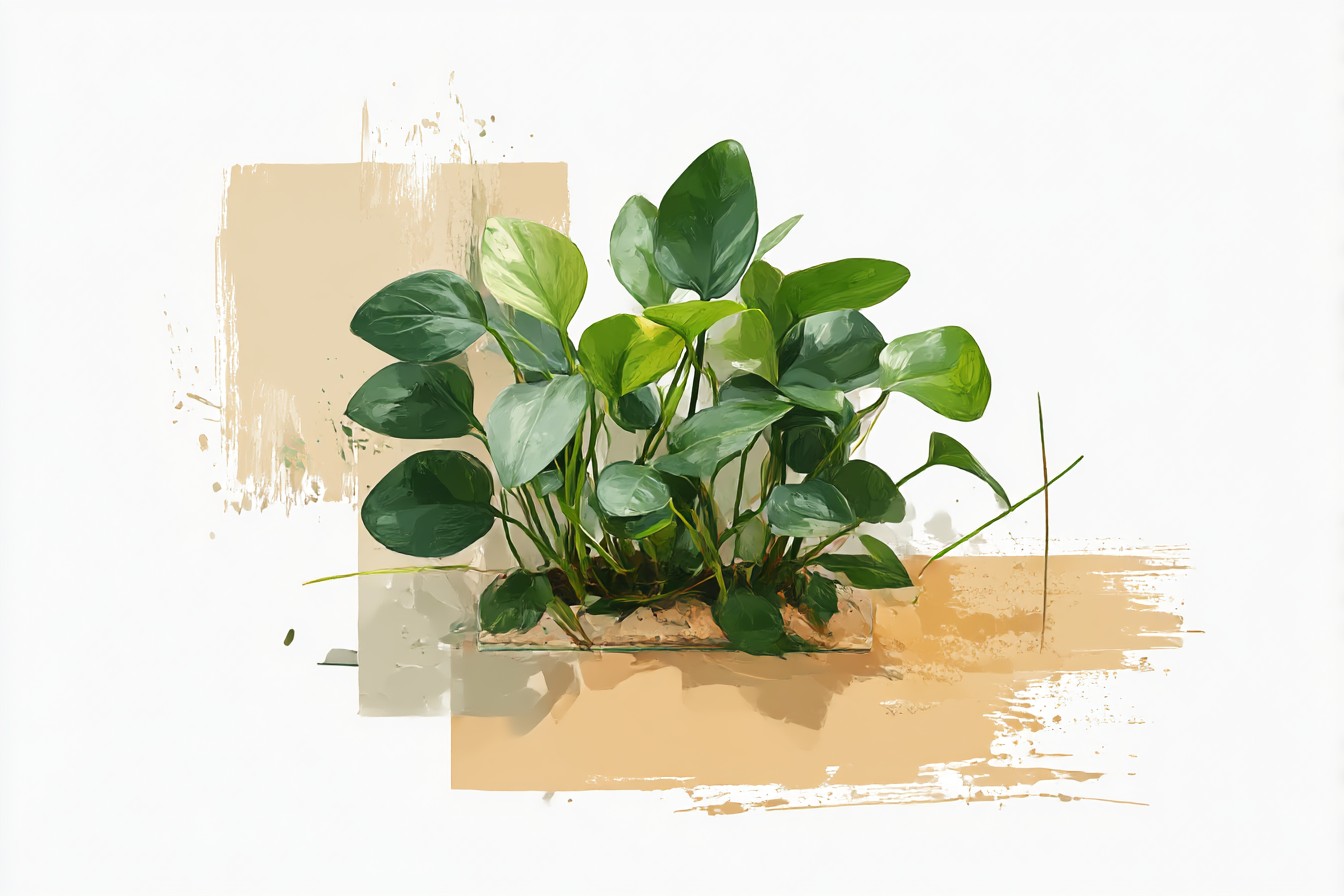
# Anubias and Why Every Shop Recommends It and Why They Are Right I walked into my first aquatics shop to buy a goldfish bowl and somehow ended up in a forty-minute conversation about plants I’d never heard of. The lad behind the counter was enthusiastic about something called Anubias, waving around what looked like a chunk of wood with leaves growing out of it. “Perfect for beginners,” he said.
“Can’t go wrong with this one.” I nodded politely, bought it along with everything else he’d talked me into, and spent the drive home wondering what I’d got myself into. Eighteen months later, that same piece of Anubias is still there, bigger now, still green, still doing whatever it is plants do to keep a tank looking decent. It’s been through water changes I got wrong, lighting upgrades I didn’t understand, and at least three complete rearrangements of the hardscape.
It just keeps growing. Slowly, but steadily.

The shop lad was right, and I’ve since discovered that every aquatics shop in the country says exactly the same thing about this plant.
There’s a reason for that. This is what Anubias actually is, why it’s become the default recommendation for anyone starting with planted tanks, and whether it lives up to the reputation that’s made it probably the most widely kept aquarium plant in the hobby. | **Care Level** | **Lighting Needs** | **CO2 Required** | **Growth Rate** | **Max Size** | **Our Rating** | |—|—|—|—|—|—| | Beginner | Low to Moderate | No | Very Slow | 10-40cm | 9/10 | ## Where It All Started Anubias takes its name from Anubis, the Egyptian god of the afterlife (Wikipedia), which feels appropriate for a plant that seems capable of surviving anything you throw at it. The genus was first described in 1857 by Heinrich Wilhelm Schott (Wikipedia), a Austrian botanist who probably had no idea he was cataloguing what would become the backbone of the aquarium plant trade 150 years later.
Native to tropical central and western Africa (Buce Plant), Anubias grows naturally along riverbanks and in areas that flood seasonally. This background explains everything about why it works so well in aquariums. In the wild, it spends part of the year underwater and part above the surface, which means it’s genuinely comfortable in both environments.
It’s evolved to handle variable water levels, changing light conditions, and periods of nutrient scarcity. All of which translates into a plant that won’t panic if you get things slightly wrong in your tank. The hobby latched onto Anubias sometime in the latter half of the twentieth century, and it’s been a staple ever since.
Over 30 varieties are now available in the aquarium trade (Fluvico), ranging from the tiny Anubias nana, which maxes out at around 10cm tall (Fishkeeping World), to the much larger varieties that can reach 40cm or more. What they all share is that fundamental African resilience and the kind of steady, undemanding growth that makes them perfect for people who want their tanks to look planted without becoming full-time gardeners. ## What Makes It Special The first thing you notice about Anubias is that it doesn’t look like other aquarium plants. The leaves are thick, almost leathery, and a deep green that stays consistent regardless of what’s happening with your lighting or CO2 levels.
These leather-like leaves resist being eaten by most fish, including cichlids (Aquarium Care Basics), which makes it one of the few plants safe with African cichlids and goldfish (Build Your Aquarium). I learned this the hard way when I added some goldfish to a tank and watched them systematically demolish every other plant I’d carefully positioned. The Anubias just sat there, unbothered.
The plant grows from a rhizome, which is essentially a thick horizontal stem that runs along whatever surface you’ve attached it to. This is crucial to understand because the rhizome must not be buried in substrate or it will rot (Dustins Fish Tanks). Instead, you attach it to wood, rocks, or other hardscape using superglue or thread (2Hr Aquarist).
The first time I tried this, I was convinced I was doing it wrong. It seemed unnatural to glue a plant to a piece of bogwood. But the roots grow out from the rhizome and anchor themselves to whatever surface you’ve provided, eventually creating what looks like a completely natural arrangement.
What sets Anubias apart from most aquarium plants is its complete indifference to high-tech setups. It thrives in low to moderate light without CO2 injection (Modern Aquarium) and tolerates a remarkably wide range of water parameters, handling temperatures from 72 to 82°F and pH from 6.0 to 8.0 (The Shrimp Farm). This means it works in soft water setups, hard water tanks, low-tech builds, and high-tech planted aquariums equally well.
I’ve never adjusted my water parameters for Anubias. It just adapts to whatever I’m running. The plant can grow both submerged and emersed above water (Aquarium Breeder), which opens up possibilities for paludarium builds or tanks where the water level varies.
I’ve seen it growing out of the top of tanks where the water level dropped during summer holidays, the emerged leaves larger and a slightly different shade of green than the submerged ones. When the water level was restored, the plant carried on as if nothing had happened. The growth rate is deliberately slow, roughly one new leaf every 2 to 4 weeks (Modest Fish).
For someone used to the instant gratification of most hobbies, this can be frustrating at first. You attach a small piece to your hardscape and it just sits there, doing very little visibly. But this slow growth is actually one of its greatest strengths.
You Might Also Like
It means the plant won’t outgrow your aquascape or need constant trimming. Once you’ve positioned it where you want it, it gradually fills out that space without taking over the tank. ## The Honest Assessment Anubias isn’t perfect, and pretending it is would be dishonest. The slow growth that makes it low-maintenance also means it takes months to achieve any significant visual impact.
If you’re looking for quick results or dramatic changes to your aquascape, this isn’t the plant for you. I spent the first six months wondering if mine was actually growing at all. It was, but so slowly that the changes weren’t obvious week to week.
The slow growth also makes it expensive relative to faster-growing plants. You’re paying for something that won’t give you much biomass quickly, and if you want to create a substantial planted area, you’ll need multiple pieces. A single small Anubias can cost as much as a bunch of stem plants that would fill three times the space within a month.
For someone on a tight budget trying to get a tank looking established quickly, that’s a significant consideration. The thick, leathery leaves that resist fish damage also make Anubias prone to algae problems if your tank balance is off. The slow growth means the plant can’t outcompete algae for nutrients, and those broad, stable leaves provide perfect surfaces for algae to establish on.
I’ve had to scrub algae off Anubias leaves more often than I care to admit, particularly in the early days when I was still working out lighting and feeding schedules. The algae comes off easily enough, but it’s an ongoing maintenance task. The plant’s tolerance for low light can also work against it in higher-light tanks.
If you’ve got strong lighting and CO2 injection, faster-growing plants will often outcompete Anubias for nutrients and space. It won’t die, but it might struggle to thrive in the same way it would in a lower-energy setup. I’ve noticed this in my higher-tech tank where the Anubias looks healthy but grows even more slowly than usual. ## Legacy and Influence Anubias has shaped the planted tank hobby more than probably any other single genus.
It’s the plant that proved you could have greenery in your aquarium without turning into a full-time aquatic gardener. Before reliable sources of Anubias became widely available, planted tanks were either the domain of serious hobbyists with significant technical knowledge or they were artificial plants. Anubias created a middle ground where ordinary fishkeepers could have real plants that actually survived and looked decent.
The plant’s resilience with cichlids opened up planted tank possibilities for African cichlid keepers who had previously assumed live plants weren’t an option. It’s become the foundation plant for countless cichlid tanks, providing cover and visual interest in setups that would otherwise be limited to rocks and artificial decorations. In the broader aquascaping world, Anubias has influenced design approaches toward sustainability and natural growth patterns.
Its slow, steady development and attachment to hardscape encouraged aquascapers to think in longer timescales and to design layouts that would mature gradually rather than look finished immediately.

This patience-based approach has become central to many aquascaping philosophies. The plant’s success has also driven the development of the attachment-based planting method that’s now standard for epiphytic plants throughout the hobby.
The techniques developed for Anubias attachment using thread, superglue, and elastic bands are now applied to Java fern, Bucephalandra, and dozens of other species. ## The Verdict Every aquatics shop recommends Anubias because it works. Not just for beginners, though it’s perfect for them, but for anyone who wants reliable, attractive plants without the technical overhead of high-demand species. I’ve been keeping fish for eighteen months now, and Anubias remains in every tank I run.
Not because I lack imagination, but because I’ve learned to appreciate plants that just get on with the job. If you want instant gratification or dramatic growth, look elsewhere. If you want something that will quietly establish itself in your tank, provide consistent visual interest, and not punish you for the occasional mistake, Anubias is exactly what you need.
It’s the plant equivalent of a reliable friend: not flashy, not demanding attention, but absolutely dependable when it matters. The shop assistant who sold me my first piece was right. You genuinely can’t go wrong with this one.
See where this placed in our full ranking.



[…] covered the full attachment methods and variety breakdown in our complete Anubias guide. ## 2. Java Moss **Moss | Extremely […]