
I nearly destroyed four tanks learning this the hard way. Thought I could save money running CO2 to multiple setups from one big cylinder instead of buying separate systems for each tank. Spent three weeks wondering why my crypts were melting in one tank while the other was pearling beautifully, both supposedly getting the same CO2 flow.
Turns out petrol doesn’t distribute as evenly as you’d hope when you’re trying to be clever about plumbing. The appeal is obvious. CO2 cylinders are expensive, regulators cost a fortune, and if you’ve got multiple planted tanks the costs add up fast.
When you’re working with several small tanks in the same space, it seems logical to run everything off one large cylinder with a manifold setup. I tried exactly that approach and learned why it’s trickier than most forums make it sound.

But I also learned how to make it work properly, which is what this article covers. | **Aspect** | **Details** | |————|————-| | Minimum Cylinder Size | 10 lb for large tank setups | | Tank Compatibility | Multiple tanks possible with proper manifold | | Key Requirement | Separate needle valve per tank | | Recommended PSI | Higher than typical 20-25 when splitting | | Main Challenge | Uneven CO2 distribution | | Our Rating | 7/10 (complex but economical) | ## Why CO2 Systems Scale Differently Than You’d Expect Most planted tank advice treats CO2 like it’s electricity.
Connect everything to the main supply and it flows where needed. Petrol doesn’t behave like that. When you split pressurised CO2 between tanks, it takes the path of least resistance, which usually means one tank gets flooded with petrol while the others barely get any.
I discovered this when my 60-litre was pearling like mad while my 30-litre beside it showed zero CO2 activity despite both being connected to the same source. The traditional sizing guidance suggests a 2.5-5 lb cylinder for tanks up to about 20 gallons, a 5 lb cylinder for 25-40 gallon setups, and 10 lb cylinders for 55 gallons and larger (Splashy Fish Store). That works fine for single tank systems.
When you start connecting multiple tanks, the calculations get messier because you’re not just scaling up the petrol volume, you’re dealing with pressure distribution across different sized systems with different resistances. Forum discussions confirm you can run multiple tanks off one CO2 cylinder (Aquarium Co-Op Forum), but the setup requires more than just T-junctions and hope. The physics matter.
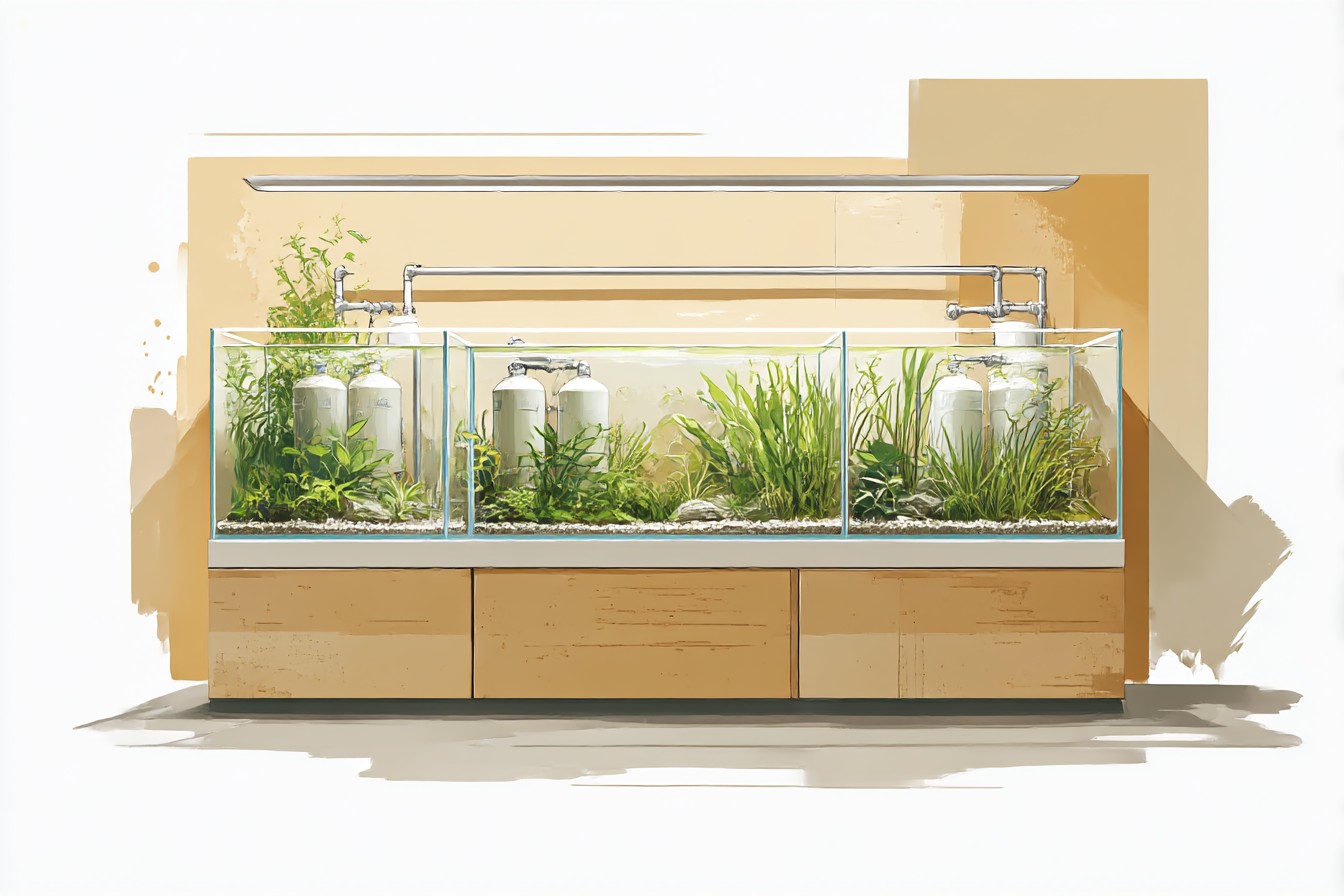
Each tank creates different back pressure depending on its size, how deep your diffuser sits, what type of diffusion method you’re using, and how much plant mass is consuming CO2. Connect them all to a single regulator output and the CO2 will flow to whichever path offers least resistance. ## The Manifold Solution and Why It’s Not Optional A proper manifold system is essential for running multiple tanks correctly (Aquarium Advice Forum). I initially tried to get away with just splitting tubing with T-connectors.
That lasted exactly one day before it became obvious why that doesn’t work. One tank was getting all the CO2 while the others got nothing, which is precisely what other hobbyists report when they try the same shortcut approach (Aquarium Advice Forum). The manifold gives you individual control over each output line.
More importantly, each tank needs its own needle valve for fine control (Aquarium Co-Op Forum). This is where the costs start adding up, but there’s no way around it. You need independent flow control for each tank because they’ll all have different requirements.
Setting the secondary regulator pressure higher than the typical 20-25 PSI helps when splitting petrol between multiple lines (Aquarium Co-Op Forum). I run mine at about 35 PSI when feeding three tanks. Higher pressure gives you better control at the needle valves and helps overcome the resistance differences between tanks of various sizes. ## Large Tank Considerations and Multiple Diffusion Points Large tanks present their own challenges even without the multi-tank complexity.
Some hobbyists run two atomisers on tanks as large as 360 litres to ensure even distribution (UKAPS). This makes sense when you consider how CO2 mixes in water. A single diffusion point in a 300+ litre tank might not provide even coverage, especially if your flow patterns aren’t perfect.
I’ve found that tanks over 200 litres benefit from multiple diffusion points even with single cylinder setups. When you’re already running a manifold system for multiple tanks, adding extra diffusion points to your larger tanks becomes straightforward. Just treat each diffusion point as a separate output requiring its own needle valve control.
The cylinder sizing becomes more critical when supporting both large individual tanks and multiple tank setups. A 10 lb cylinder that might last six months on a single 200-litre tank will run out much faster when supporting three or four smaller tanks plus providing multiple diffusion points to larger setups. ## The Real Challenges Nobody Warns You About Balancing CO2 across different tank sizes is genuinely difficult. My 100-litre tank needs roughly three times the flow rate of my 30-litre to maintain the same dissolved CO2 levels, but it’s not a linear relationship.
You Might Also Like
Plant mass, surface agitation, filtration flow rates, and even fish bioload all affect how much CO2 each tank consumes. You can’t just set the needle valves once and forget them. Plant growth changes CO2 consumption over time.
A newly planted tank uses much less CO2 than the same tank six months later when everything’s established and growing rapidly. With multiple tanks on one system, you’re constantly rebalancing flows as individual tanks mature at different rates. Solenoid timing becomes more complex with multiple tanks.
Some of my tanks get direct morning sunlight while others rely on LED schedules. Running everything off a single solenoid means CO2 timing that’s perfect for one tank might be wasteful or insufficient for others. Some people solve this with individual solenoids on each line, but at that point you’re approaching the cost of separate systems anyway.
Troubleshooting problems is harder when everything’s connected. When CO2 levels drop in one tank, is it a clogged diffuser, a loose fitting, a needle valve that’s drifted, or is another tank in the system suddenly consuming more petrol? With individual systems, problems are isolated.
With manifold setups, everything affects everything else. ## When the Economics Actually Work Despite the complications, manifold systems make financial sense in specific situations. If you’re running four or five small tanks in the same area, buying one large cylinder and a good manifold setup costs less than five separate CO2 systems. The ongoing cylinder refill costs are lower too since you’re buying larger quantities of petrol less frequently.
Space considerations matter as much as money. Five separate cylinders take up considerably more room than one large cylinder with distribution tubing. If you’re dealing with limited space, consolidating makes practical sense beyond just the economics.
The system works best when your tanks are similar sizes with comparable plant loads. Three 60-litre tanks with similar stocking and planting are much easier to balance than trying to run a 200-litre high-tech setup alongside two 30-litre low-light tanks. The more similar your tanks’ requirements, the less you’ll struggle with distribution. ## Learning From the Disasters My first attempt at running two 20-gallon tanks from one system ended up with all the CO2 going to one tank (Aquarium Advice Forum), exactly the problem other hobbyists report.
I’d underestimated how much the different depths and diffusion methods would affect flow distribution. The tank with the ceramic diffuser sitting deeper got almost nothing while the one with a glass diffuser higher in the water column got flooded with CO2. The solution was installing proper needle valves on each line and spending two weeks gradually adjusting flows while monitoring pH swings in each tank.
It’s not a quick setup.
Plan on at least a week of daily adjustments to get the balance right, and be prepared to keep tweaking as plants grow and conditions change. YouTube demonstrations of splitting CO2 for multiple tanks (YouTube) make it look straightforward, but they rarely show the ongoing maintenance and adjustment required to keep everything balanced.
The initial setup is the easy part. The next six months of gradual tweaking is where most people give up and go back to individual systems. ## The Verdict Running multiple tanks off one CO2 cylinder can work, but it’s significantly more complex than most people expect. If you’re comfortable with ongoing adjustments, have tanks with similar requirements, and genuinely need to save space or money, it’s worth attempting.
The key is understanding that you’re not just scaling up a single tank system, you’re creating a distribution network that needs constant attention. For someone with two or three small tanks and limited space, I’d recommend trying it with the understanding that you might end up separating things later. For anyone with vastly different tank sizes or limited time for adjustment and maintenance, individual systems will save you considerable frustration.
The economics work when cylinder costs are high and refills are inconvenient, but factor in the time cost of constant rebalancing. Some people enjoy the complexity and treat it as part of the hobby. Others find it tedious and wish they’d just bought separate systems from the start.
Know which type you are before committing to a manifold setup that might take months to get running smoothly.



[…] of either the budget options below it or the premium reliability above it. **3. Paintball CO2 Systems with Adapter** **Budget Pressurised | […]