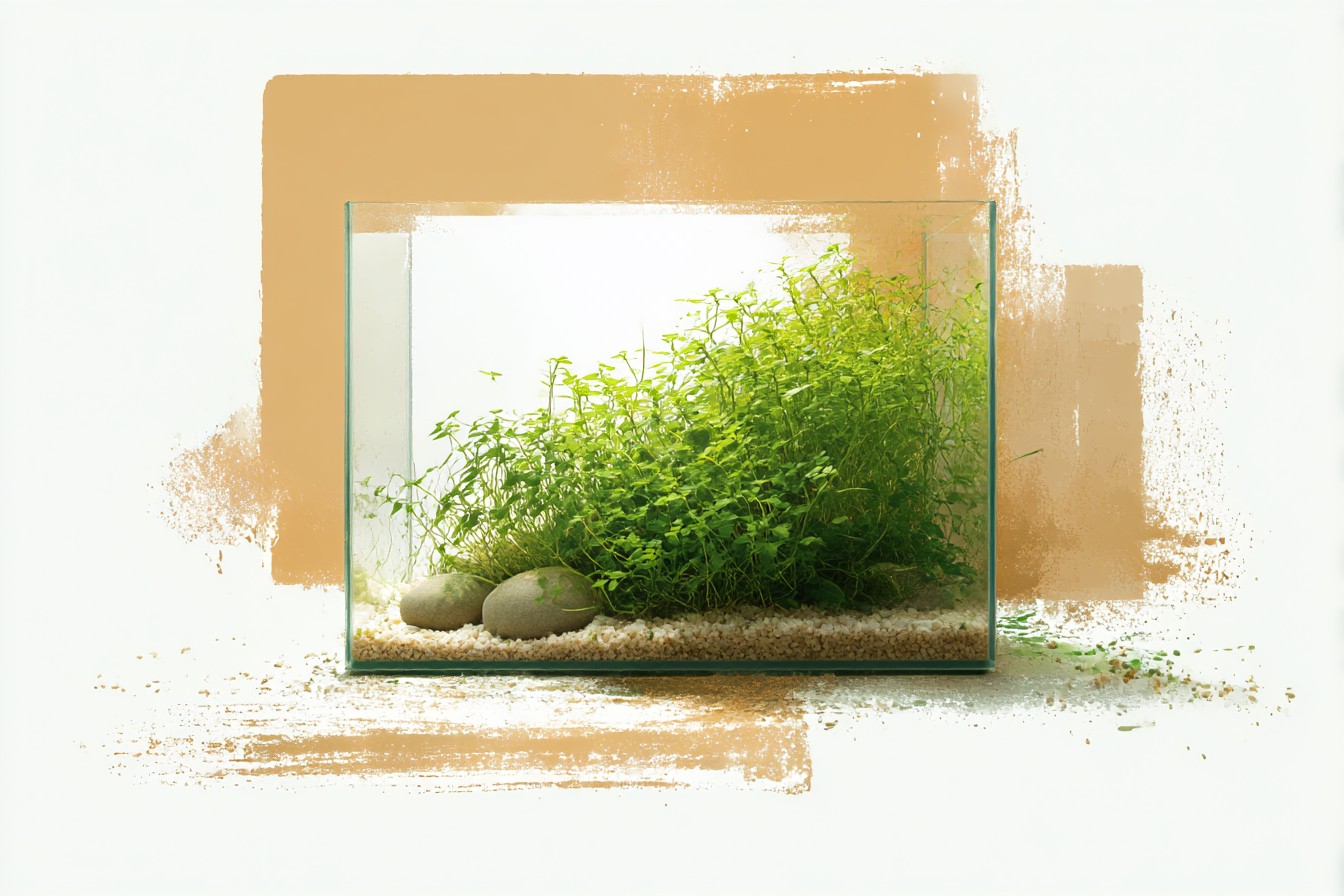
# Glossostigma and the Carpet That Made Amano Famous but Makes Beginners Cry I still remember the first time I saw a proper Glossostigma carpet. It was in a photo of one of Takashi Amano’s tanks from the late 1990s, and the thing looked like someone had managed to grow a perfect lawn underwater. Tiny, bright green leaves spread across the substrate in an unbroken mat, creating this sense of scale that made the hardscape look like a mountain range viewed from an aeroplane.
I wanted that in my tank immediately. Three failed attempts later, I had a much clearer understanding of why Glossostigma elatinoides is simultaneously one of the most iconic carpeting plants in aquascaping and one of the most frustrating for anyone who hasn’t got their CO2 and lighting sorted properly. It’s a plant that can make your tank look like something from a magazine or turn into a stringy, melting mess that you’ll spend a weekend picking out with tweezers.
There’s not much middle ground. This is the plant that helped define what we think a planted tank can look like, but it’s also the plant that’s probably caused more beginners to pack up their CO2 systems and go back to plastic plants than any other single species.

Understanding why requires looking at what makes Glossostigma special and what makes it so bloody difficult to keep properly. ## Quick Reference | Care Level | Lighting Needs | CO2 Required | Growth Rate | Max Size | Our Rating | |————|—————-|————–|————-|———-|————| | Difficult | Very High | Essential | Fast | 1-2 cm | 7/10 | ## Background and History Glossostigma elatinoides comes from New Zealand and southeastern Australia, where it grows as both an aquatic and semi-aquatic plant in shallow water along riverbanks and lake margins (AquariumLesson).
In the wild, it experiences seasonal flooding and varying light conditions, which probably explains some of its particular requirements in cultivation. The plant entered the aquascaping world in a serious way through the work of Takashi Amano in the 1990s. Amano was looking for plants that could create the sense of scale and proportion he wanted in his nature aquarium designs, and Glossostigma’s tiny leaves and spreading growth habit made it perfect for creating the illusion of vast lawns in relatively small tanks.
Some of his most famous photographs feature Glossostigma carpets as the foundation of the entire composition. What made Amano’s use of Glossostigma so influential wasn’t just that it looked good in photos. It demonstrated that you could create underwater landscapes with the same sense of depth and perspective you’d find in terrestrial environments.
The carpet became a tool for making viewers forget they were looking at a tank and instead feel like they were looking at a natural scene. That visual trick became central to the nature aquarium movement. The plant quickly spread through the hobby in the late 1990s and early 2000s, as aquascapers around the world tried to replicate Amano’s results.
This is also when most people discovered that what looked effortless in his tanks required a level of technical precision that many weren’t prepared for. Glossostigma became synonymous with both the highest achievements in aquascaping and some of the most spectacular failures. ## What Makes It Special The first thing you notice about healthy Glossostigma is the scale. The leaves are genuinely tiny, typically staying under 1-2 cm (Aqua-Fish.net), which means a well-established carpet creates an almost grass-like texture that’s unlike anything else available to aquascapers.
When it’s growing properly, it spreads through runners that hug the substrate, creating an increasingly dense mat that can cover the entire floor of a tank. The growth habit is what made it revolutionary. Rather than growing upward like most aquarium plants, healthy Glossostigma stays low and spreads outward, sending out runners that produce new plants every few centimetres.
Under intense lighting with adequate CO2, it will carpet an area faster than almost any other plant, with a growth rate described as fast (Aqua-Fish.net). I’ve seen it double its coverage in a month when conditions are right. The visual effect is remarkable when it works.
The carpet creates this perfect middle ground in a tank, neither foreground nor background, that gives other plants something to sit against. It makes rocks look like they’re emerging from a natural hillside rather than just sitting on substrate. It turns driftwood into fallen trees in a meadow.
The sense of scale it provides is genuinely transformative for the overall composition. But here’s what makes it both special and difficult: it only does this under very specific conditions. Glossostigma requires intense lighting, substantial CO2 injection, and consistent nutrient levels to maintain its carpeting growth habit.
The plant needs CO2 levels of 20-40 mg/L (AquariumLesson) and nitrate levels between 10-50 mg/L (AquariumLesson) to perform properly. Miss any of these requirements, and it stops behaving like a carpet plant entirely. Under insufficient light or without adequate CO2, Glossostigma grows tall and stringy instead of low and spreading.
The leaves elongate, the plant reaches toward the surface, and instead of a carpet you get this unsightly mess of vertical stems that defeats the entire purpose. It’s one of the most dramatic changes in plant behaviour I’ve seen in response to changing conditions. The temperature requirements are quite specific as well, preferring 20-26°C (Aqua-Fish.net) with pH levels between 5.8-7.2 (Aqua-Fish.net).
It’s more tolerant of pH variations than some plants, handling ranges from 4.5-7.5 according to some sources (AquariumLesson), but the lighting and CO2 requirements are non-negotiable if you want it to carpet. When everything is dialled in correctly, Glossostigma demonstrates why Amano chose it as a foundational species. It provides texture, scale, and a sense of natural proportion that’s difficult to achieve with other plants.
You Might Also Like
The way it interacts with hardscape elements creates depth and perspective that can make a 60-litre tank look like a landscape photograph. ## The Honest Assessment The problem with Glossostigma isn’t that it’s a bad plant. It’s that it’s been marketed to beginners as a carpeting option when it absolutely isn’t. Multiple sources describe it as “difficult” to care for (Fish Laboratory), noting high light, CO2, and nutrient demands that make it unsuitable for beginner setups (AquariumBreeder).
The technical requirements are genuinely demanding. You need powerful lighting, pressurised CO2 injection, and a solid understanding of nutrient dosing to make it work. This isn’t a plant you can grow under a basic LED fixture with liquid carbon.
I learned this the hard way when my first attempt turned into what looked like green spaghetti within six weeks. Planting it properly is also more involved than most people expect. You need to separate small portions and plant them individually across the area you want to carpet, ensuring each piece has good contact with the substrate.
Plant them too close together and they’ll shade each other out. Too far apart and the gaps never fill in properly. Getting the initial placement right requires patience and usually multiple attempts.
The maintenance demands are significant once it’s established. Glossostigma grows fast when happy, which means regular trimming to prevent it from getting too thick and developing layers that shade the bottom portions. If the lower layer dies off, you end up with patches of bare substrate that require replanting.
It’s not a set-and-forget carpet plant. Cost is another factor that often gets overlooked. Because you need multiple portions to establish a carpet and because the technical requirements are so specific, the total investment in lighting, CO2 equipment, and enough plant material to cover a decent area can run into hundreds of pounds.
That’s a lot to spend on something that might not work if you haven’t got the fundamentals sorted. Availability can be inconsistent as well. Because it requires specific growing conditions to maintain its compact form, not all suppliers keep it in good condition.
I’ve received Glossostigma that was already growing in its tall, stringy form, which meant starting with plant material that was already adapting to low-light conditions. ## Legacy and Influence Glossostigma’s impact on aquascaping extends far beyond its use as a single species. It established carpeting plants as an essential element in serious aquascaping and demonstrated that the floor of a tank could be as important as any other layer in creating a convincing natural scene. The plant essentially created the template for what we now call the nature aquarium style.
The combination of precise carpeting, dramatic hardscape, and careful attention to scale that defines contemporary aquascaping can be traced back to those early Amano layouts featuring Glossostigma. It showed that aquascaping could achieve the same sense of composition and natural perspective found in landscape photography.

Its technical demands also pushed the hobby toward better equipment and more sophisticated understanding of plant requirements.
The success of Glossostigma carpets required aquascapers to invest in proper lighting, CO2 injection, and nutrient management, which raised the technical bar for the entire hobby. Many of the equipment innovations in aquascaping over the past twenty years can be traced back to the demands created by plants like Glossostigma. The plant’s difficulty also led to the development of alternative carpeting species that could achieve similar visual effects under less demanding conditions.
Plants like Hemianthus callitrichoides and various moss species became popular partly because they offered some of the aesthetic benefits of Glossostigma without quite the same technical requirements. ## The Verdict Glossostigma elatinoides deserves its reputation as one of the most visually striking carpeting plants available to aquascapers, but it also deserves its reputation as one of the most technically demanding. If you’ve got a high-tech setup with intense lighting, pressurised CO2, and a solid grasp of nutrient management, it’s still one of the best options for creating that perfect lawn effect that made Amano’s tanks so compelling. For anyone working with lower light levels, limited CO2, or less experience with demanding plants, it’s genuinely not worth the frustration.
The plant will grow, but it won’t carpet, and watching it turn into stringy mess while you try to work out what’s wrong isn’t good for your confidence or your wallet. If you’re determined to try it, make sure your technical setup is sorted first. Get your lighting, CO2, and fertilisation working reliably with easier plants before attempting a Glossostigma carpet.
The plant will tell you very quickly whether your system is up to the task, and it’s better to find that out after you’ve proved everything works rather than discovering your limitations while watching expensive plant material slowly die. See where this placed in our full ranking of carpeting plants.



[…] of a carpet, you get stringy vertical growth that looks nothing like what you were aiming for. Our detailed Glossostigma analysis covers why this legendary plant has become so challenging for modern aquarists. **”Does it […]