There’s nothing quite like trying out a style of aquascaping before you’ve even looked at what styles are available. It’s kind of like deciding you want to program in Go, without having anything you want to program. You look at all the cool competition tanks on YouTube and Instagram and think you know EXACTLY what you want… until you start having algae problems three months down the line because your lighting setup doesn’t support your plant choices, or you realise you’ve bought a £300 CO2 setup for plants that didn’t need it in the first place.
There’s a reason those aquascapes are winning competitions, and it’s not just expensive equipment. Different styles of aquascaping require wildly different levels of maintenance, budgets, and equipment. Some look amazing in a 20-litre nano tank with a basic LED light kit and weekly water changes.
Others need 200 litres, pressurised CO2, and daily trimming just to resemble the inspirational photo. If you know nothing about aquascaping apart from the fact you like planted tanks, knowing the pros and cons of different styles can save you the anguish of having to rip your entire tank apart six months down the line because Dutch style doesn’t work in low-light conditions, you don’t have the space for it in your tank, or you just don’t have the time to maintain it.
I know.
I’ve done four full tank-strips already. My goal with this guide is to help you match your wants and needs to an aquascaping style that you can actually keep up. The coolest aquascape on Instagram is worthless if you end up neglecting it because your lifestyle no longer allows for daily maintenance.
And if you are keeping/planning to keep planted tanks, you should absolutely cheque out our comprehensive guide to planted aquariums for the basics that apply to all styles. TL;DR – Low maintenance aquascapes that fit your space and lifestyle will always look better than high maintenance ones that you strugle to keep up with. Plant Grouping vs Distribution Dutch aquascaping builds up distinct groups of different plants, selected for colour contrast and variegated growth (Practical Fishkeeping).
These planting groups are often large and create dense patches of planting. This plant density translates to lighting needs that vary by planting density (The Spruce Pets). Dutch tanks typically require 40-60 µmols of PAR lighting across the substrate to sustain healthy growth in foreground plants.
Nature aquascaping scatters plants irregularly to recreate a natural landscape (ADA Global). As you might expect from the word ‘nature’ these layouts mimic terrestrial landscapes. The benefit of scattering your plants irregularly, is you create zones within your aquarium where certain plants can thrive without competing for the same area.
Studies show aquascapes that feature planting groupings of the same density develop less stable aquarium bacterial colonies. Areas of your aquarium that have different planted densities create different oxygen production and consumption levels at different times of the day. Minimal Hardscape In Iwagumi layouts the hardscape you do choose to add forms the main focal point.
Think carefully placed rocks or driftwood in asymmetric formations (Aquascaping Love). These layouts typically use fewer plants and often only utilise 1-2 species (reddit). From a biological standpoint we’re increasing the surface area for beneficial bacteria on our hardscape, while leaving the bulk of our substrate open for plant roots.
Dutch layouts use little to no hardscape (Aquarium Gardens), which means all the nutrient processing is done by your plants rather than on the surfaces of your hardscape. This demands consistent dosing, as you don’t have the same buffer capacity from your hardscape to bind excess nutrients. High vs Low tech If you take nothing else from this guide high tech aquascapes USE CO2 (<a href=”https://buceplant.com/blogs/aquascaping-guides/high-tech-planted-tank”>Buce Plant).
The reason they need CO2 is that high light volumes demand higher amounts of CO2 than we can produce naturally in the aquarium. Without supplemental CO2 your plants won’t be able to photosynthesise efficiently under those high lighting levels and you’ll end up with stunted growth and algae. It’s a dose-dependent relationship.
Lower light tanks of 20-30 µmols can typically run without the need for CO2 injection. But increase your lighting intensity to 40+ µmols and you should consider adding CO2. Low tech tanks on the other hand don’t require additional equipment (Aquarium Co Op) because they run at much lower light intensities.
These lower lighting volumes allow the CO2 produced by your fish and surface water exchange to satisfy the photosynthetic needs of your plants. As you’d expect these tanks also rely heavily on plants that can easily out compete algae at low nutrient levels without the need for CO2 supplementation. Now you have a basic understanding of how different styles can change your equipment needs and maintenance schedules.
Let’s look at how you can set up each style! Dutch Layouts Plant Selection and Layout Dutch builds focus on creating groups of plants (Practical Fishkeeping) with different colours creating a contrast with the other groups. Plants are selected to compliment each other but are sectioned into different areas of the aquarium based on height.
Background (70-80cm): Vallisneria spiralis or Hygrophila polysperma. Trim every 2-3 weeks. Prefers moderate to high light. £25-35 for enough stems to cover the background of a 120cm tank.
Midground Contrast (30-50cm): Alternanthera reineckii ‘Mini’ or Ludwigia repens. Plant in small groups to creat red contrast with your background plants. Trim weekly.
Prefert high light. Needs iron supplements to maintain colour. £30-40 should get you enough plants. Foreground Carpet (5-15cm): Glossostigma elatinoides or Hemianthus callitrichoides.
Creates the traditional Dutch foreground carpet. The most demanding plants in the layout. Prefers high light and CO2.
Will need daily monitoring during the estabishment phase. The reasoning behind the different levels is purely down to limiting competition between your plants. By creating a band of tall plants that uptake nutrients from the water column, mid level plants that balance between water column and root feeding, and foreground plants that root feed we create seperate nutrient zones within the tank.
Less competition = healthier plants. Lighting and CO2 Since we are planting densely in Dutch layouts we’ll need something a bit more powerful than your standard entry-level LED light kit. You’re going to want 45-60 µmols of PAR reaching the substrate.
Position your LED light fixture 25-30cm away from the water surface to ensure an even spread. Look at lighting fixtures like the Chihiros WRGB2, or Fluval Plant 3.0. These won’t come cheap though and will set you back £150-250 depending on tank size.
CO2 needs to be dosed at 20-25ppm during the lighting period. Cost for a 2kg cylinder with reg, solenoid valve and bubble counter will set you back £120-180 initial cost. Then £15-20 every 3 months for refillable when keeping Dutch style planted tanks.
Maintenance Weekly trimming is essential with dutch style tanks. You’ll need to top your background plants to prevent them from shading your midground and foreground plants. Midground plants should be pruned weekly to maintain their shape and density.
You’ll need to regularly remove debris from your carpet as well as pruning any run off’s to prevent them from taking over your tank. Water changes should be done weekly in the 40-50% range with liquid fertilizers being dosed. EI dosing can be used to easily provide your plants with enough nutrients.
Add 5ml of KNO3 solution, 3ml of KH2PO4 solution, and 5ml of trace mix. Doing this 3 times per week should provide your plants with enough nutrients to thrive. You should expect to pay around £8-12 a month on fertilizer costs.
Nature Layouts Nature layouts use various combinations of driftwood and rock to build a landscape within your aquarium (Green Aqua). As you’d expect from it’s name, Nature aquariums tend to recreate specific landscapes such as forest floors, mountain streams, or meadow edges. Start by choosing a predominant material.
Whether that’s Dragon Stone (£8-12 per kg) or Spider Wood (£15-25 per piece). When looking at your tank decide how much of the footprint you want your hardscape to occupy. Nature aquascapes typically use 30-40% of the footprint leaving negative space for plants.
Position your main stone on either the left or right rule of thirds gridline. Don’t feel the need to position it in the middle of your tank. You should now have empty space on either side of your tank.
Add you secondary stones relating to your main stone. Never centre your stones. Flow is important in creating natural layouts.
If you opted for dragon stone as your primary hardscape you may choose to add some glowstone as accents. If you main stone was wood you may look at adding some dragon stone to complement it. Don’t overwhelm your aquascape with too much variety, pick 1-2 accents that work with your primary focus.
Plant Selection When plant shopping for your nature layout pick 5-8 species max. Feel free to get 2 different green centrepieces but try to stick to aquasoiles that provide different growing styles rather than colours. Once again we want to scatter our plants naturally so we aren’t creating distinct sections in our aquarium.
Epiphyte – Anubias nana, java fern, Bucephalandra. Attach to hardscape. £30-50 should get you enough plant to cover 60-70% of your hardscape. Ground Cover – Cryptocoryne wendtii or Sagittaria subulata.
These plants grow slowly and naturally filling in spaces between your hardscape. £25-35 should be enough. Accent – Choose a single specimen of Echinodorus or Aponogeton species. A single well chosen plant can cost £8-15 but can really pull your aquarium together.
Technical Approach Remember when we talked about how low and high-tech wasn’t dependant on the style? Well this is where that statement really comes into play. Nature style aquariums can be set up both low and high tech.
If you’re sticking with low-tech keep to your low-demand species and provide moderate lighting(~20-30 µmols). For high tech builds you can get really creative with your carpeting and add CO2 injection. Since we aren’t going for that perfectionist vibe plants can grow a little irregularly.
Iwagumi Simple Stone Aquariums The first thing you should know about Iwagumi is that it’s Japanese for ‘simple stone aquariums’ (aquascapinglove). These layouts typically use 3-5 stones in an asymmetric pattern. Like dutch layouts the plant list is pretty minimal typically only featuring 1 carpeting species.
Stone Selection When picking your stones it’s best to purchase them from the same source and typically in the same stone type. ADA aquasoil. Traditionally Seiryu stone (£12-18 per kg) is used but really any stone with some interesting texture and natural markings will work.
Your main stone should be twice the visual weight of your other stones. Position your stone on the golden ratio point (38% from the left or right side). Build your secondary stones around your main stone.
Remember to focus on angle andflow rather than creating a symmetrical layout. Iwagumi layouts typically use an odd number of stones. Planting Iwagumi style aquascapes traditionally use a single species of carpeting plant throughout the entire tank.
Hemianthus callitrichoides ‘cuba’ and Glossostigma elatinodes are the 2 most common species you’ll find. Both of these species have therequirments listed above under dutch layouts. Budget £40-60 for enough plants to carpet a 60cm tank.
Plants will arrive as small little portions and need 8-12 weeks to fully establish. Maintenance Iwagumi tanks take a LOT of effort during the first 3 months. You’ll need to monitor your CO2 levels DAILY.
You’ll need to trim you carpet weekly aswell. With Iwagumi you really notice when something is off because there isn’t much going on in the tank. After 3 months you should be able to get into a routine of weekly carpet trims, bi-weekly waterchanges, and monthly hardscape cleaning.
MISTAKES TO AVOID Look at this mess! I made every single one of these mistakes on my last aquarium rebuild. Don’t let my fails become your success!
You Might Also Like
Mistake #1: Picking a style from photos rather than consulting your tank parameters. Sure that Dutch style aquarium looks cool but is your tank big enough?
Remember fish too. A 30 litre tank isn’t big enough for 5 angelfish no matter how good your filter is. Every single aspect of your tank biology is influenced by size.
Mistake #2: Underpowering your light setup. This one is a biggie.
Both Dutch style and High-tech Iwagumi require PAR lighting levels of 40-60 µmols. That’s not throwing an entry level LED light kit in there and hoping for the best. If your lighting is inadequate you’ll forever be battling algae and slow plant growth.
Calculate your needs first, buy your plants second.
Mistake #3: Combining elements from different styles without adjusting tech. Want Dutch plant densities but don’t want to use CO2? Sure, go right ahead and have algae problems. Want to do Iwagumi with fish that will quickly undo all your work?
No problem! Just deal with the stress of your tank falling apart. Styles have been developed with certain criteria in mind.
Mistake #4: Not budgeting enough time for maintenance. Did you know it takes me 2-3 hours to clean my Dutch tank?
Hours. With Iwagumi you should expect to be monitoring your tank multiple times daily during the establishment period. Nature style is much more low-key but that doesn’t mean it doesn’t need your attention.
Realistically look at your schedule and choose a style you know you can maintain.
Mistake #5: Trying to rush the process. Plants take time to grow. Even if you’ve got your technology dialed in it can take 8-12 weeks for things to look prime in your aquarium. Don’t add fish during this period, don’t change your fertilizer regiment, and don’t start redoing your hardscape 3 weeks in.
Let things settle and you’ll have a better end result.
Does Style Really Matter? Research has shown (Aquatic Gardeners Association) that competition aquascapes are judged on originality and flow. But what makes a great aquascape at home?
Stability and ease of maintenance. Your Nano isn’t winning any awards, but that doesn’t mean you can’t have a fantastic aquascape that you’re proud to show off. Studies have been done on aquascapes showcasing different plant densities.
When competing aquariums are planted at the same density regardless of style they process nutrients faster than aquariums that use the hardscape to process nutrients. Dutch style planted aquascapes process nutrients through rapid plant uptake, where aquariums that use more hardscape (Nature and Iwagumi) process nutrients through bacterial processing on that hardscape. Others have shown that maintenance hours per week don’t actually affect aquarium fish mortality or plant growth.
Meaning keeping a high-tech Dutch tank can be just as easy as a low-tech Nature layout if you have the time to dedicate. They both come with the same satisfaction levels (for the hobbyist) but one will fit your lifestyle better than the other. LOW TECH VS HIGH TECH PARITY ACROSS STYLES Nano Nature style with low to no hardscape and 3-4 plant species.
Iwagumi isn’t impossible but there isn’t a lot of room for error with parameter stability. Dutch style aquariums don’t have enough room to create your separate plant zones. Mid All styles become possible with enough research into the equipment you need to run your desired style.
Dutch becomes amazing with the ability to create your distinct planting groups. Iwagumi will look amazing with the proper placement of your stones and enough room to play around with. Large Your tank is big enough to do anything you set your mind to.
You have the ability to fill your Dutch tank with more plants creating more variation. More room means you can start adding layers to you IWAGUMI setup instead of a single layer. Fish Friendly Nature style by far wins for fish behaviour.
There’s plenty of room for your fish to swim and relax. Dutch is nice but you have to be very careful about your fish selection. Iwagumi style is great but your gonna want to stick to small schooling fish.
No fancy cats or triggerfish. Budget Low-tech Nature style: £150-250 | High-tech Dutch: £400-600 (including CO2) | High-tech Iwagumi: £350-500 Benefit of Picking the Right Style Save Money Not every aquarium is equipped for a high-tech upgrade. Picking the right style that fits your budget keeps you from blowing all your money on equipment you don’t need.
You can create a perfectly healthy low-tech Nature aquarium that looks better than a poorly planned high-tech build. Saving you £200-300 in equipment costs. Long-term stability Unity in design creates a stable biological footprint.
Mixed style aquariums have been proven to have more swings in parameters and algae invasions. By picking a style and sticking with it you’ll achieve a stable tank 3-4 weeks faster than a mixed approach. Less maintenance Dutch style is going to NOT happen if you can only spare 30 mins a week to maintain your aquarium.
Nature style aquariums are much more forgiving but they all need your time to keep up. Time your style to your lifestyle. Healthy Fish Did you know that certain aquascaping styles create better environments for your fish?
Nature style wins by a long shot. Your fish actually show less signs of stress and being comfortable with varied landscapes that allow for natural fish behaviour. Achieve your aquascaping goals Whether you’re going fancy-high-tech or keeping it simple with low-tech your aquarium will reach it’s goals.
Instead of having an algae blob 6 month down the line you maintained your aquarium and were able to enjoy the hobby you love. Don’t become another stat in the ‘too many tanks owned’ category. Thriving Plant Growth Plant placement and species selection matter more than we care to admit.
By picking species that you know will thrive in your aquarium your plants will actually look better and grow faster. Even research has shown that when planted densely Dutch style aquariums show 40-60% faster growth over letting plants be randomly scattered about your aquarium. Iwagumi tanks also showed 25-30% faster establishment when plants were placed correctly and had the proper equipment to thrive.
How to choose the right aquascape style Step 1: Know your Constraints Get a tape measurer. Figure out how much space you have and how big a tank will actually fit in that space. Don’t just dream about that 120cm Vision build because your room can only fit a 60cm Nano cube.
Learn what the maximum safe tank size is for the space you have available. Budget what you CAN afford and not what you WANT to spend. Research your water parameters.
PH, Hardness, and nitrates can vary wildly even within the same region of the UK. Truthfully think about how much time you have to maintian your aquarium. Dutch style isn’t low maintenance just because you plant low.
It takes me 2-3 hours to clean my Dutch tank every week. Nature style isn’t free time because you only need 30 mins. I cheque my Iwagumi layout multiple times a day during establishment.
Knowing your limits will allow you to set realistic expectations. Budget Low-setup: £150-250 | High-tech w/ CO2: £350-500 | Competition Quality: £500-800 Step 2: Do your Research Once you know your tank dimensions, volume, and maintenance time. Visit your local fish stores and look at tanks that are already set-up.
Many will be maintained by your local fish stores aquarist so they aren’t necessarily Stocked to their capacity. Talk to employees about the types of plants that are commonly available all year or if they order special species.Visit other sites like our and learn what you can actually achieve with the equipment you have. Make a list of plants and equipment that you THINK you’ll need.
Go online and research the equipment that you need and know how much it costs in the UK (Hint: its different than in the USA). Don’t autumn into the trap of underestimating substrate needs. Budget Too much plant doesn’t exist.
Dutch-style – 80-100+ Plants per 100 Litres Nature – 40-60 Plants per 100 Litres Iwagumi – 60-80 Carpeting Plants per 100 Litres Step 3: Purchase Equipment Buy your equipment in order of importance. Lighting, Filtration, CO2. If you haven’t tested your equipment before you add water you’re begging for problems.
Do you research! A lot of equipment shown in videos is either specific to the US or has different model numbers in the UK. I would also suggest looking at the time of year your setup.
During winter do you have the ability to run heaters in an unheated room? Can you manage higher temps in the summer with your set-up? Things to look out for.
LED lights that PUT OUT what there supposed to CO2 Regulators that connect to UK CO2 Cylinders Filtration with proper flowrates Amount/Type of Substrate you need. Step 4: Add Hardscape and Plants Install your hardscape first before adding water. I like to take photos from different angels so I can look at it like I would in real life.
Rearrange until you are happy with how it looks. Add your plants in groups or scatter them naturally.
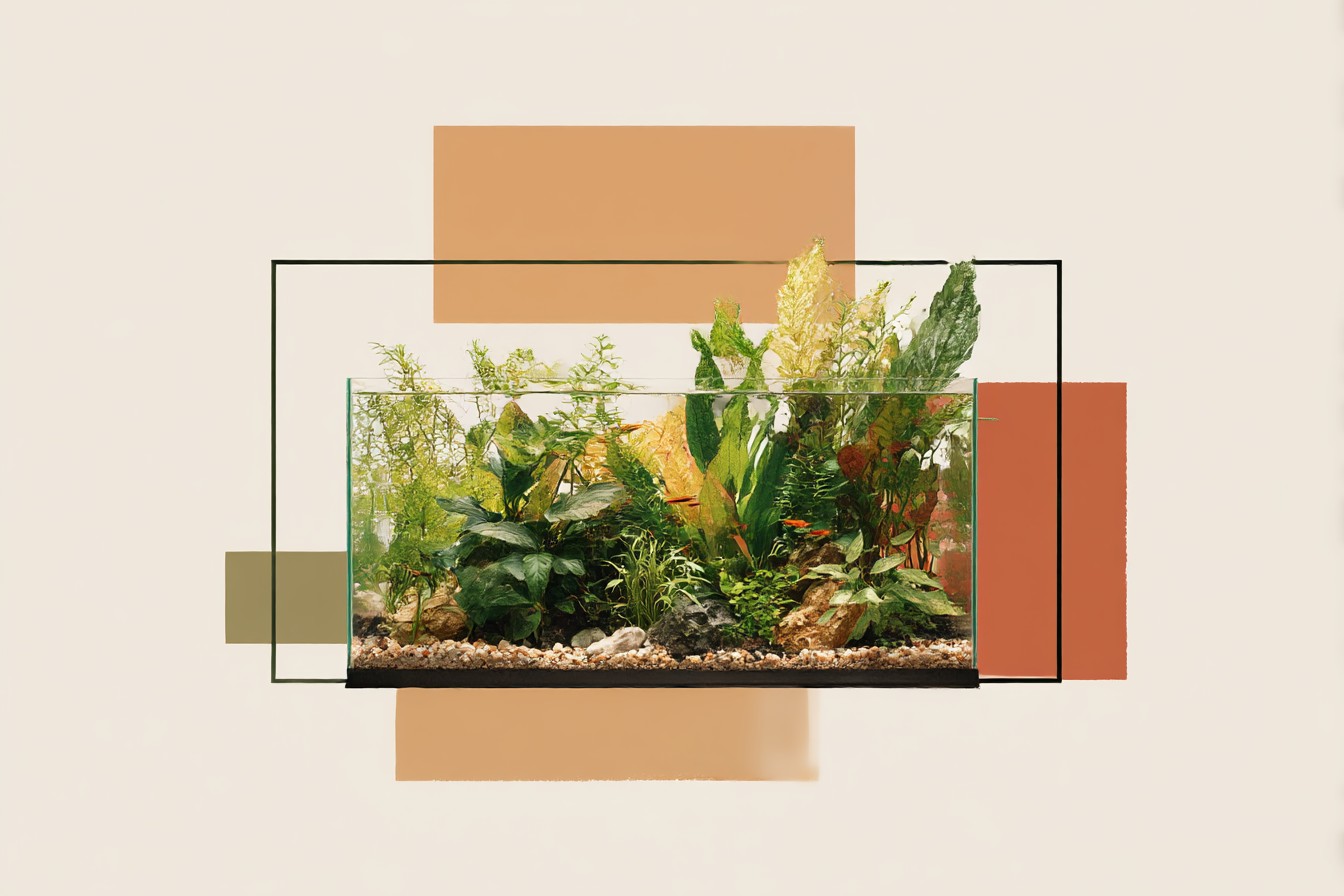
Don’t plant too sparse you’ll always think you don’t have enough plants.
Budget Hardscape: £40-80 | Plants: £80-120 | Substrate: £30-50 Step 5: Maintain your Aquarium! Perform water changes and monitor your parameters. Learn what your aquarium tells you.
If your aquarium was able to talk it would thank you for your weekly water changes. When your plants start exhibiting new growth or appear faded/redder that’s your aquarium telling you something. Total Cost £200-600 Depending on tank size and style chosen.
After much trial and error I’ve learned that the best style for your aquarium isn’t always the coolest one you saw online. It’s the one that actually works with your lifestyle and space constraints. A simple well maintained aquarium is always going to look better than that setup you saw in a YouTube video.
Don’t bit off more then you can chew. Planning and research goes a long way.